
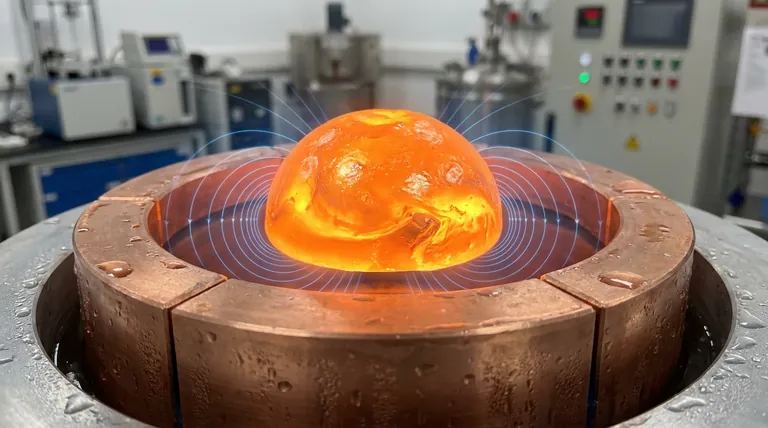
The semi-levitation effect is generated by powerful electromagnetic forces inherent to the induction furnace system. These forces act physically on the molten material, pushing it inward and causing it to partially separate from the water-cooled crucible walls. This separation creates a gap between the vessel and the material, reducing physical contact during the melting process.
The semi-levitation effect acts as a barrierless container, using magnetic pressure to isolate the melt from the crucible walls. This simultaneously prevents heat loss and contamination while driving the intense mixing required for complex alloy synthesis.
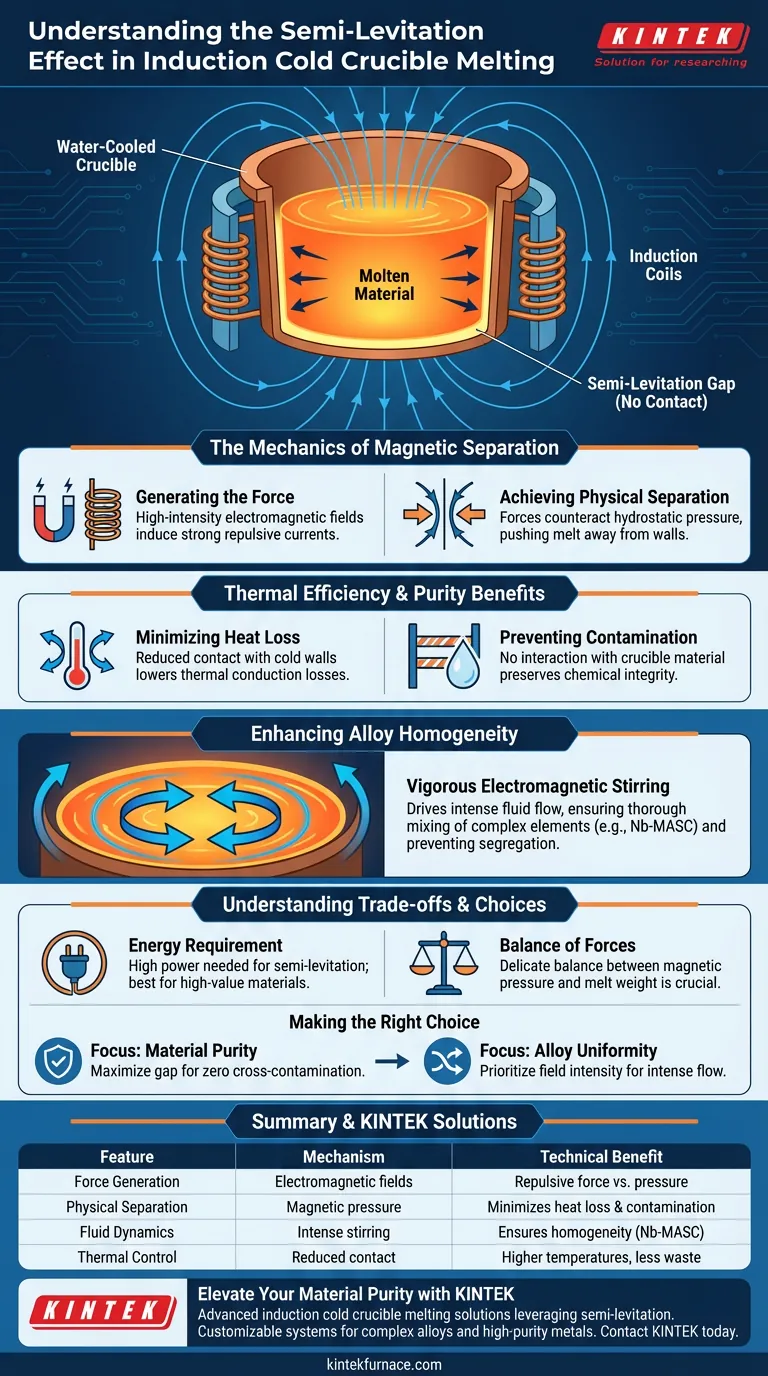
The Mechanics of Magnetic Separation
Generating the Force
The induction cold crucible melting process relies on high-intensity electromagnetic fields. These fields induce currents within the conductive charge that result in strong repulsive forces.
Achieving Physical Separation
These forces counteract the hydrostatic pressure of the liquid metal. As a result, the melt pushes away from the crucible sides, maintaining a "semi-levitated" state rather than resting fully against the container.
Thermal Efficiency and Purity
Minimizing Heat Loss
The crucible walls in this process are water-cooled, which creates a massive temperature differential. By reducing the direct contact area between the melt and these cold walls, the semi-levitation effect significantly lowers thermal conduction losses.
Preventing Contamination
High-temperature melts are often highly reactive and can degrade if they touch the containment vessel. The electromagnetic separation ensures the melt does not interact with the crucible material, preserving the chemical integrity of the alloy.
Enhancing Alloy Homogeneity
Driven Fluid Dynamics
The semi-levitation effect is not static; the same forces that suspend the metal also drive intense fluid flow. This creates a vigorous stirring action within the molten pool that mechanical stirring cannot replicate.
Mixing Complex Elements
This internal agitation is critical for synthesizing materials with complex chemical proportions, such as Nb-MASC alloys. The intense flow ensures that various elemental components are thoroughly mixed, preventing segregation.
Understanding the Trade-offs
The Energy Requirement
Generating the electromagnetic forces necessary for semi-levitation requires substantial power. This is an energy-intensive process designed for high-value materials where standard melting methods fail.
The Balance of Forces
The process relies on a delicate balance between the magnetic pressure and the weight of the melt. If the electromagnetic force is insufficient, the melt will contact the water-cooled wall, leading to rapid heat loss and potential freezing (skull formation).
Making the Right Choice for Your Goal
To maximize the benefits of induction cold crucible melting, align your process parameters with your specific material requirements.
- If your primary focus is material purity: Utilize the semi-levitation effect to maximize the gap between the melt and the wall, ensuring zero cross-contamination from the crucible.
- If your primary focus is alloy uniformity: Prioritize the intensity of the electromagnetic field to drive the fluid flow, ensuring complex elements like those in Nb-MASC are perfectly distributed.
The semi-levitation effect is the critical mechanism that allows modern metallurgy to achieve high temperatures and high purity simultaneously.
Summary Table:
| Feature | Mechanism | Technical Benefit |
|---|---|---|
| Force Generation | High-intensity electromagnetic fields | Creates repulsive force against hydrostatic pressure |
| Physical Separation | Magnetic pressure pushes melt from walls | Minimizes heat loss and prevents crucible contamination |
| Fluid Dynamics | Intense electromagnetic stirring | Ensures chemical homogeneity in complex alloys (e.g., Nb-MASC) |
| Thermal Control | Reduced contact with water-cooled walls | Allows for higher melt temperatures with less energy waste |
Elevate Your Material Purity with KINTEK
Are you struggling with contamination or poor homogeneity in your high-performance alloys? KINTEK’s advanced induction cold crucible melting solutions leverage the power of semi-levitation to provide a barrierless environment for your most reactive materials.
Backed by expert R&D and world-class manufacturing, we offer customizable Muffle, Tube, Rotary, Vacuum, and CVD systems tailored to your unique laboratory and industrial needs. Whether you are synthesizing complex Nb-MASC alloys or refining high-purity metals, our high-temperature furnace expertise ensures consistent, superior results.
Contact KINTEK today to discuss your custom furnace requirements and achieve the ultimate precision in thermal processing.
Visual Guide
References
- M. Guglielmi, Sebastian Herbst. Induction melting in cold crucible furnace for the production of components in turbine applications. DOI: 10.22364/mhd.61.1-2.5
This article is also based on technical information from Kintek Furnace Knowledge Base .
Related Products
- Vacuum Induction Melting Furnace
- Custom Made Versatile CVD Tube Furnace Chemical Vapor Deposition CVD Equipment Machine
People Also Ask
- What are the core functions of the High Vacuum Induction Melting (VIM) furnace? Optimize DD5 Superalloy Purification
- What are the advantages of using a VIM furnace to control residual oxygen pressure? Achieve Superior Metal Uniformity
- What role does a Vacuum Induction Melting furnace play in the production of high-aluminum nickel-based superalloys?
- What are the technical advantages of using a Vacuum Induction Melting furnace in the development of advanced packaging steel?
- Why is a Vacuum Induction Melting furnace (VIM) used for Cu-Zn-Al-Sn alloys? Achieve Precision Composition Control

