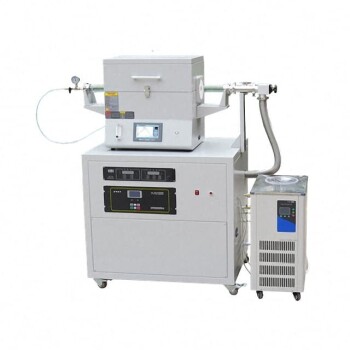
A laboratory high-temperature tube furnace is the primary instrument used to simulate the extreme thermal gradients iron ore pellets encounter during industrial processing. By subjecting samples to precise temperatures between 600°C and 1100°C, the furnace allows researchers to evaluate "thermal shock" resistance and macroscopic integrity. This testing identifies the exact temperature thresholds at which pellets maintain their structure during solid-state reduction, preventing premature degradation in the blast furnace.
Core Takeaway: The tube furnace serves as a controlled micro-environment to determine the maximum temperature limit of iron ore pellets. It bridges the gap between raw material analysis and industrial-scale performance by measuring how thermal stress impacts physical durability.
Simulating Industrial Thermal Gradients
Replicating Solid-State Reduction Conditions
The tube furnace provides a stable thermal field that mimics the heat zones of a production kiln. Researchers use these environments to observe how pellets behave as they transition through specific temperature increments.
Precise Temperature Control
Unlike larger kilns, a laboratory furnace allows for programmed temperature-rise conditions. This precision is critical for identifying the specific point of failure or phase change within the iron ore's mineral structure.
Atmosphere Manipulation
By utilizing gas-tight reaction tubes, typically made of quartz or alumina, researchers can introduce specific gases like nitrogen or compressed air. This allows the testing of pellets under reducing or oxidizing atmospheres, mirroring real-world chemical environments.
Measuring Physical and Macroscopic Integrity
Executing Thermal Shock Protocols
Pellets are often subjected to rapid temperature changes within the furnace to test for decrepitation. If a pellet cannot withstand the internal pressure of expanding gases or mineral changes, it will crack or shatter, which is a key indicator of low thermal stability.
Identifying Temperature Thresholds
Testing typically focuses on the 600°C to 1100°C range. By observing the macroscopic integrity of the pellets at these peaks, engineers can set operational limits for industrial reactors to ensure the ore does not fail during processing.
Monitoring Mass and Phase Changes
Some setups integrate the tube furnace with mass-monitoring tools. This helps track the loss of volatile components or the progress of solid-state reactions that contribute to the final mechanical strength of the pellet.
Understanding the Trade-offs
Sample Volume vs. Precision
The primary limitation of a tube furnace is its restricted sample capacity. While it offers superior atmosphere and temperature control, it cannot process the large batches of pellets that a muffle furnace or industrial grate-kiln can handle.
Heating Rate Constraints
Tube furnaces are excellent for isothermal exposure but may have slower ramp-up speeds than some industrial processes. This can sometimes lead to differences between laboratory results and the behavior of pellets in a high-speed production line.
Material Compatibility
The choice of tube material is a critical trade-off. Quartz tubes offer excellent visibility and gas-tightness but are limited to lower temperatures, while alumina tubes handle higher heat but are more susceptible to cracking if heated or cooled too rapidly.
How to Apply This to Your Project
Making the Right Choice for Your Goal
To get the most out of thermal stability testing, align your furnace parameters with your specific metallurgical objectives.
- If your primary focus is determining atmospheric resistance: Use a horizontal tube furnace with a gas-tight quartz inner tube to precisely control the reduction-oxidation environment.
- If your primary focus is maximum temperature threshold: Conduct thermal shock tests in an alumina-lined furnace at increments up to 1100°C to identify the point of macroscopic failure.
- If your primary focus is sintering and mechanical strength: Consider a muffle furnace instead, as it provides the oxidative environment and space needed for grain growth and crystal bridge formation.
Utilizing a high-temperature tube furnace correctly ensures that iron ore pellets are optimized for the rigors of industrial smelting.
Summary Table:
| Feature | Application in Iron Ore Pellet Testing |
|---|---|
| Primary Goal | Evaluate thermal shock resistance & macroscopic integrity |
| Temperature Range | 600°C to 1100°C (simulates kiln reduction zones) |
| Atmosphere Control | Gas-tight tubes for precise reducing or oxidizing environments |
| Key Outcome | Identifies specific failure thresholds to prevent industrial degradation |
| Tube Material Choice | Quartz (visibility/sealing) vs. Alumina (max temperature durability) |
Elevate Your Metallurgical Research with KINTEK
Ensure the highest precision in your thermal stability testing with KINTEK’s industry-leading laboratory equipment. We specialize in a comprehensive range of high-temperature furnaces, including tube, muffle, rotary, vacuum, CVD, and induction melting systems, all fully customizable to meet your specific research parameters.
Whether you are identifying failure thresholds for iron ore or developing new solid-state reduction protocols, KINTEK provides the reliability and atmosphere control your lab demands. Contact our experts today to discuss your unique needs and discover how our advanced heating solutions can optimize your industrial-scale performance.
References
- Jaroslav Legemza, Kostyantyn Karamanits. Rudomain Iron Ore Treatment by High-Temperature Reduction. DOI: 10.3390/app131910698
This article is also based on technical information from Kintek Furnace Knowledge Base .
Related Products
- Vacuum Sealed Continuous Working Rotary Tube Furnace Rotating Tube Furnace
- 1400℃ High Temperature Laboratory Tube Furnace with Alumina Tube
- 1700℃ High Temperature Laboratory Tube Furnace with Alumina Tube
- 1200℃ Split Tube Furnace Laboratory Quartz Tube Furnace with Quartz Tube
- Vertical Laboratory Quartz Tube Furnace Tubular Furnace
People Also Ask
- What is the purpose of rotary tube furnaces? Achieve Uniform Heat Treatment for Powders and Granules
- What are the key advantages of using a rotary tube furnace? Achieve Dynamic, Uniform Heating for Powders
- How does the amount of material processed vary between batch and continuous rotary tube furnaces? Scale Your Production Efficiently
- What are the advantages of rotary tube furnaces in fuel compatibility? Boost Efficiency and Cut Costs
- What is the temperature range of some rotary tube furnaces? Achieve Uniform Heating Up to 1200°C