
Thermal treatment at 2400 °C acts as a fundamental structural reset for natural graphite, transforming it into a highly efficient material for electrochemical applications. This process utilizes extreme heat to provide the kinetic energy necessary for carbon atoms to realign, effectively healing atomic defects and optimizing the material for lithium-ion batteries.
The core value of this treatment is the conversion of thermal energy into structural order. By eliminating atomic imperfections, you create a pathway for lithium ions that offers less resistance and greater chemical stability, directly enhancing battery longevity and performance.
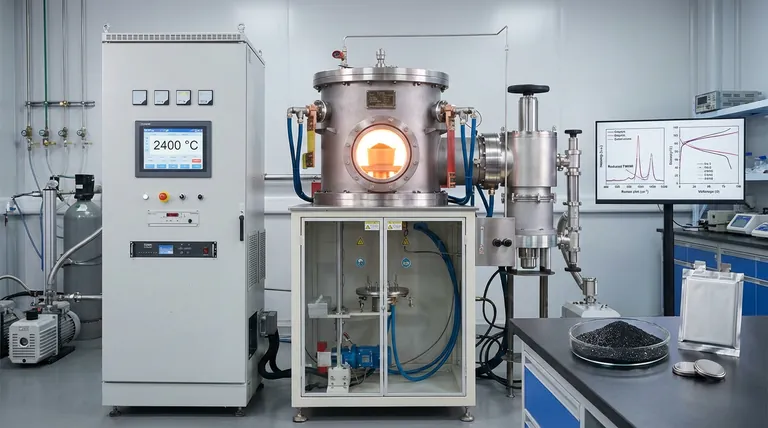
The Mechanism of Structural Refinement
Atomic Rearrangement
At 2400 °C, the thermal energy supplied to the graphite is sufficient to break existing, imperfect bonds.
This allows the carbon atoms to rearrange themselves, shifting from disordered states into a more thermodynamically stable, ordered lattice.
Elimination of Defects
This reorganization targets specific imperfections known as D-band defects (in-plane defects).
By removing these irregularities, the material achieves a higher degree of three-dimensional structural order, essentially "straightening out" the atomic layers.
Measurable Crystallinity
The impact of this process is quantifiable through Raman spectroscopy.
The treatment significantly reduces the Full Width at Half Maximum (FWHM) values, a key indicator that crystallinity has increased and the graphite structure is uniform.
Translating Structure to Electrochemical Performance
Reduced Intercalation Resistance
The primary benefit of a highly ordered crystalline structure is physical accessibility.
By aligning the graphite layers, the treatment reduces the resistance encountered by lithium ions during intercalation (the process of ions inserting themselves between graphite layers).
Minimizing Surface Reactivity
Defects on the surface of graphite often act as reactive sites that degrade performance.
Thermal treatment at this temperature effectively "heals" these surface defects, making the material less chemically reactive to its environment.
Controlling SEI Formation
A direct consequence of reducing surface defects is the minimization of electrolyte side reactions.
Fewer side reactions lead to a lower formation of the Solid Electrolyte Interphase (SEI) layer, a barrier that—if too thick—can impede ion flow and reduce battery capacity.
Understanding the Trade-offs
The Cost of Disorder
While high-temperature treatment is energy-intensive, skipping this step results in a material with significant electrochemical liabilities.
Untreated natural graphite retains high levels of D-band defects, which act as obstacles to ion flow and catalysts for electrolyte degradation.
Balancing Energy Input vs. Performance output
The process at 2400 °C is a specific optimization point.
It effectively balances the energy cost of treatment against the massive gains in battery cycle life and efficiency, ensuring the graphite acts as a stable host for lithium ions rather than a reactive contaminant.
Making the Right Choice for Your Goal
To determine if this grade of graphite is required for your specific application, consider your performance targets:
- If your primary focus is Cycle Life: This treatment is essential as it minimizes the SEI layer formation that typically degrades battery capacity over time.
- If your primary focus is Power Efficiency: The removal of D-band defects lowers internal resistance, making this ideal for high-efficiency applications.
Thermal treatment at 2400 °C is not merely a heating process; it is a critical purification step that dictates the final efficiency of the energy storage system.
Summary Table:
| Feature | Impact of 2400 °C Treatment | Electrochemical Benefit |
|---|---|---|
| Atomic Structure | Rearrangement into ordered lattice | Lower intercalation resistance |
| Defect Density | Significant reduction in D-band defects | Higher chemical stability |
| Crystallinity | Lower FWHM values (Raman spectroscopy) | Uniform material performance |
| Surface State | Healed surface imperfections | Minimized SEI layer formation |
| Ion Flow | Straightened atomic layers | Enhanced power efficiency |
Maximize Your Material Performance with KINTEK
Ready to elevate your graphite processing to the next level? Backed by expert R&D and manufacturing, KINTEK offers specialized High-Temperature Vacuum, Tube, and CVD systems capable of reaching 2400 °C and beyond. Our customizable lab furnaces are designed to meet the rigorous demands of battery material research and industrial production.
Whether you are focusing on increasing cycle life or reducing internal resistance, our precision equipment ensures consistent structural refinement for your unique needs. Contact us today to discuss how our advanced thermal solutions can optimize your electrochemical materials.
Visual Guide

References
- Anna Lähde, Jorma Jokiniemi. Effect of high temperature thermal treatment on the electrochemical performance of natural flake graphite. DOI: 10.1557/s43578-024-01282-z
This article is also based on technical information from Kintek Furnace Knowledge Base .
Related Products
- 2200 ℃ Graphite Vacuum Heat Treat Furnace
- 2200 ℃ Tungsten Vacuum Heat Treat and Sintering Furnace
- Molybdenum Vacuum Heat Treat Furnace
- 1400℃ High Temperature Laboratory Tube Furnace with Alumina Tube
- High Temperature Muffle Oven Furnace for Laboratory Debinding and Pre Sintering
People Also Ask
- Why are vacuum heat treating furnaces essential for aerospace? Ensure Superior Material Integrity for High-Stakes Applications
- What is the primary application of vacuum heat treating furnaces in aerospace? Enhance Component Performance with Precision
- How does a vacuum heat treating furnace improve the condition of metal alloys? Achieve Superior Metal Performance
- How does vacuum heat treating work in terms of temperature and time control? Master Precise Material Transformations
- What is the process of vacuum heat treating? Achieve Superior Metallurgical Properties



















