
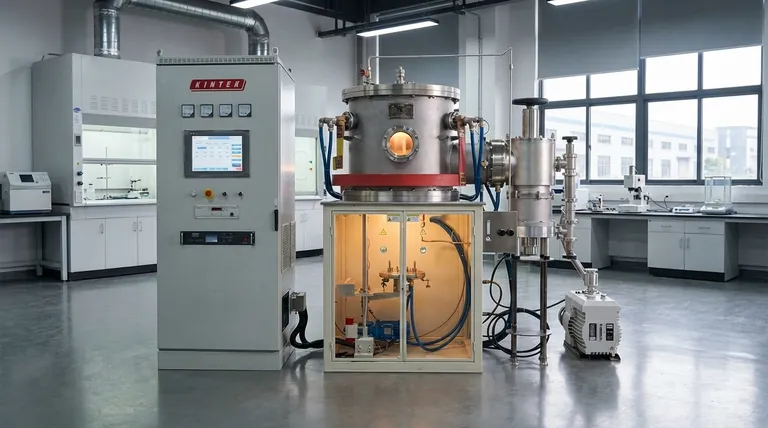
The pressure-assisted mechanism in a Vacuum Hot Press Furnace improves YAG transparent ceramics by applying axial mechanical pressure at high temperatures to stimulate thermoplasticity. This mechanical force drives plastic flow and particle rearrangement, enabling the material to reach full density and eliminate light-scattering pores at significantly lower temperatures than conventional sintering, which preserves the fine grain structure required for optical transparency.
Core Takeaway The fundamental advantage of this mechanism is the substitution of thermal energy with mechanical force. By driving densification through pressure rather than excessive heat, you eliminate microscopic pores while simultaneously inhibiting abnormal grain growth—the two critical factors for achieving high optical transmission in ceramics.
The Mechanics of Pressure-Assisted Densification
Stimulating Thermoplasticity
The primary reference indicates that the core driver of this process is the application of axial mechanical pressure during the heating phase.
This pressure stimulates thermoplasticity within the ceramic powder. At elevated temperatures, the material becomes pliable, allowing the external force to physically deform the particles.
Promoting Plastic Flow and Rearrangement
Unlike pressureless sintering, which relies mainly on diffusion, hot pressing utilizes plastic flow.
The mechanical pressure forces the YAG particles to slide past one another and rearrange. This efficiently fills the voids between particles, leading to rapid consolidation of the ceramic body.
Optimizing Optical Properties via Microstructure
Lowering the Sintering Temperature
A critical benefit of the pressure-assisted mechanism is the ability to achieve densification at temperatures significantly lower than conventional methods.
Because mechanical force contributes to the densification energy, the requirement for thermal energy is reduced. This is vital for YAG ceramics, as excessive heat is the primary enemy of fine microstructures.
Inhibiting Abnormal Grain Growth
High temperatures and long holding times typically lead to abnormal grain growth, which degrades the mechanical strength and optical quality of the ceramic.
By enabling full densification at lower temperatures and shorter holding times, the pressure-assisted mechanism effectively inhibits excessive grain growth. This maintains a fine, uniform grain structure essential for high-performance transparent ceramics.
Eliminating Microscopic Pores
Transparency in YAG ceramics is strictly defined by the absence of scattering centers, primarily residual pores.
The uniaxial mechanical compaction acts as a driving force to close internal micro-pores that might otherwise remain in a pressureless environment. This physical "squeezing" ensures the high-density necessary for superior linear transmittance.
Understanding the Process Trade-offs
Balancing Vacuum and Pressure
While pressure drives densification, the high-vacuum environment (e.g., $10^{-5}$ mbar) plays an equally critical, competing role.
The vacuum is necessary to discharge adsorbed gases and volatile impurities before the pores seal shut. If mechanical pressure closes the pores too early (before gases escape), transparency will be compromised.
The Uniaxial Limitation
The pressure applied is typically uniaxial (from one direction).
While effective for plates and discs, this can create density gradients in complex shapes compared to Isostatic pressing. The process relies heavily on the redistribution of force through particle rearrangement to ensure the entire YAG component is uniformly dense.
Making the Right Choice for Your Goal
When evaluating sintering techniques for YAG ceramics, consider your specific performance metrics:
- If your primary focus is Optical Transparency: The pressure-assisted mechanism is essential for eliminating the final microscopic pores that cause light scattering.
- If your primary focus is Mechanical Strength: The lower sintering temperatures enabled by pressure prevent grain coarsening, preserving the fine grain boundaries that enhance fracture toughness.
- If your primary focus is Process Efficiency: This method allows for shorter holding times and faster densification cycles compared to pressureless sintering.
Ultimately, the Vacuum Hot Press mechanism bridges the gap between theoretical density and actual optical transparency by mechanically forcing the elimination of defects that thermal energy alone cannot resolve without damaging the material's structure.
Summary Table:
| Feature | Pressure-Assisted Mechanism | Conventional Sintering |
|---|---|---|
| Driving Force | Axial Mechanical Pressure + Heat | Thermal Energy (Diffusion) Only |
| Sintering Temp | Significantly Lower | High |
| Grain Structure | Fine and Uniform (Inhibits Growth) | Prone to Abnormal Coarsening |
| Porosity | Eliminated via Plastic Flow | Residual Pores Common |
| Optical Quality | High Transparency (No Scattering) | Variable/Lower Transmission |
Elevate Your Advanced Ceramic Production with KINTEK
Are you struggling to achieve theoretical density and optical transparency in your YAG ceramics? KINTEK’s high-performance Vacuum Hot Press Furnaces provide the precise pressure and thermal control needed to eliminate microscopic pores while preserving fine grain structures.
Why choose KINTEK?
- Expert R&D & Manufacturing: Our systems are engineered for the most demanding material science applications.
- Customizable Solutions: From Muffle and Tube to Vacuum and CVD systems, we tailor our high-temp furnaces to your unique specifications.
- Proven Results: Enable faster densification cycles and superior material properties for lab and industrial production.
Ready to optimize your sintering process? Contact our technical experts today to discuss your custom furnace needs!
Visual Guide

Related Products
- Vacuum Hot Press Furnace Machine for Lamination and Heating
- 600T Vacuum Induction Hot Press Vacuum Heat Treat and Sintering Furnace
- Vacuum Hot Press Furnace Machine Heated Vacuum Press Tube Furnace
- Vacuum Hot Press Furnace Machine Heated Vacuum Press
- High Pressure Laboratory Vacuum Tube Furnace
People Also Ask
- What are the primary components of a vacuum hot press furnace? Master the Core Systems for Precise Material Processing
- What safety features are incorporated in vacuum hot press furnaces? Ensure Operator and Equipment Protection
- What are the benefits of the vacuum environment system in a vacuum hot press furnace? Unlock High-Density Sintering
- What industries benefit from the use of vacuum hot press furnaces? Unlock High-Performance Materials for Your Industry
- How does the uniaxial pressure applied by a vacuum hot press furnace affect the microstructure of ZrC-SiC materials?



















