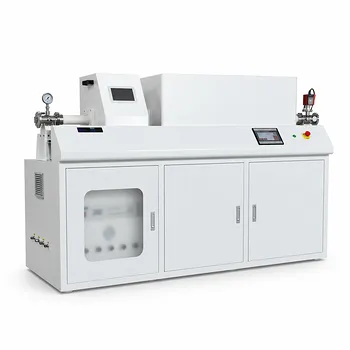
Precise temperature control in a muffle furnace is the primary mechanism for regulating the crystalline growth of Titanium Dioxide Quantum Dots (TDS). By maintaining stable thermal environments at 280°C, 290°C, and 300°C, the furnace produces particle sizes of approximately 3.1 nm, 5.5 nm, and 8.5 nm, respectively.
This thermal precision allows researchers to manipulate the material's bandgap energy through the quantum size effect, transforming the furnace from a simple heating tool into a precise instrument for tuning photocatalytic performance.
The Relationship Between Thermal Energy and Particle Growth
Temperature as a Growth Catalyst
A laboratory muffle furnace provides the specific thermodynamic energy required for TiO2 crystals to expand from their initial nuclei. Higher temperatures increase the rate of atomic diffusion, allowing particles to incorporate more material and grow larger within the same timeframe.
Quantitative Size Correlations
Specific temperature setpoints yield highly predictable results in TDS production. Research indicates that a 10-degree increase from 280°C to 290°C nearly doubles the particle size from 3.1 nm to 5.5 nm, while reaching 300°C results in 8.5 nm particles.
Maintaining Homogeneity
Precise control prevents temperature fluctuations that would otherwise lead to a wide "polydispersity" or a mix of different particle sizes. A stable environment ensures that the entire batch of quantum dots receives uniform energy, resulting in a consistent and high-quality material.
Impact on Optoelectronic Properties
The Quantum Size Effect
As the muffle furnace regulates the physical size of the dots, it simultaneously dictates their electronic properties. This phenomenon, known as the quantum size effect, occurs because the physical dimensions of the particle influence the energy levels of its electrons.
Bandgap Energy Tuning
By adjusting the furnace between 280°C and 300°C, the material’s bandgap energy can be fine-tuned between 3.09 eV and 2.97 eV. This precision is critical for optimizing how the quantum dots absorb light and perform in photocatalytic applications.
Phase Transformation and Crystallinity
Beyond size, higher temperatures provided by the furnace facilitate the transition from an amorphous state to the Anatase phase. While TDS are often processed at lower ranges, increasing the furnace to 450°C–570°C is used to ensure pure crystal structures and remove organic residues.
Understanding the Trade-offs
The Risk of Thermal Over-Sintering
While higher temperatures can improve crystallinity, excessive heat can lead to sintering, where individual nanoparticles fuse together. This reduces the specific surface area and may cause the material to lose its unique "quantum" properties as it grows into larger, bulk-like structures.
Stability vs. Precision
Maintaining a precise gradient becomes more difficult as temperatures increase toward 650°C to 800°C. At these levels, the furnace is often used for carbon doping or creating core-shell structures, but the risk of lattice defects or unwanted phase transitions (like the shift to the Rutile phase) increases.
Energy Consumption and Processing Time
Achieving extreme precision at lower temperatures (like 280°C) requires high-quality heating elements and sophisticated PID controllers. Balancing the duration of the "soak" time with the exact temperature is a delicate trade-off between achieving the desired size and maximizing laboratory throughput.
How to Apply This to Your Project
When utilizing a muffle furnace for TiO2 synthesis, your temperature choice should be dictated by the specific end-use of the nanoparticles.
- If your primary focus is Maximum Bandgap (Blue-Shift): Set the furnace to the lower end of the spectrum (approx. 280°C) to maintain the smallest possible particle size (3.1 nm).
- If your primary focus is Photocatalytic Activity: Target the Anatase phase transition by utilizing higher temperatures (approx. 450°C) to ensure high crystallinity and a porous microstructure.
- If your primary focus is Solar Cell Efficiency: Use higher-temperature sintering (approx. 500°C+) to eliminate organic solvents and improve the dielectric strength of the resulting film.
Precise thermal regulation is the definitive factor in transforming raw precursors into high-performance, size-specific Titanium Dioxide Quantum Dots.
Summary Table:
| Temperature (°C) | Particle Size (nm) | Bandgap Energy (eV) | Material Phase/Focus |
|---|---|---|---|
| 280°C | ~3.1 nm | 3.09 eV | Maximum Bandgap (Blue-Shift) |
| 290°C | ~5.5 nm | ~3.03 eV | Controlled Growth |
| 300°C | ~8.5 nm | 2.97 eV | Enhanced Light Absorption |
| 450°C - 570°C | Larger / Sintered | N/A | Anatase Phase Transition |
Achieve Nanoscale Precision with KINTEK
Precise thermal regulation is the difference between a failed experiment and a breakthrough in nanotechnology. KINTEK specializes in high-performance laboratory equipment, offering a comprehensive range of muffle, tube, vacuum, and CVD furnaces designed for the rigorous demands of quantum dot synthesis.
Whether you need to maintain a stable 280°C for bandgap tuning or reach 1000°C+ for phase transformations, our furnaces feature advanced PID controllers and uniform heating zones to ensure consistent results.
Ready to elevate your research? Contact KINTEK today to discuss our customizable high-temperature solutions and find the perfect furnace for your laboratory!
References
- Walied A.A. Mohamed, Ammar A. Labib. Confinement size effect on dielectric properties, antimicrobial activity, and recycling of TiO <sub>2</sub> quantum dots <i>via</i> photodegradation processes of Congo red dye and real industrial textile wastewater. DOI: 10.1515/ntrev-2024-0001
This article is also based on technical information from Kintek Furnace Knowledge Base .
Related Products
- Custom Made Versatile CVD Tube Furnace Chemical Vapor Deposition CVD Equipment Machine
- 1400℃ Muffle Oven Furnace for Laboratory
- Multi Heating Zones CVD Tube Furnace Machine for Chemical Vapor Deposition Equipment
- Laboratory Muffle Oven Furnace with Bottom Lifting
- High Temperature Muffle Oven Furnace for Laboratory Debinding and Pre Sintering
People Also Ask
- Why are CVD tube furnace sintering systems indispensable for 2D material research and production? Unlock Atomic-Scale Precision
- What is a CVD tube furnace and what is its primary function? Discover Precision Thin-Film Deposition
- How does CVD tube furnace sintering enhance graphene growth? Achieve Superior Crystallinity and High Electron Mobility
- Which industries and research fields benefit from CVD tube furnace sintering systems for 2D materials? Unlock Next-Gen Tech Innovations
- What are the practical applications of gate media prepared by CVD tube furnaces? Unlock Advanced Electronics and More