The answer lies in the exponential temperature dependence of McLean’s equation. Raising the annealing temperature in your laboratory sintering furnace directly weakens solute segregation. According to McLean's relationship, the grain-boundary concentration (C_{gb} = C_o \exp(\Delta G_a / RT)) plummets as (T) climbs, because the exponential term shrinks. This drop in segregated solute atoms releases a powerful brake on grain-boundary mobility, fundamentally altering how your ceramic oxide densifies and how large its grains grow.
Temperature acts as the master switch for solute segregation. Higher heat diminishes the equilibrium concentration of segregated solute, slashing the solute drag force and permitting faster grain-boundary migration. Mastering this knob inside a precision furnace is how researchers freeze in a specific microstructure—from nano-grained to coarse—before the ceramic reaches final density.
The Thermodynamic Mechanism: McLean’s Equation Broken Down
The McLean relationship isn’t just a formula; it’s a roadmap for turning temperature into a microstructure design tool. By dissecting its two key terms, you’ll understand exactly why your furnace’s setpoint controls grain growth.
The Driving Force: Free Energy Difference (ΔG_a)
The term (\Delta G_a) represents the free energy advantage of moving a solute atom from the crystal lattice to the disordered grain boundary.
- High (\Delta G_a) values create strong segregation. The boundary acts like a low‑energy haven, pulling solute out of the grains and piling it up at interfaces.
- This solute accumulation then governs mobility. A heavily decorated boundary experiences a large solute drag force, physically impeding its movement.
The size of (\Delta G_a) is set by your material’s chemistry and defect structure, but it’s the furnace temperature that dictates how powerfully this driving force translates into real segregation.
The Temperature Factor: Why Heat Reverses Segregation
Temperature appears in the denominator of the exponent—(\Delta G_a / RT)—and that position gives it outsized control.
- Higher (T) makes the exponent smaller. As you turn up the annealing temperature, the ratio (\Delta G_a / RT) shrinks, and the exponential term (e^{\Delta G_a / RT}) falls toward one.
- The result is leaner grain boundaries. (C_{gb}) drops, sometimes dramatically, because thermal energy now allows solute atoms to escape the boundary’s energetic trap and disperse back into the bulk.
- This is a reversible thermodynamic effect. By carefully selecting a hold temperature and then quenching, you can lock in a precise segregation level—cold enough to maintain strong solute decoration, hot enough to clean the boundaries.
How Segregation Dictates Grain Boundary Mobility
Knowing the equation is only half the story. The practical impact unfolds inside your sintering ceramic as boundaries try to move.
Solute Drag: A Brake on Boundary Motion
Segregated atoms do not sit idly at the boundary. They interact with the moving interface, creating a resistive force.
- A solute‑rich boundary moves sluggishly. The segregated layer must be dragged along, and the diffusion rate of those solute atoms limits how fast the boundary can migrate.
- This drag directly controls grain growth. When drag is high, grains stay small because boundaries are pinned. When drag falls, boundaries break free and grains coarsen rapidly.
In oxide ceramics, solute drag is often the dominant factor—not just an inconvenience—determining whether your final piece has a sub‑micron microstructure or millimeter‑sized crystals.
High Temperature Releases the Brake
Elevating the furnace temperature attacks the solute brake on two fronts simultaneously.
- First, it strips solute from the boundary, as McLean’s equation predicts, reducing the number of atoms available to exert drag.
- Second, it accelerates solute diffusion. The atoms that remain can move faster through the boundary, further diminishing the drag effect.
The combined outcome is a grain boundary that approaches its intrinsic, undoped mobility. This is why a small temperature bump can sometimes cause a sudden surge in grain growth—you’ve crossed a threshold where drag collapses.
Laboratory Furnaces: Freezing the Desired State
Your high‑temperature lab furnace is the tool that lets you exploit this physics. It provides the thermal precision to control the segregation state and then a fast quench to preserve it.
- Controlled hold times let you dial in a target (C_{gb}). Soak at a high temperature to clean boundaries; soak at a lower one to maximize segregation.
- Rapid cooling prevents re‑equilibration. A sharp quench freezes the high‑temperature segregation pattern, so the room‑temperature microstructure reflects the chosen thermal state.
- This is the basis for tailoring grain growth. By programming a thermal profile, you can, for instance, maintain strong boundary pinning during early‑stage densification and then remove it later to close residual porosity.
Beyond Temperature: The Overlooked Role of Atmosphere
While temperature acts on the McLean term directly, your furnace atmosphere can alter the equation’s very ingredients. In ceramic oxides, ignoring atmosphere means you’re only seeing half the picture.
How Atmosphere Shifts ΔG_a and Defect Chemistry
Oxygen partial pressure—whether you’re running in air, pure oxygen, or a reducing hydrogen mix—re‑tunes the electrostatic landscape at grain boundaries.
- Reducing atmospheres change defect populations. A hydrogen environment can generate oxygen vacancies and alter the space‑charge potential, effectively modifying the ΔG_a value for aliovalent dopants.
- Segregation can even reverse. By adjusting atmosphere and temperature, some oxides pass through an isoelectric point where the net boundary charge flips, turning a segregated solute into a depleted one.
This means the simple McLean exponential curve can shift or change shape based on your gas environment, making simultaneous temperature and atmosphere control essential for reproducible results.
Understanding the Trade‑offs
Temperature is powerful, but it’s not a free lunch. The same heat that lowers solute drag to promote densification can also unleash runaway grain growth if not balanced.
- Excessive temperature leads to boundary break‑away. Once the solute cloud evaporates, boundaries can accelerate abruptly, resulting in duplex microstructures with a few giant grains surrounded by a fine matrix.
- Too little temperature sacrifices densification. Strong segregation and low diffusivity may keep grains tiny, but they also slow pore removal. You can end up with a porous, under‑densified ceramic with excellent grain‑size control.
- Quenching rate sensitivity. If your furnace cools too slowly, some re‑segregation may occur, blurring the microstructural snapshot you intended to capture. The thermal history between sintering temperature and room temperature always matters.
Making the Right Choice for Your Sintering Goal
The key is to view temperature not as a single setpoint, but as a dynamic lever that you move deliberately to steer the segregation‑drag engine.
- If your primary focus is minimizing grain size: Select a lower annealing temperature to retain strong solute segregation and use longer hold times or two‑step cycles (a low‑temperature nucleation step followed by a brief high‑temperature spike) to complete densification without boundary runaway.
- If your primary focus is rapid densification and pore elimination: Raise the temperature into the regime where McLean’s equation predicts near‑boundary cleanliness. The reduction in drag will allow boundaries to sweep through and engulf pores, but you must monitor the hold time strictly to avoid over‑coarsening.
- If you work with atmosphere‑sensitive oxides: First map how ΔG_a shifts with pO₂ in a controlled‑atmosphere tube furnace, then apply McLean’s equation at each condition. You may discover a processing window where a modest temperature delivers the same drag reduction as a much higher temperature in air, giving you a gentler thermal budget.
By owning the relationship between your furnace’s annealing temperature and solute segregation, you transform a theoretical equation into a practical recipe for achieving the exact ceramic microstructure your application demands.
Summary Table:
| Process Parameter | McLean Effect ($C_{gb}$) | Solute Drag Force | Boundary Mobility | Microstructural Impact |
|---|---|---|---|---|
| High Temperature | Exponential Drop ($C_{gb} \downarrow$) | Slashing / Minimal | High / Unpinned | Rapid grain growth, rapid pore removal |
| Low Temperature | Exponential Rise ($C_{gb} \uparrow$) | Strong / Pinning | Low / Sluggish | Fine/nano-grain retention, slower sintering |
| Controlled Atmosphere | Shifts $\Delta G_a$ via defects | Variable | Tunable | Reversible segregation, optimized $pO_2$ window |
| Rapid Quenching | Freezes $C_{gb}$ concentration | Locked state | Zeroed (Room Temp) | Preserves high-temp segregation state |
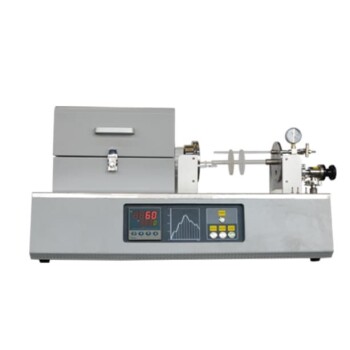
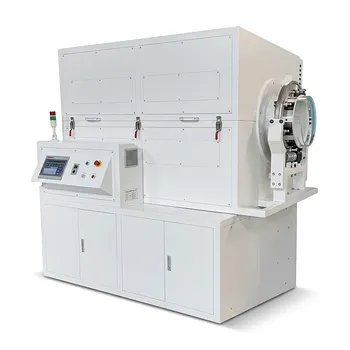
Ready to achieve precise thermal and atmospheric control in your advanced ceramic sintering? KINTEK specializes in premium laboratory equipment and consumables, offering a comprehensive range of customizable high-temperature furnaces—including muffle, tube, vacuum, atmosphere, CVD, and rotary furnaces tailored for your unique research needs.
Whether you need precise $pO_2$ atmosphere tuning or rapid thermal quenching to freeze target microstructures, KINTEK delivers reliable, high-performance solutions for materials scientists and industrial researchers.
Contact KINTEK today to discuss your customizable furnace requirements!
Related Products
- Vacuum Dental Porcelain Sintering Furnace for Dental Laboratories
- High Temperature Muffle Oven Furnace for Laboratory Debinding and Pre Sintering
- Small Vacuum Heat Treat and Tungsten Wire Sintering Furnace
- Spark Plasma Sintering SPS Furnace
- Vacuum Heat Treat Sintering Furnace with Pressure for Vacuum Sintering
People Also Ask
- What is the purpose of dental sintering furnaces? Transform Zirconia into Durable, High-Quality Dental Restorations
- How does a dental vacuum porcelain furnace maintain restoration quality? Precision Sintering for Superior Esthetics
- What is the role of dental sintering furnaces in dental restorations? Transform Zirconia into Durable, Aesthetic Teeth
- What is a dental sintering furnace and what is its purpose? Achieve High-Strength Dental Restorations
- How does a dental sintering furnace save time compared to traditional ceramic processing? Streamline Your Lab's Workflow