
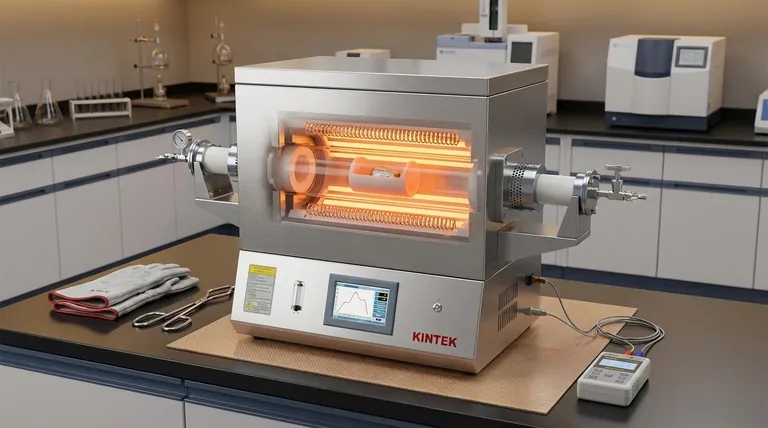
A tube furnace acts as a precision thermal controller designed to execute the strict temperature profiles required for T5 and T6 heat treatments. By surrounding the aluminum alloy with heating elements external to the work tube, the furnace creates a highly stable environment that facilitates critical phase transformations, such as solutionizing and artificial aging.
Core Takeaway The effectiveness of T5 and T6 treatments depends entirely on the manipulation of microscopic precipitates within the alloy. The tube furnace facilitates this by delivering exact temperature uniformity, which allows strengthening phases like Mg2Si to form correctly, transforming coarse particles into spherical grains and maximizing material hardness.
The Role of Thermal Precision
Generating Uniform Heat
The fundamental advantage of a tube furnace is its heating geometry. Resistive heating elements surround the cylindrical work tube, ensuring heat is transferred evenly along the length of the chamber.
Eliminating Thermal Gradients
In heat treatment, temperature variations can lead to uneven material properties. The tube furnace design minimizes these gradients, ensuring every part of the sample experiences the exact same thermal history.
Digital Parameter Control
Precise digital controllers allow operators to set specific parameters for ramp rates and dwell times. This is essential for navigating the distinct temperature stages required for complex alloy protocols.
Facilitating the T6 Process: Solution Treatment
Achieving High-Temperature Stability
The T6 process begins with solution heat treatment, often requiring temperatures around 535 °C for alloys like Al-7075. The tube furnace maintains this high temperature within a tight tolerance range.
Microstructural Transformation
During this phase, the furnace's stable heat allows for the dissolution of solute atoms. This process transforms coarse silicon particles into spherical grains, a necessary structural change for superior mechanical properties.
Preparing for Quenching
By ensuring the entire sample reaches the solutionizing temperature uniformly, the furnace prepares the alloy for effective subsequent quenching. This uniformity prevents "soft spots" that occur if parts of the material fail to reach the critical temperature.
Facilitating Artificial Aging (T5 and T6)
Promoting Precipitation
After cooling, the alloy must undergo artificial aging, typically at lower temperatures such as 160 °C. The tube furnace holds this temperature steady for extended periods to drive the precipitation hardening process.
Forming Strengthening Phases
The controlled thermal environment promotes the nucleation and growth of strengthening phases, specifically Mg2Si (magnesium silicide). The precision of the furnace ensures these precipitates are distributed evenly throughout the matrix.
Hardness Optimization
This controlled precipitation is what ultimately dictates the alloy's performance. By regulating the aging environment, the tube furnace significantly increases the final hardness and strength of the aluminum alloy.
Understanding the Trade-offs
Sample Size Limitations
The cylindrical geometry of a tube furnace inherently limits the size and shape of the aluminum components you can treat. It is ideal for rods, small parts, or powder synthesis, but unsuitable for large, irregular structural components.
Throughput Volume
While tube furnaces offer exceptional precision, they generally lack the volume for high-throughput mass production. They are best suited for research, development, and low-volume, high-precision processing.
Making the Right Choice for Your Goal
To maximize the effectiveness of your heat treatment process, match your objectives to the furnace's capabilities:
- If your primary focus is Research and Development: Use a tube furnace to isolate specific variables in the T6 cycle, as the high precision allows you to correlate exact temperatures with microstructural changes.
- If your primary focus is Material Hardness: Prioritize the uniformity of the aging phase (around 160 °C), as the stable formation of Mg2Si precipitates is the primary driver of strength in alloys like Al-7075.
Precision in temperature regulation is the single most critical factor in successful precipitation hardening.
Summary Table:
| Heat Treatment Stage | Process Temperature (Approx.) | Key Role of Tube Furnace |
|---|---|---|
| Solutionizing (T6) | ~535 °C (e.g., Al-7075) | Uniform dissolution of solute atoms & grain spheroidization. |
| Artificial Aging (T5/T6) | ~160 °C | Stable nucleation of Mg2Si strengthening phases. |
| Thermal Control | High Precision | Eliminates thermal gradients to prevent material soft spots. |
| Parameter Management | Digital Control | Precise ramp rates and dwell times for repeatable results. |
Elevate Your Metallurgy with KINTEK Precision
Unlock the full potential of your aluminum alloys with KINTEK’s high-performance thermal solutions. Backed by expert R&D and manufacturing, KINTEK offers customizable Muffle, Tube, Rotary, Vacuum, and CVD systems specifically designed to meet the rigorous demands of T5 and T6 heat treatment protocols. Whether you are conducting cutting-edge research or high-precision low-volume processing, our furnaces deliver the temperature uniformity and stability required for superior precipitation hardening.
Ready to optimize your material hardness and microstructure? Contact our laboratory furnace experts today to find the perfect system for your unique needs.
Visual Guide

References
- Qussay Salah Mahdi, Mustafa Mohammed Abdulrazaq. [RETRACTED] An Investigation of the Equal Channel Angular Pressing Process on the Hardness of Heat-Treated Al-7075 Alloy. DOI: 10.48084/etasr.10911
This article is also based on technical information from Kintek Furnace Knowledge Base .
Related Products
- Vacuum Sealed Continuous Working Rotary Tube Furnace Rotating Tube Furnace
- 1400℃ High Temperature Laboratory Tube Furnace with Alumina Tube
- 1700℃ High Temperature Laboratory Tube Furnace with Alumina Tube
- Magnesium Extraction and Purification Condensing Tube Furnace
- High Pressure Laboratory Vacuum Tube Furnace
People Also Ask
- What is the purpose of rotary tube furnaces? Achieve Uniform Heat Treatment for Powders and Granules
- What are the key advantages of using a rotary tube furnace? Achieve Dynamic, Uniform Heating for Powders
- How does the amount of material processed vary between batch and continuous rotary tube furnaces? Scale Your Production Efficiently
- What are the advantages of rotary tube furnaces in fuel compatibility? Boost Efficiency and Cut Costs
- What is the temperature range of some rotary tube furnaces? Achieve Uniform Heating Up to 1200°C



















