
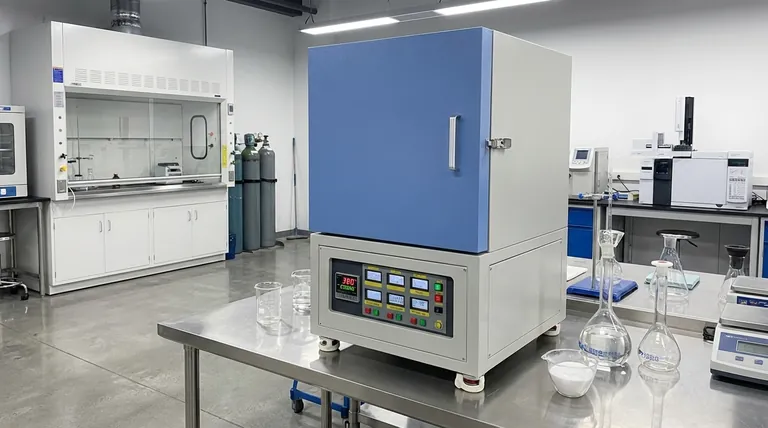
A high-temperature muffle furnace acts as the thermodynamic driver for the synthesis of mixed-phase Titanium Dioxide (TiO2) nanofillers. It provides a precise, stable heat field that facilitates two simultaneous processes: the elimination of organic impurities and the transformation of amorphous precursors into a defined crystalline structure.
Core Takeaway The muffle furnace is not merely a drying tool; it is an instrument of phase control. By maintaining specific thermal conditions, it converts raw, amorphous powder into a functional material featuring a mixed-phase structure of anatase and brookite, which is essential for advanced catalytic and electrochemical performance.
The Mechanism of Transformation
Establishing Thermodynamic Stability
The formation of mixed-phase TiO2 requires a precise thermodynamic environment. The muffle furnace creates a stable heat field that surrounds the sample uniformly. This stability is critical for ensuring that the phase transformation occurs homogeneously throughout the material, rather than just on the surface.
Removal of Volatile Components
Before crystallization can fully stabilize, the precursor material must be purified. The furnace is operated at sustained temperatures, such as 300°C for 3 hours, to ensure thorough processing. This thermal soak effectively drives off residual organic volatiles remaining from the initial synthesis steps.
From Amorphous to Crystalline
The most significant function of the furnace is inducing crystallization. The raw precursor is typically amorphous (lacking a defined structure). The thermal energy provided by the furnace forces the atoms to rearrange into an ordered lattice, resulting in the desired mixed-phase structure.
The Resulting Material Structure
The Anatase and Brookite Mix
Unlike processes that yield a single phase, this thermal treatment facilitates the coexistence of two specific polymorphs: anatase and brookite. This mixed-phase composition is highly sought after in materials science.
Enhanced Functional Properties
The presence of these specific phases directly dictates the utility of the nanofillers. The crystalline structure achieved through this heating process endows the TiO2 with specific catalytic and electrochemical properties, making it suitable for high-performance applications.
Critical Process Constraints
The Importance of Thermal Duration
Time is just as critical as temperature in this process. The duration (e.g., 3 hours) ensures that the removal of volatiles is complete. Cutting this time short can lead to carbon contamination in the final lattice, which would degrade the electronic properties of the nanofiller.
Temperature Precision
The specific temperature setpoint (e.g., 300°C) is a thermodynamic boundary. If the temperature is too low, the amorphous material will not crystallize. If the temperature fluctuates or drifts significantly, the ratio of anatase to brookite may become unbalanced, altering the material's expected behavior.
Application Strategy for Your Project
To maximize the effectiveness of your TiO2 synthesis, align your furnace parameters with your specific material goals.
- If your primary focus is Purity: Ensure the dwell time at 300°C is strictly maintained to guarantee the complete removal of all organic volatiles.
- If your primary focus is Phase Composition: Verify the stability of your furnace's heat field, as thermal fluctuations can disrupt the formation of the desired anatase-brookite ratio.
Precise control over the thermal history of your precursor is the single most important factor in determining the final catalytic efficiency of your TiO2 nanofillers.
Summary Table:
| Process Step | Function | Key Parameter |
|---|---|---|
| Thermodynamic Driver | Facilitates amorphous-to-crystalline transformation | Precise Temperature Control |
| Volatile Removal | Eliminates organic impurities and residues | Sustained Dwell Time (e.g., 3h) |
| Phase Control | Enables mixed-phase (Anatase/Brookite) formation | Stable Heat Field Uniformity |
| Functionalization | Endows catalytic & electrochemical properties | Specific Thermal History |
Elevate Your Materials Synthesis with KINTEK Precision
Unlock the full potential of your TiO2 nanofiller research with equipment designed for absolute thermal stability. KINTEK provides industry-leading muffle, tube, and vacuum furnace systems engineered to deliver the precise phase control required for advanced materials science.
Backed by expert R&D and manufacturing, our customizable high-temperature furnaces ensure uniform heat distribution and exact temperature setpoints, preventing phase imbalance and carbon contamination in your lattice structures.
Ready to optimize your catalytic and electrochemical performance? Contact our experts at KINTEK today to find the perfect customizable furnace solution for your laboratory needs.
References
- Mohan Srinivas, R. F. Bhajantri. Strategy on enhancing ionic conductivity of biocompatible hydroxypropylmethylcellulose/polyethylene glycol polymer blend electrolyte with TiO2 nanofillers and LiNO3 ionic salt. DOI: 10.5599/jese.2351
This article is also based on technical information from Kintek Furnace Knowledge Base .
Related Products
- 1700℃ High Temperature Muffle Oven Furnace for Laboratory
- 1800℃ High Temperature Muffle Oven Furnace for Laboratory
- 1200℃ Muffle Oven Furnace for Laboratory
- 1400℃ Muffle Oven Furnace for Laboratory
- High Temperature Muffle Oven Furnace for Laboratory Debinding and Pre Sintering
People Also Ask
- What is the primary function of a high-temperature laboratory muffle furnace in chemical synthesis? Achieve Precision.
- How does a high-temperature laboratory muffle furnace affect material properties? Transform Anodic Oxide Films Fast
- What role does a muffle furnace play in BCZY712 electrolyte powder production? Achieve Perfect Phase Purity
- How does a muffle furnace impact Ni/MgAl2O4 catalysts? Optimize Stability and Catalytic Performance
- How does the two-stage sintering process contribute to the synthesis of MeCuFeO3 perovskite? Optimize crystal purity.



















