
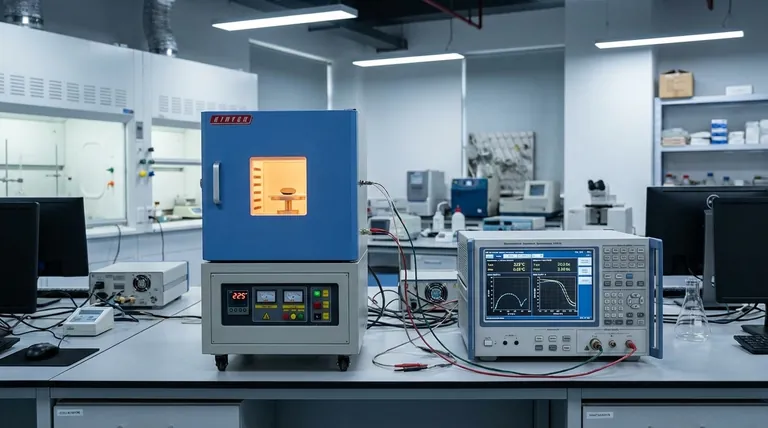
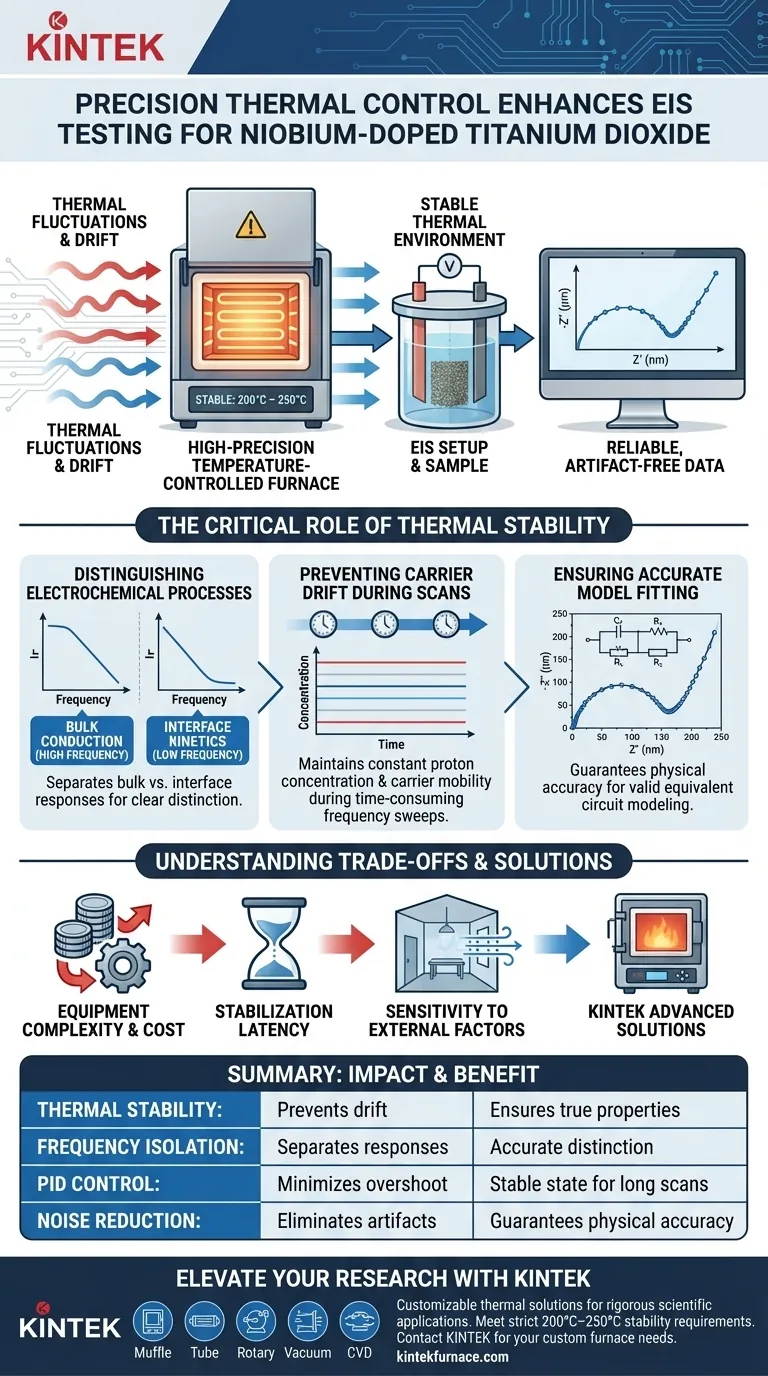
A high-precision temperature-controlled furnace enhances Electrochemical Impedance Spectroscopy (EIS) by maintaining a strictly stable thermal environment, particularly within the critical 200°C to 250°C operating window. This stability is the deciding factor in preventing the drift of proton concentration and carrier mobility during time-consuming frequency scans. By eliminating thermal noise, the furnace ensures that the resulting data reflects the true material properties of the niobium-doped titanium dioxide rather than environmental fluctuations.
Reliable EIS analysis depends on the isolation of specific electrochemical mechanisms. Without precise temperature control, thermal drift blurs the distinction between bulk conduction and interface reactions, rendering equivalent circuit models physically inaccurate.
The Critical Role of Thermal Stability
Distinguishing Electrochemical Processes
In niobium-doped titanium dioxide, different electrochemical behaviors occur at different frequencies. High-frequency responses typically represent bulk properties, such as proton conduction resistance. Conversely, low-frequency responses usually correspond to interface phenomena, like charge transfer impedance.
A high-precision furnace ensures these responses remain distinct. If the temperature fluctuates, the spectral features of these processes can overlap or shift. This stability allows you to clearly separate the bulk material performance from surface interface interactions.
Preventing Carrier Drift During Scans
EIS frequency scans are not instantaneous; they require time to sweep from high to low frequencies. During this period, the internal state of the material must remain constant.
Temperature fluctuations cause immediate changes in proton concentration and carrier mobility within the doped oxide. If these variables change during the scan, the data becomes skewed. Precise thermal regulation "freezes" the thermodynamic state of the material, ensuring the first data point and the last data point represent the same physical environment.
Ensuring Accurate Model Fitting
The end goal of EIS is often to fit the raw data to an equivalent circuit model. This model provides the quantitative values for resistance, capacitance, and inductance in the system.
If the temperature drifts, the data will contain artifacts that do not fit standard physical models. A high-precision furnace guarantees the physical accuracy of the data, allowing for a valid fit that truly represents the microstructure and electrochemical behavior of the niobium-doped titanium dioxide.
Understanding the Trade-offs
Equipment Complexity and Cost
Achieving high precision, especially at the specific 200°C to 250°C range, requires advanced heating elements and controllers. This increases the initial capital investment and the complexity of the experimental setup compared to standard laboratory ovens.
Stabilization Latency
High-precision furnaces often utilize complex PID (Proportional-Integral-Derivative) control loops to minimize overshoot. This can result in longer wait times for the system to reach and fully stabilize at the setpoint temperature before testing can begin.
Sensitivity to External Factors
Because these furnaces are designed for high sensitivity, they can be more susceptible to ambient room temperature changes or airflow drafts if not properly insulated. Rigorous calibration and isolation are often required to maintain the promised precision.
Making the Right Choice for Your Goal
How to Apply This to Your Project
To maximize the value of your EIS testing, match your thermal control strategy to your specific analytical needs.
- If your primary focus is Bulk Proton Conduction: Prioritize stability to ensure high-frequency resistance values are not skewed by rapid thermal changes.
- If your primary focus is Interface Kinetics: Ensure the furnace holds temperature precisely over long durations to capture slow, low-frequency charge transfer processes without drift.
Precision in temperature control is not just an operational detail; it is the baseline requirement for valid electrochemical data in advanced materials.
Summary Table:
| Feature | Impact on EIS Testing | Benefit for Niobium-Doped TiO2 |
|---|---|---|
| Thermal Stability | Prevents drift in proton concentration | Ensures data reflects true material properties |
| Frequency Isolation | Separates bulk vs. interface responses | Accurate distinction between conduction and kinetics |
| PID Control | Minimizes temperature overshoot | Provides a stable thermodynamic state for long scans |
| Noise Reduction | Eliminates thermal artifacts | Guarantees physical accuracy for circuit model fitting |
Elevate Your Electrochemical Research with KINTEK
Precise data starts with a stable environment. KINTEK provides high-performance thermal solutions specifically designed for rigorous scientific applications. Backed by expert R&D and manufacturing, we offer Muffle, Tube, Rotary, Vacuum, and CVD systems, all of which can be customized to meet the strict 200°C–250°C stability requirements of your EIS testing.
Whether you are analyzing proton conduction or interface kinetics in advanced oxides, our lab high-temp furnaces ensure your materials are tested under perfect conditions. Contact KINTEK today to discuss your custom furnace needs and secure the precision your research deserves.
Visual Guide
References
- Tomoyuki Shiraiwa, Takahisa Omata. Enhanced Proton Transport in Nb-Doped Rutile TiO<sub>2</sub>: A Highly Useful Class of Proton-Conducting Mixed Ionic Electronic Conductors. DOI: 10.1021/jacs.5c05805
This article is also based on technical information from Kintek Furnace Knowledge Base .
Related Products
- 1400℃ Controlled Inert Nitrogen Atmosphere Furnace
- 1700℃ Controlled Inert Nitrogen Atmosphere Furnace
- 1400℃ High Temperature Laboratory Tube Furnace with Alumina Tube
- 1700℃ High Temperature Laboratory Tube Furnace with Alumina Tube
- 1200℃ Muffle Oven Furnace for Laboratory
People Also Ask
- How does oxygen partial pressure control affect ceramic sintering? Master Defect Chemistry
- Why is controlled-atmosphere heating required for functional ceramics and sensors? Master Defect Engineering
- Why is thorough binder burnout necessary before sintering advanced ceramics? Ensure Peak Density & Zero Defects
- How do controlled-atmosphere furnaces support polymer pyrolysis? Master SiC & Si3N4 Ceramic Conversion
- How does real-time dilatometric analysis in a controlled-atmosphere furnace optimize PZT ceramic sintering?



















