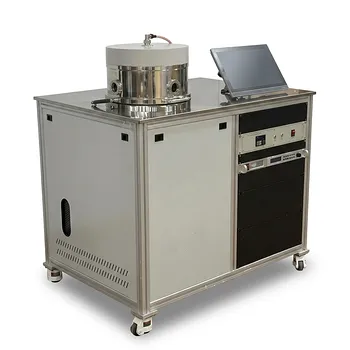
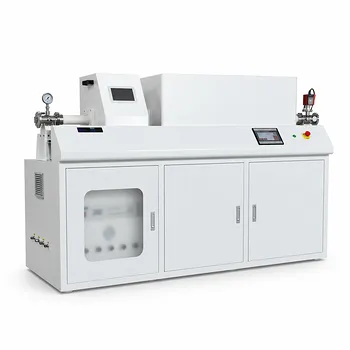
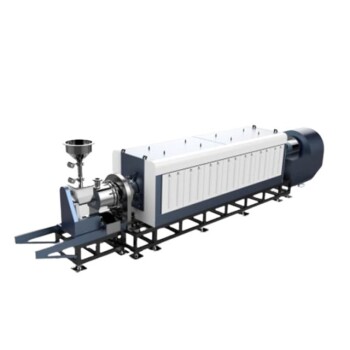
The fixed-bed tube furnace reactor facilitates CO2 adsorption testing by providing a highly controlled thermal environment capable of rapid temperature swings between 550°C and 800°C. This precise regulation allows researchers to simulate the distinct adsorption and desorption phases of the Sorption Enhanced Steam Reforming (SESR) process. By ensuring consistent contact between reactant gases and the adsorbent bed, the reactor enables the accurate quantification of adsorption capacity and cyclic stability.
A fixed-bed tube furnace serves as the foundational testing ground for SESR by replicating the extreme thermal cycles required to capture and release CO2. Its primary value lies in its ability to maintain stable gas-solid contact while transitioning between the kinetic requirements of adsorption and the thermodynamic demands of regeneration.
Precise Thermal Management for Cyclic Performance
Simulating the SESR Temperature Swing
The SESR process relies on a dual-stage cycle: adsorption occurs at approximately 550°C, while regeneration (desorption) requires spikes up to 800°C. A tube furnace is engineered to oscillate between these temperatures with high precision, allowing the adsorbent to capture CO2 and subsequently release it for the next cycle.
Achieving Rapid Thermal Equilibrium
For testing to be valid, the reactor must reach and maintain the target temperature across the entire catalyst bed. The furnace's heating elements are designed to minimize thermal lag, ensuring that the adsorbent is tested under the exact kinetic conditions intended for the SESR reaction.
Maximizing Gas-Solid Contact Efficiency
The Role of the Fixed Catalyst Bed
In a fixed-bed configuration, the adsorbent and catalyst are packed into a stationary column within the tube. This setup forces the reactant gas streams—including CO2, N2, and H2—to permeate through the interstitial spaces, ensuring every particle of the adsorbent is exposed to the gas.
Controlling Flow Residence Time
By adjusting the flow rates of the input gases relative to the bed volume, researchers can control the residence time. This is critical for determining how quickly an adsorbent can capture CO2 and identifying the saturation point where the bed no longer removes carbon from the stream.
Understanding the Trade-offs and Technical Constraints
Managing Pressure Drop
As gases are forced through a tightly packed fixed bed, a pressure drop occurs across the length of the tube. If the bed is packed too densely or if particles degrade into "fines," the resulting backpressure can disrupt flow measurements and damage equipment.
Addressing Thermal Gradients
In larger tube furnaces, the temperature at the center of the bed may differ from the temperature near the tube wall. These radial thermal gradients can lead to uneven adsorption, potentially skewing data if the reactor is not properly insulated or if the thermocouple placement is inaccurate.
Evaluating Long-Term Adsorbent Stability
Assessing Cyclic Durability
SESR adsorbents must survive hundreds of cycles without losing their structural integrity or capture efficiency. The tube furnace allows for automated cycling, testing whether the material sinters or degrades when repeatedly exposed to the 800°C regeneration phase.
Monitoring Regeneration Efficiency
By analyzing the output gases during the 800°C phase, researchers can determine the regeneration efficiency. A fixed-bed reactor makes it easy to see if the CO2 is being fully purged, which is essential for maintaining a high working capacity in subsequent cycles.
How to Apply This to Your Research Project
To get the most out of a fixed-bed tube furnace for SESR testing, tailor your configuration to your specific material goals:
- If your primary focus is Adsorbent Capacity: Prioritize precise mass-flow controllers to accurately measure the volume of CO2 captured before the "breakthrough" point occurs.
- If your primary focus is Thermal Stability: Program the furnace for extended multi-cycle runs (e.g., 50+ cycles) to observe how high-temperature regeneration impacts the material's surface area over time.
- If your primary focus is Kinetic Modeling: Use a smaller diameter tube to minimize radial temperature gradients, ensuring the entire bed reacts at a uniform temperature.
By mastering the thermal and fluid dynamics of the fixed-bed reactor, you can transform raw material data into a scalable solution for carbon-neutral hydrogen production.
Summary Table:
| Feature/Parameter | SESR Requirement | Importance in Testing |
|---|---|---|
| Adsorption Temp | ~550°C | Determines CO2 capture kinetics and capacity. |
| Regeneration Temp | ~800°C | Evaluates efficiency of CO2 release/desorption. |
| Thermal Management | Rapid Swings | Minimizes thermal lag for valid cyclic performance. |
| Bed Configuration | Fixed Catalyst Bed | Ensures maximum gas-solid contact and residence time. |
| Stability Testing | Multi-cycle Runs | Assesses long-term adsorbent durability and sintering. |
Elevate Your SESR Research with KINTEK Precision
Unlock the full potential of your carbon capture and hydrogen production studies with KINTEK’s advanced thermal solutions. As specialists in laboratory equipment, we provide a comprehensive range of high-temperature furnaces—including tube, muffle, rotary, vacuum, CVD, and atmosphere furnaces—all fully customizable to meet the rigorous demands of Sorption Enhanced Steam Reforming (SESR).
Whether you need to minimize radial thermal gradients or automate high-temperature cycling, KINTEK delivers the reliability and precision your research deserves. Contact our experts today to design a tailored furnace system for your unique laboratory needs.
References
- Muhammad Qasim, Sarah Farrukh. A Comparative Study of Eggshell and Commercial Sorbent-Based Catalysts through Synthesis and Characterization for SESR Process. DOI: 10.3390/su152014762
This article is also based on technical information from Kintek Furnace Knowledge Base .
Related Products
- Slide PECVD Tube Furnace with Liquid Gasifier PECVD Machine
- Custom Made Versatile CVD Tube Furnace Chemical Vapor Deposition CVD Equipment Machine
- Laboratory Quartz Tube Furnace RTP Heating Tubular Furnace
- Inclined Rotary Plasma Enhanced Chemical Deposition PECVD Tube Furnace Machine
- Inclined Rotary Plasma Enhanced Chemical Deposition PECVD Tube Furnace Machine
People Also Ask
- What are the main advantages of PECVD tube furnaces compared to CVD tube furnaces? Lower Temp, Faster Deposition, and More
- What is plasma in the context of PECVD? Unlock Low-Temperature Thin Film Deposition
- What are the typical conditions for plasma-enhanced CVD processes? Achieve Low-Temperature Thin Film Deposition
- What plasma source is used in PE-CVD tube furnaces? Unlock Low-Temperature, High-Quality Deposition
- What are the advantages of using a tube furnace CVD system for Cu(111)/graphene? Superior Scalability and Quality