Heating schedules govern the kinetic balance between densification and grain coarsening, while furnace heating element selection determines whether that schedule is delivered with the uniformity and precision required to avoid microstructural defects. Fast heating rates suppress non-densifying mechanisms, multi-stage profiles keep pore channels open, and the right elements eliminate harmful thermal gradients—together enabling fine-grained, high-density ceramics.
The core engineering challenge in conventional sintering is to maximize density while minimizing grain growth. This is solved by treating the furnace not just as a heat source, but as a precision instrument: programming specific heating schedules to manipulate diffusion pathways, and selecting heating elements that provide the uniform radiation and responsive control necessary to execute that program flawlessly.
The Fundamental Competition: Densification vs. Coarsening
At its heart, sintering is a race. The goal is to remove pores via material transport to grain boundaries, but some of that transport simply moves atoms around pore surfaces without shrinking them.
Why Grain Size Dictates Performance
Mechanical strength, optical transparency, and dielectric properties in advanced ceramics often scale inversely with grain size. A fine, uniform microstructure is the primary target. Uncontrolled grain growth not only weakens the body but can trap porosity inside large grains, making full density impossible.
Two Classes of Diffusion Mechanisms
Densifying mechanisms—grain boundary and volume diffusion—move material from grain boundaries into pores, eliminating them. Non-densifying coarsening mechanisms—surface diffusion and vapor transport—redistribute material across pore surfaces without shrinkage, ripening the microstructure. The relative rates of these processes are highly temperature-dependent, and that’s where the heating schedule becomes the master control lever.
Crafting the Ideal Heating Schedule
The heating schedule isn’t a simple ramp to a peak temperature. It’s a timed sequence of thermal events designed to favor densification when it matters most.
Fast Heating to Bypass Surface Diffusion
At lower temperatures, surface diffusion often dominates because its activation energy is lower than that of grain boundary diffusion. A fast heating rate blasts through this temperature window quickly, minimizing the time available for non-densifying coarsening. This preserves the high driving force needed for rapid densification once the body reaches higher temperatures, keeping grain sizes in the nanometer or submicron range right up to final-stage sintering.
Multi-Stage and Rate-Controlled Sintering
A single, fast ramp can sometimes trap pores by prematurely sealing the surface. Multi-stage sintering introduces intentional hold steps at intermediate temperatures. This allows pore migration and gentle shrinkage before the body enters the rapid grain growth regime. Going further, rate-controlled sintering (RCS) uses real-time feedback from dilatometry to dynamically adjust the heating rate. When the compact starts shrinking too fast, the furnace slows down, keeping pore channels open until nearly full density is achieved, a foolproof method for suppressing runaway grain boundary migration.
Dwell Times and the Dangers of Over-Firing
Holding at peak temperature is a double-edged sword. It completes densification, but once closed porosity forms, grain boundaries can detach from pores and migrate rapidly. Abnormal grain growth then takes over, where a few grains consume the matrix, trapping porosity inside them. The solution is to use the shortest dwell time that achieves the target density. Additives like MgO in alumina pin grain boundaries, but even with dopants, an over-extended hold will coarsen the structure.
The Critical Role of Furnace Heating Elements
A perfect heating schedule written on paper is worthless if the furnace cannot deliver it uniformly. This is where heating element selection becomes a primary control factor.
Thermal Uniformity and the Elimination of Gradients
Temperature gradients across a ceramic compact cause differential shrinkage. Some regions density faster than others, generating stresses that lead to warping, micro-cracking, or localized exaggerated grain growth. High-quality heating elements—such as molybdenum disilicide (MoSi₂) or silicon carbide (SiC)—radiate heat evenly across the hot zone. Their physical arrangement and emissivity define the thermal landscape. A furnace with poor element placement or degraded elements will always produce a scatter in grain size.
Precision Control and Responsiveness
The ability to hit a target ramp rate and hold a temperature without oscillation depends on the element’s thermal mass and the controller’s power-delivery response. Low-thermal-mass elements (e.g., some MoSi₂ designs) allow the furnace to rapidly change temperature, essential for fast-fire schedules. An oversized furnace with sluggish elements will overshoot and undershoot the setpoint, inadvertently subjecting the ceramic to unintended coarsening cycles. Precise programmable controllers paired with responsive elements are the backbone of reproducible microstructural control.
Understanding the Trade-offs
No single schedule or furnace design is universally optimal. Decisions involve balancing speed, cost, and component complexity.
Balancing Speed Against Thermal Shock
While fast heating minimizes coarsening, it can induce catastrophic thermal shock in large or thick-walled parts. The brittle ceramic can fracture before it ever starts to densify. Engineers must compromise between a rapid ramp for microstructure and a safer, slower ramp for survival, often using a graduated heating approach.
The Cost of Complexity
Multi-stage and rate-controlled sintering demand advanced laboratory furnaces with sophisticated programming and, for RCS, integrated dilatometry. These systems carry higher capital and maintenance costs. For commodity ceramics, a simple single-stage cycle in a well-characterized kiln may be sufficient. The extra complexity is justified only when the value of an ultra-fine grain, high-strength component outweighs the process investment.
Making the Right Choice for Your Goal
Your specific application dictates where you push hardest in the schedule–element combination.
- If your primary focus is minimizing grain size for peak strength: Prioritize an extremely fast heating rate through the low-temperature zone in a furnace with low-thermal-mass elements, and use a minimal peak-temperature hold. Consider RCS if budget allows.
- If your primary focus is maximum density in thick, complex shapes: Abandon the fastest profile and design a multi-stage schedule with holds below the rapid grain growth temperature, paired with heating elements that produce a highly uniform hot zone to prevent differential shrinkage.
- If your primary focus is process reproducibility and cost-effectiveness: Invest in a furnace with robust, responsive heating elements (e.g., high-grade SiC or MoSi₂) and a precise PID controller. A well-characterized, single-stage fast-fire schedule often provides the best balance, assuming the green body is homogeneous and dopants are optimized to pin grain boundaries.
- If your primary focus is preventing abnormal grain growth in doped systems: Use a dwell time at peak temperature only long enough to close porosity, then cool rapidly. Confirm that your heating element configuration does not create a local hot spot that could trigger local liquid formation and exaggerated growth.
The furnace is not a black box but a finely tunable instrument. When the heating schedule is tailored to the diffusion kinetics of your ceramic, and the heating elements deliver that schedule with unwavering uniformity, achieving a pore‑free, nano‑grained microstructure becomes a predictable engineering outcome.
Summary Table:
| Process / Component | Core Function & Impact | Best Practice / Solution |
|---|---|---|
| Fast Heating Rate | Bypasses non-densifying surface diffusion at lower temperatures | Suppresses coarsening; maintains fine grain size before final sintering |
| Multi-Stage / RCS Sintering | Dynamically controls shrinkage and keeps pore channels open | Prevents premature surface sealing and runaway grain boundary migration |
| Optimized Dwell Time | Prevents pore detachment and abnormal grain growth (AGG) | Minimize peak hold time to only what is needed for final pore closure |
| Heating Elements (MoSi₂ / SiC) | Provides uniform heat radiation and rapid thermal responsiveness | Eliminates thermal gradients to prevent localized growth and warping |
Achieve Precise Microstructural Control with KINTEK
Mastering advanced ceramic sintering requires unmatched thermal uniformity and responsive furnace performance. KINTEK offers high-performance laboratory equipment and consumables, featuring custom high-temperature furnaces—including muffle, tube, rotary, vacuum, CVD, atmosphere, and induction melting furnaces—engineered with premium heating elements like MoSi₂ and SiC to eliminate thermal gradients and give you total control over grain growth.
Whether you need fast-fire capabilities, multi-stage temperature control, or fully customized furnace builds tailored to your research or production goals, KINTEK has you covered.
Contact KINTEK today to upgrade your lab's sintering capabilities
Related Products
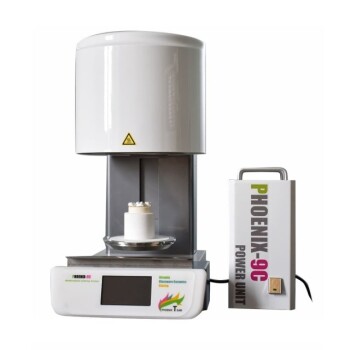
- Chairside Dental Porcelain Zirconia Sintering Furnace with Transformer for Ceramic Restorations
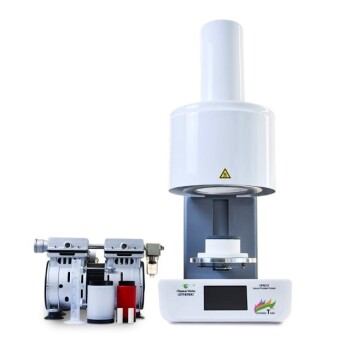
- Dental Porcelain Zirconia Sintering Ceramic Vacuum Press Furnace
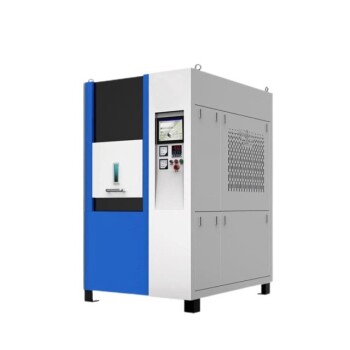
- Vacuum Heat Treat Sintering Furnace with Pressure for Vacuum Sintering
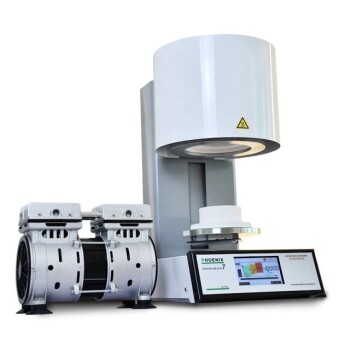
- Vacuum Dental Porcelain Sintering Furnace for Dental Laboratories
- Spark Plasma Sintering SPS Furnace
People Also Ask
- What factors determine the quality of sintered zirconia restorations? Master Material, Equipment, and Technique
- How do conventional vs rapid sintering in dental furnaces affect zirconia? Optimize Efficiency Without Sacrificing Strength
- What industries use zirconia sintering furnaces? Beyond Dental and Jewelry Applications
- Why is a zirconia sintering furnace considered essential for dental laboratories and clinics? Unlock Precision and Durability
- What are the key components of a zirconia sintering furnace? Unlock Precision for Superior Dental Restorations