
At its core, a zirconia sintering furnace is built around five key components. These are the heating elements that generate extreme temperatures, a sophisticated temperature control system to manage the process, high-quality insulation to maintain thermal stability, a programmable interface to define custom heating cycles, and essential safety systems to protect the equipment and operator.
A zirconia furnace is not simply an oven; it is a precision instrument. Understanding how its core components work together is the key to transforming a chalky, fragile zirconia blank into a final restoration with predictable strength, perfect shade, and exceptional durability.
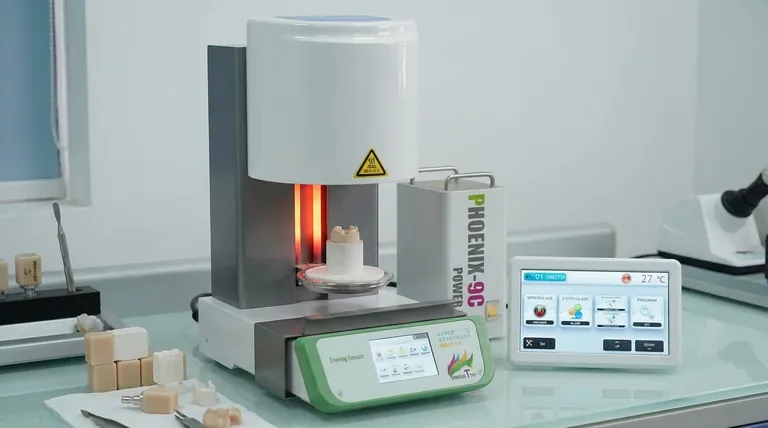
The Anatomy of a High-Performance Sintering Furnace
A sintering furnace's value lies in its ability to execute a precise temperature profile flawlessly and repeatedly. Each component plays a critical role in achieving this goal.
The Heart: Heating Elements
The heating elements are responsible for generating the intense heat required for sintering, typically reaching up to 1600°C or more.
The most common type used for zirconia are molybdenum disilicide (MoSi2) elements. They are chosen for their ability to operate at very high temperatures and, crucially, for providing a "clean" heat that does not discolor or contaminate the translucent zirconia.
The quality and placement of these elements directly impact temperature uniformity within the firing chamber, which is essential for preventing stress and ensuring consistent results across an entire batch of restorations.
The Brain: Temperature Control System
This is arguably the most critical system for achieving high-quality results. It acts as the furnace's brain, directing the entire sintering process.
It consists of a programmable controller and one or more thermocouples. The thermocouple is a sensor that measures the exact temperature inside the chamber, providing real-time feedback.
The controller uses this feedback to precisely regulate the heating elements, ensuring the furnace follows the programmed temperature curve—including the rate of heating, holding times at peak temperature, and the cooling rate. This precision is what determines the final physical and aesthetic properties of the zirconia.
The Guardian: The Firing Chamber and Insulation
The firing chamber and its surrounding insulation are designed to create a perfectly stable thermal environment.
The chamber is built from high-purity refractory materials that can withstand extreme thermal cycling without degrading or releasing contaminants.
High-quality, multi-layer insulation minimizes heat loss. This not only improves energy efficiency but, more importantly, it prevents rapid temperature fluctuations that could compromise the sintering process and lead to inconsistent density or internal stresses in the final product.
The Support Crew: Safety and Ventilation Systems
These systems are essential for protecting the investment and ensuring safe operation.
Features like over-temperature protection automatically shut down the furnace if it exceeds safe limits, protecting the heating elements and the zirconia restorations from being ruined.
Proper ventilation is also critical. During the pre-sintering "burnout" phase, binding agents in the zirconia are burned away, and these fumes must be safely exhausted to prevent contamination of the firing chamber and ensure a safe lab environment.
Understanding the Key Trade-offs
Choosing or operating a furnace involves balancing competing factors. Understanding these trade-offs is essential for process optimization and purchasing decisions.
Sintering Speed vs. Final Aesthetics
Many modern furnaces offer "speed" or "fast" sintering cycles that can be completed in a fraction of the time of a conventional cycle.
While efficient, these rapid cycles place immense stress on the heating elements and can, in some cases, impact the final translucency of the zirconia if the control system isn't precise enough to manage the rapid heating and cooling without introducing thermal shock.
Element Type and Contamination Risk
While MoSi2 elements are the industry standard for high-purity zirconia, some general-purpose high-temperature furnaces may use silicon carbide (SiC) elements.
For sintering zirconia, especially highly translucent varieties, SiC elements pose a contamination risk that can lead to a slight grayish or greenish discoloration in the final restoration. For this reason, dedicated zirconia furnaces almost exclusively use MoSi2.
Open vs. Closed Programmable Systems
The furnace's programmable controller dictates its flexibility. A "closed" system may come with pre-set programs optimized only for a specific manufacturer's brand of zirconia.
An "open" system provides complete freedom to create and store custom sintering programs. This offers far greater flexibility to work with zirconia from various manufacturers, each of which may have a unique recommended sintering profile.
Making the Right Choice for Your Goal
Your specific objectives will determine which furnace components you should prioritize.
- If your primary focus is maximum aesthetic quality and consistency: Prioritize a furnace with premium MoSi2 heating elements and a highly precise, multi-stage programmable controller for unparalleled thermal control.
- If your primary focus is high-volume production: Look for robust construction, proven element longevity, and validated speed-sintering cycles that don't compromise core strength.
- If your primary focus is material flexibility and future-proofing: Choose a furnace with a fully "open" and user-friendly programming interface that allows you to adapt to any zirconia material on the market.
Ultimately, mastering your sintering furnace begins with understanding that each component is a tool to control the final outcome of your restorations.
Summary Table:
| Component | Key Function | Common Types/Features |
|---|---|---|
| Heating Elements | Generate high temperatures (up to 1600°C+) | Molybdenum disilicide (MoSi2), Silicon carbide (SiC) |
| Temperature Control System | Manages heating cycles precisely | Programmable controller, Thermocouples |
| Insulation | Maintains thermal stability | High-purity refractory materials, Multi-layer design |
| Programmable Interface | Defines custom sintering cycles | Open or closed systems |
| Safety Systems | Protects equipment and operator | Over-temperature protection, Ventilation |
Ready to elevate your dental lab's capabilities? KINTEK specializes in advanced high-temperature furnace solutions, including Muffle, Tube, Rotary, Vacuum & Atmosphere Furnaces, and CVD/PECVD Systems. With our exceptional R&D and in-house manufacturing, we offer deep customization to meet your unique zirconia sintering needs—ensuring precise temperature control, uniform heating, and enhanced safety for consistent, high-quality restorations. Contact us today to discuss how our tailored solutions can optimize your sintering process and boost productivity!
Visual Guide

Related Products
- Chairside Dental Porcelain Zirconia Sintering Furnace with Transformer for Ceramic Restorations
- Dental Porcelain Zirconia Sintering Ceramic Vacuum Press Furnace
- Small Vacuum Heat Treat and Tungsten Wire Sintering Furnace
- Vacuum Dental Porcelain Sintering Furnace for Dental Laboratories
- Spark Plasma Sintering SPS Furnace
People Also Ask
- What factors determine the quality of sintered zirconia restorations? Master Material, Equipment, and Technique
- How do conventional vs rapid sintering in dental furnaces affect zirconia? Optimize Efficiency Without Sacrificing Strength
- What industries use zirconia sintering furnaces? Beyond Dental and Jewelry Applications
- Why is a zirconia sintering furnace considered essential for dental laboratories and clinics? Unlock Precision and Durability
- What type of heating elements are preferred for zirconia sintering and why? Choose SiC or MoSi2 for Optimal Results



















