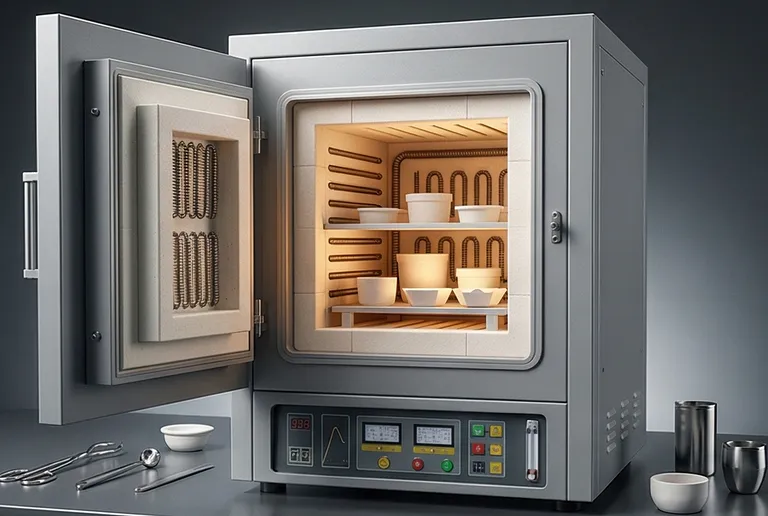
The Mystery of the Brittle Sample: When Heat Isn't Enough
Imagine this: your team has spent weeks synthesizing a specialized iron-bearing amorphous silicate gel. You’ve followed the temperature protocol to the letter, yet when the sample emerges from the drying oven, it’s "off." Perhaps the color is wrong, the magnetic properties are inconsistent, or the molecular framework seems compromised.
In high-precision material science, heat is only half the equation. The more frustrating half is the invisible environment surrounding your sample. For many researchers, the struggle isn't reaching the right temperature—it’s preventing the atmosphere from sabotaging the chemistry before the process is even complete.
The Trap of "Good Enough" Atmosphere Control
When facing oxidation or contamination, the common instinct is to increase the flow of inert gases like nitrogen or argon. It seems logical: push out the air, and the problem should disappear.
However, many labs find that even with high-purity gas purging, results remain unpredictable. In projects involving iron-based alloy ribbons or delicate silicates, surface oxidation and chemical degradation still occur. This leads to a cycle of failed nanocrystallization analyses and unreliable magnetic measurements.
The business cost of this "trial and error" is steep. It’s not just about wasted raw materials; it’s about project timelines slipping by weeks and the potential for critical data errors in high-stakes industries like aerospace or medical implant manufacturing, where material integrity is a matter of safety.
The Root Cause: The Invisible Saboteurs (CO2 and Oxygen)
Why does standard drying fail for iron-bearing silicates? The answer lies in the atomic-level reactivity of iron and the surrounding gases.
- Carbonate Contamination: At even moderate pressures, amorphous silicate gels are highly susceptible to reacting with atmospheric carbon dioxide. This results in the formation of carbonate impurities that weaken the material’s structure.
- Valence Instability: Iron is a "restless" element. Without a strictly controlled environment, iron atoms will not stay stably embedded in the silicate framework. Instead, they react with trace oxygen to change their oxidation state, leading to the formation of independent oxide phases—essentially, your advanced material begins to "rust" from the inside out before it’s even formed.
Standard furnaces fail because they cannot reduce the "partial pressure" of these reactive gases low enough. To ensure that iron remains at its intended valence state and that solvents are removed without secondary reactions, you don't just need an inert environment; you need an absent environment.
The Solution: Precision Vacuum as a Chemical Shield
This is where the high-vacuum furnace transitions from a luxury to a necessity. By employing a sophisticated multi-stage pumping system—utilizing roughing, rotary, and diffusion pumps—a high-vacuum environment reduces available oxygen to minuscule, non-reactive levels.
At KINTEK, our high-vacuum furnaces are designed specifically to address these fundamental chemical challenges. By creating a nearly total void, our systems:
- Enforce Chemical Purity: Prevent CO2 from ever reaching the gel, ensuring zero carbonate formation.
- Lock the Valence State: Provide the extremely low-oxygen environment required to keep iron stably embedded in the silicate framework, a critical factor for magnetic and structural consistency.
- Facilitate Densification: For materials like yttria or zirconia, the vacuum environment facilitates particle diffusion, allowing for solid-phase sintering at temperatures as high as 2400°C without the risk of impurity oxides.
Our furnaces are not just heating chambers; they are controlled "voids" that allow your material’s true properties to emerge without atmospheric interference.
Unlocking New Frontiers in Material Science
When you eliminate the variable of atmospheric contamination, the ceiling for your research rises significantly. Solving the vacuum challenge opens doors to applications that were previously too "unstable" to pursue:
- Aerospace & Defense: You can now simulate the extreme 1200°C oxidative stresses found in gas turbines to verify the thermal stability of new shielding metamaterials.
- Advanced Electronics: High-precision annealing of iron-based alloys becomes repeatable, ensuring the accuracy of magnetic property measurements for next-generation sensors.
- Medical Innovation: Sintering biocompatible materials with total confidence in their chemical purity and mechanical strength.
By mastering the environment, you stop fighting the atmosphere and start perfecting the material.
Whether you are working with iron-bearing silicates, titanium alloys for aerospace, or refractory oxides for industrial shells, the right vacuum environment is the foundation of your success. At KINTEK, we specialize in tailoring high-temperature vacuum solutions to the specific chemical and thermal demands of your most challenging projects. Don’t let atmospheric interference compromise your innovation—reach out to our technical team today to discuss how we can help you achieve absolute environmental control.
Related Products
- 2200 ℃ Tungsten Vacuum Heat Treat and Sintering Furnace
- High Pressure Laboratory Vacuum Tube Furnace
- 2200 ℃ Graphite Vacuum Heat Treat Furnace
- 9MPa Air Pressure Vacuum Heat Treat and Sintering Furnace
- Molybdenum Vacuum Heat Treat Furnace
Related Articles
- Why Your High-Strength Titanium Biomaterials Are Brittle—and How Vacuum Heat Treatment Fixes It
- Why Your Alloy Phase Separation Observations Are Inconsistent—And the "Invisible" Variable You’re Missing
- The Unseen Engine: Why Graphite Dominates High-Temperature Vacuum Furnaces
- Heat, Void, and Control: Designing the Heart of a High-Temperature Vacuum Furnace
- The Paradox of Strength: Why Graphite Dominates High-Temperature Vacuum Furnaces



















