The Frustrating Cycle of Tool Wear and Downtime
Imagine a high-precision machining run where everything seems perfect—until it isn’t. Mid-shift, a high-speed steel (HSS) tool loses its edge. The friction increases, the temperature spikes, and suddenly, the surface finish of your workpiece is ruined. You are forced to stop the line, replace the tool, and recalibrate.
For many laboratory and industrial managers, this is a daily reality. High-speed steel is prized for its toughness and ability to withstand heat, yet in demanding applications, it often falls victim to adhesive wear and friction. The "solution" is usually to buy more tools or try generic surface treatments, but these are often just band-aids on a deeper problem.
The Common Struggle: Why Traditional Hardening Falls Short
When faced with tool failure, the standard response is often traditional gas nitriding or simple salt bath treatments. While these methods aim to harden the surface, they frequently introduce a new set of headaches:
- Core Softening: Traditional methods often require high temperatures that "over-temper" the base HSS material. You end up with a hard surface, but a soft, brittle core that can’t support the load.
- Dimensional Distortion: High heat causes precision tools to warp or change size, meaning they require expensive post-processing grinding.
- The "Eggshell" Effect: If the surface coating doesn't bond perfectly due to microscopic oxide layers, it will simply peel or "delaminate" under pressure.
These failures lead to a cascading series of business costs: project delays, wasted raw materials, and an ever-growing budget for replacement consumables.
The Hidden Barrier: Understanding the "Passivation Layer"
The root cause of many surface treatment failures isn't the nitrogen itself; it’s the invisible barrier on the tool's surface. High-speed steel naturally forms a "passivation oxide layer." Think of it as a microscopic suit of armor that, while protecting the steel from rust, also prevents nitrogen atoms from diffusing into the metal.
Traditional methods try to "force" nitrogen through this layer using heat and time. Plasma nitriding works differently.
By utilizing high-voltage electric fields in a vacuum, the equipment creates a "glow discharge." This state of matter—plasma—contains high-energy positive ions. These ions perform two critical tasks that traditional furnaces cannot:
- Cathodic Sputtering: The ions physically bombard the tool surface at an atomic level, "sandblasting" away the oxide passivation layer. This "activates" the surface, making it ready to receive nitrogen.
- Low-Temperature Diffusion: Because the plasma provides the energy needed for the nitrogen to react, the entire process can happen at significantly lower temperatures. This ensures the nitrogen diffuses deeply and uniformly without ever reaching the point where the tool's core properties are compromised.
The Solution: Precision Plasma Engineering
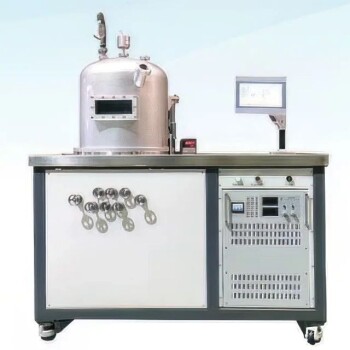
To solve the conflict between surface hardness and core integrity, you need a tool designed specifically to manage this plasma environment. KINTEK’s laboratory plasma nitriding systems are engineered to turn this complex physics into a push-button solution.
Our equipment doesn't just "heat" the tool; it manages the ionized nitrogen gas mixture within a controlled vacuum to ensure a high-hardness nitrided layer is formed precisely where it’s needed. By reducing the friction coefficient at a molecular level, our systems allow HSS tools to glide against workpieces, drastically reducing adhesive wear.
Unlike generic furnaces, KINTEK systems focus on the uniformity of the glow discharge, ensuring that even complex geometries—like rotary tools or intricate molds—receive the same level of protection on every surface.
Beyond the Fix: Unlocking New Production Potential
When you solve the fundamental problem of tool wear, you aren't just saving money on replacement cutters; you are opening the door to higher performance.
By integrating precision plasma nitriding into your workflow, the "new normal" for your facility becomes:
- Aggressive Feed Rates: With a significantly lower friction coefficient, you can run machines faster without the risk of tool "seizing."
- Elimination of Post-Processing: Because the process happens at lower temperatures, the dimensional stability of your tools is preserved, eliminating the need for corrective grinding.
- Extended Tool Life: Laboratory results consistently show that plasma-nitrided HSS tools can outlast untreated tools by 2 to 5 times, depending on the application.
Solving the surface science of your tools is the first step toward a more efficient, predictable, and profitable laboratory or production line.
At KINTEK, we understand that every material and every tool geometry presents a unique challenge. Our expertise in high-temperature vacuum environments and plasma technology allows us to provide more than just equipment—we provide a path to superior material performance. Whether you are looking to optimize high-speed steel or explore custom surface modifications for unique alloys, our team is ready to help you engineer a solution that lasts. Contact Our Experts today to discuss your specific project requirements.
Related Products
- Spark Plasma Sintering SPS Furnace
- Slide PECVD Tube Furnace with Liquid Gasifier PECVD Machine
- Inclined Rotary Plasma Enhanced Chemical Deposition PECVD Tube Furnace Machine
- Inclined Rotary Plasma Enhanced Chemical Deposition PECVD Tube Furnace Machine
- 915MHz MPCVD Diamond Machine Microwave Plasma Chemical Vapor Deposition System Reactor
Related Articles
- Why Your Titanium-Zirconia Composites Lack Strength—And How SPS Breaks the Mechanical Barrier
- Why Your Sintered Parts Fail: It’s Not Just About Heat, But Pressure and Purity
- Beyond the Program: Why Your Sintering Fails and How to Guarantee Uniformity
- Why Your Superelastic Alloys Fail to Perform—And How Solid-State Precision Fixes It
- Solving the Bonding Dilemma: Why High-Strength Alloys Need More Than Just Pressure