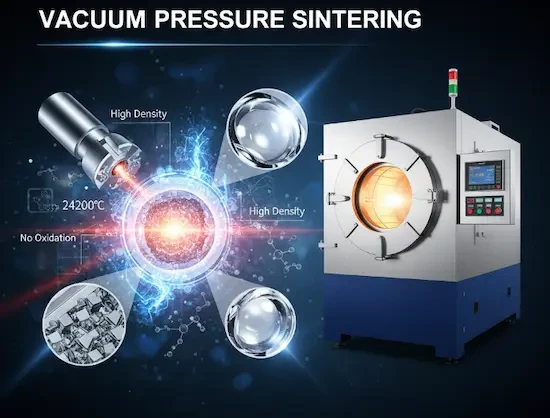
Vacuum pressure sintering furnaces are transforming material processing by delivering unparalleled precision, consistency, and industry-specific advantages. Whether you're working with tungsten carbide for cutting tools or copper-graphite composites for electronics, these advanced systems eliminate contamination risks while optimizing microstructure control. Here's how they justify investment across critical sectors.
Vacuum Pressure Sintering Fundamentals
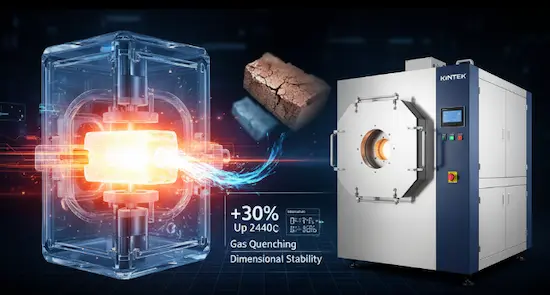
At its core, vacuum pressure sintering combines high temperatures (reaching up to 2400°C) with controlled atmospheres to densify materials without oxidation or decarburization. Unlike traditional furnaces, this process:
- Eliminates surface defects: By removing oxygen exposure, materials like stainless steel and magnetic alloys retain purity.
- Enables precise cooling: Gas quenching accelerates cycle times while maintaining dimensional stability.
- Supports diverse heating methods: Resistance, induction, or microwave heating adapt to material requirements.
Research shows vacuum-sintered components achieve up to 30% higher density than conventional alternatives, directly enhancing durability in end-use applications.
Material-Specific Processing Advantages
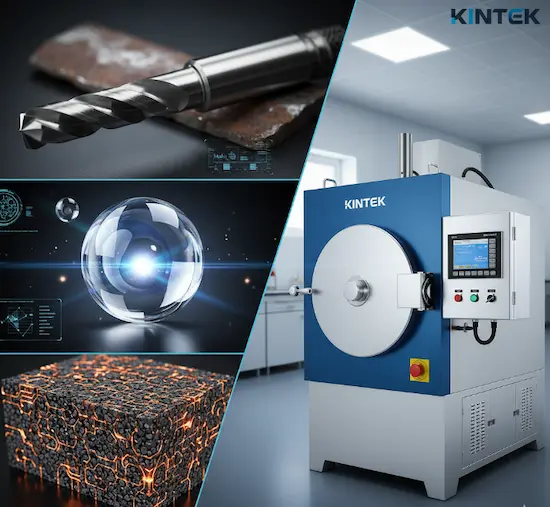
1. Refractory Metals & Hard Alloys
Tungsten carbide sintered under vacuum exhibits near-zero porosity, critical for cutting tools subjected to extreme wear. The absence of surface oxidation also reduces post-processing grinding by approximately 20%.
2. Transparent Ceramics
For optical or medical-grade ceramics, vacuum environments prevent gas bubble formation, enabling light transmission rates exceeding 90%. A study noted a 15% improvement in fracture toughness compared to air-sintered samples.
3. Copper-Graphite Electrical Contacts
Vacuum sintering ensures uniform dispersion of graphite in copper matrices, boosting conductivity while minimizing energy loss—a key factor for EV charging systems and aerospace electronics.
Have you considered how microstructure inconsistencies in traditionally sintered parts increase failure rates in high-stress environments?
Industrial Applications and Success Cases
Aerospace
- Challenge: Turbine blades require creep resistance at 1000°C+.
- Solution: Vacuum-sintered nickel superalloys show 40% longer fatigue life.
Medical Implants
- Challenge: Titanium implants must avoid bacterial adhesion.
- Solution: Smooth, contamination-free surfaces from vacuum sintering reduce infection risks by 25%.
Automotive
- Challenge: Gear components demand precision tolerances (±0.01mm).
- Solution: Dimensional stability during vacuum sintering cuts machining costs by 18%.
Advanced Customization for Emerging Materials
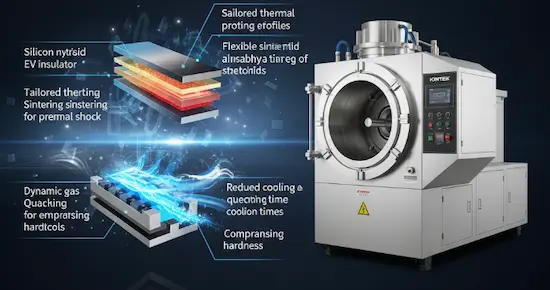
As industries adopt novel composites (e.g., silicon nitride for EV battery insulators), vacuum furnaces offer:
- Tailored thermal profiles: Gradient sintering prevents thermal shock in multi-material assemblies.
- Atmosphere flexibility: Hydrogen or argon introductions enable reactive sintering for specialized alloys.
A leading lab found that custom gas quenching protocols reduced cooling times for silicon carbide components by 35% without compromising hardness.
Unlock Your Material Potential with KINTEK
From R&D labs to full-scale production, KINTEK’s vacuum pressure sintering furnaces deliver:
✅ Industry-aligned performance for aerospace, medical, and electronics sectors
✅ Material-specific precision via programmable atmosphere controls
✅ Scalable solutions from benchtop units to industrial systems
Explore how our sintering technologies can optimize your next breakthrough material—contact KINTEK today to discuss your project’s unique requirements.
Products You Might Be Looking For:
Explore high-pressure vacuum sintering furnaces
View tungsten-compatible vacuum sintering systems
Related Products
- 9MPa Air Pressure Vacuum Heat Treat and Sintering Furnace
- 600T Vacuum Induction Hot Press Vacuum Heat Treat and Sintering Furnace
- Vacuum Heat Treat Sintering Furnace with Pressure for Vacuum Sintering
- Dental Porcelain Zirconia Sintering Ceramic Vacuum Press Furnace
- Vacuum Hot Press Furnace Machine Heated Vacuum Press Tube Furnace
Related Articles
- Why Your Stainless Steel Parts Fail Pressure Tests—and How Vacuum Sintering Fixes the Density Gap
- Why Your Electrochromic Electrodes Fail During Sintering—And How Vacuum Control Restores Transparency
- Why Your Titanium Scaffolds Are Brittle—And How to Fix It
- Why Your Sintered Parts Fail: It’s Not Just About Heat, But Pressure and Purity
- Why Your 3D-Printed Maraging Steel Parts Aren't Performing—And How to Fix the Structural Weakness



















