The Illusion of a Simple Problem
Imagine a materials scientist working late. The goal is to forge a new ceramic composite, one that's lighter yet stronger than anything before. The components are mixed, the sample is ready. The obvious next step seems to be heat—a lot of it.
But heat alone is often not enough.
The real challenge isn't just melting or altering the material; it's conquering the empty space within it. The microscopic voids between powder particles are the enemy of strength and performance. This isn't a problem of chemistry, but one of physics and architecture. The solution requires more than a simple oven; it requires a coordinated application of force.
The Three-Factor Alliance: Heat, Vacuum, and Pressure
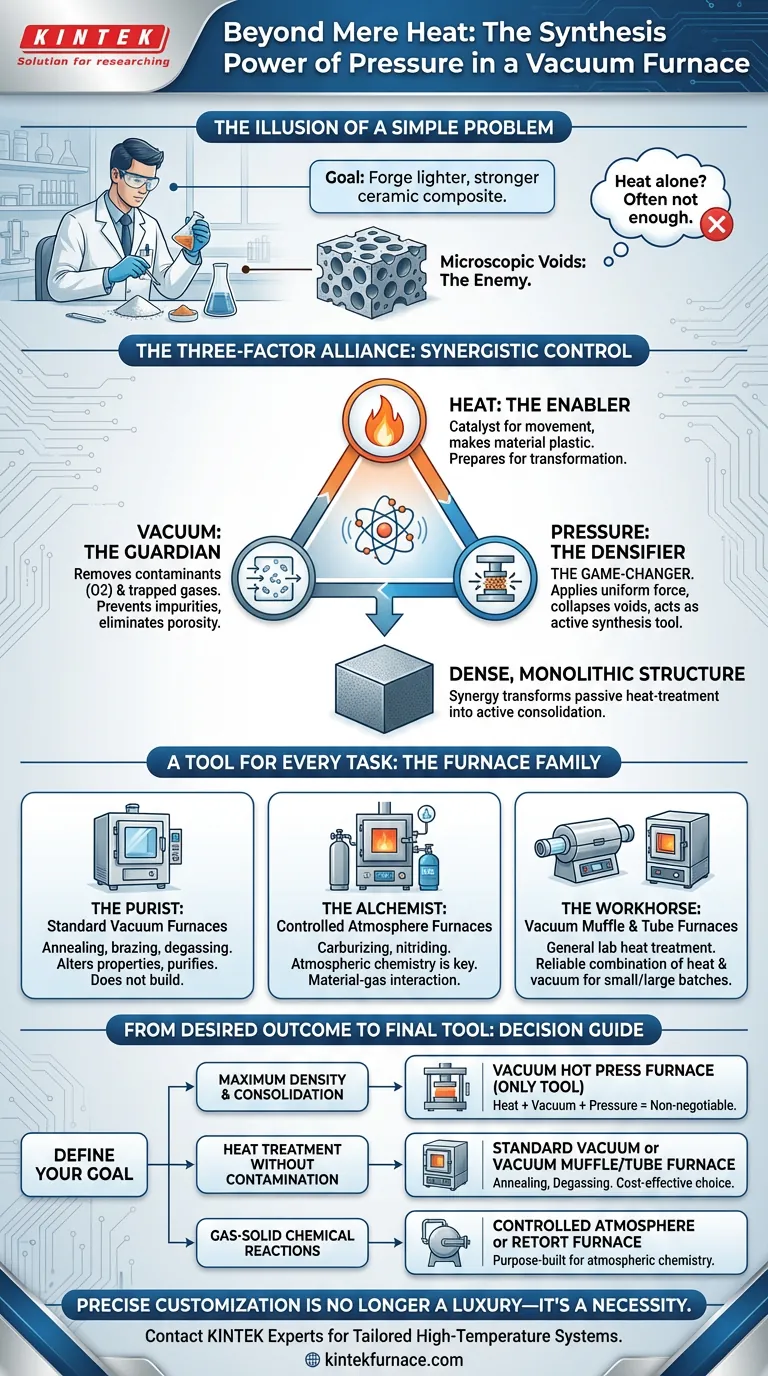
A vacuum hot press furnace is defined by the synergistic control of three environmental factors. To understand its power is to understand how these three elements work in concert, each playing an indispensable role.
Heat: The Enabler
Heat is the catalyst. It gives atoms the energy to move, making the material plastic and malleable. Without sufficient temperature, the particles remain rigid and uncooperative, and no amount of pressure can force them into a dense, monolithic structure. Heat prepares the material for transformation.
Vacuum: The Guardian
The vacuum atmosphere acts as a silent guardian. At the extreme temperatures required for synthesis, materials are highly reactive. Oxygen and other atmospheric contaminants would eagerly create unwanted oxides and impurities, compromising the final product.
The vacuum removes these threats. It also helps extract trapped gases from within the powder mass as it's compressed, eliminating a source of internal porosity. It ensures the material you create is the material you designed.
Pressure: The Densifier
This is the game-changer. While heat enables and vacuum protects, the integrated mechanical press does the brute-force work of densification. It applies immense, uniform force, physically squeezing the particles together and collapsing the voids between them.
This transforms the furnace from a passive heat-treatment device into an active synthesis and consolidation tool. It’s the difference between baking a cake and forging a sword.
A Tool for Every Task: The Furnace Family
Choosing a furnace is like a surgeon selecting an instrument. You wouldn't use a scalpel for a task requiring a bone saw. Each furnace type is a specialized tool, optimized for a specific job. The vacuum hot press is the specialist's scalpel, but sometimes a simpler tool is the right one.
The Purist: Standard Vacuum Furnaces
A standard vacuum furnace provides heat and a clean vacuum environment. It excels at processes like annealing, brazing, and degassing. The objective here is to alter a material's internal properties—like crystal structure or internal stress—without changing its shape or density. It purifies and refines, but it doesn't build.
The Alchemist: Controlled Atmosphere Furnaces
These systems, like retort furnaces, are designed for processes where the atmospheric chemistry is a key ingredient. They might use inert gases like argon to prevent reactions or introduce reactive gases for processes like carburizing or nitriding. Here, the interaction between the material and its surrounding gas is the entire point.
The Workhorse: Vacuum Muffle & Tube Furnaces
For general-purpose heat treatment in a lab, vacuum muffle and tube furnaces are the reliable workhorses. A tube furnace is perfect for small, uniform samples, while a muffle furnace accommodates larger parts or batches. They provide the essential combination of heat and vacuum for a wide range of applications, but without the integrated force of a hot press.
The Specialist's Dilemma: Understanding the True Cost
The decision to use a vacuum hot press is a significant one, involving trade-offs that go beyond the initial purchase price.
It's a common cognitive bias to assume that the most capable tool is always the best one. But the complexity of a hot press—the integration of high-force hydraulics, robust vacuum systems, and precision heating—carries a heavy cost in operation, maintenance, and training.
Using a vacuum hot press for a simple annealing task is not just inefficient; it’s an example of over-engineering. The elegance of engineering lies in matching the complexity of the tool to the complexity of the problem. Often, the smarter, more economical choice is a simpler, dedicated system.
From Desired Outcome to Final Tool
The choice of furnace must be driven backward from the final material properties you need to achieve.
- For maximum density and consolidating powders into solid parts: The simultaneous application of heat, vacuum, and pressure is non-negotiable. A vacuum hot press furnace is the only tool for this job.
- For heat treatment without contamination (e.g., annealing, degassing): A standard vacuum furnace or a vacuum muffle/tube furnace is the appropriate and more cost-effective choice.
- For processes driven by gas-solid chemical reactions: A controlled atmosphere or retort furnace is purpose-built for this task.
Comparative Overview
| Feature | Vacuum Hot Press Furnace | Standard Vacuum Systems (Muffle, Tube, etc.) |
|---|---|---|
| Primary Function | Densification & Synthesis | Heat Treatment & Annealing |
| Key Variable | Integrated Mechanical Pressure | Heat & Atmosphere Control |
| Material Output | High-density, low-porosity solids | Altered material properties, same form |
| Complexity | High | Low to Medium |
| Application | Advanced ceramics, composites, diffusion bonding | Brazing, sintering, degassing, hardening |
When your material goals demand a furnace that's as unique as your research, precise customization is no longer a luxury—it's a necessity. At KINTEK, our expertise in R&D and manufacturing allows us to engineer tailored high-temperature systems, from versatile vacuum tube furnaces to highly specialized hot press systems, ensuring your equipment is a perfect match for your process. Contact Our Experts
Visual Guide
Related Products
- Vacuum Hot Press Furnace Machine Heated Vacuum Press Tube Furnace
- Vacuum Hot Press Furnace Machine Heated Vacuum Press
- 600T Vacuum Induction Hot Press Vacuum Heat Treat and Sintering Furnace
- 2200 ℃ Tungsten Vacuum Heat Treat and Sintering Furnace
- Vacuum Heat Treat Sintering Furnace with Pressure for Vacuum Sintering
Related Articles
- How Vacuum Hot Press Furnaces Transform Advanced Material Engineering
- How to Select the Right Vacuum Hot Pressing Furnace Temperature for Your Materials
- Beyond the Parts List: The Real Reason Your Vacuum Hot Press Fails (And How to Fix It)
- Why Your High-Temperature Materials Fail: The Hidden War Inside Your Furnace
- Is Your Material Data Real? Why Temperature Gradients Are Sabotaging Your Cu2Se Resistivity Measurements



















