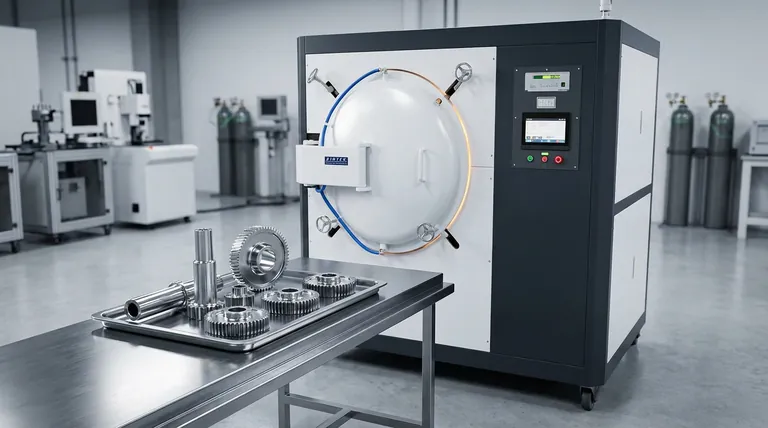
The Hidden Variable in Heat Treatment
Imagine a high-strength component, machined to micron tolerances over days. Its geometry is perfect. Its material is specified. The final step is heat treatment, a process meant to unlock its full potential.
Yet, this final step often introduces the greatest uncertainty. In a conventional furnace, the very air we breathe becomes a contaminant. At high temperatures, the component is not just being heated; it's being subjected to an uncontrolled chemical reaction with the atmosphere.
The core challenge isn't just heat, but the environment in which it's applied. Vacuum heat treatment offers a profound shift in philosophy: instead of trying to manage a reactive atmosphere, it removes it from the equation entirely.
The Tyranny of the Atmosphere
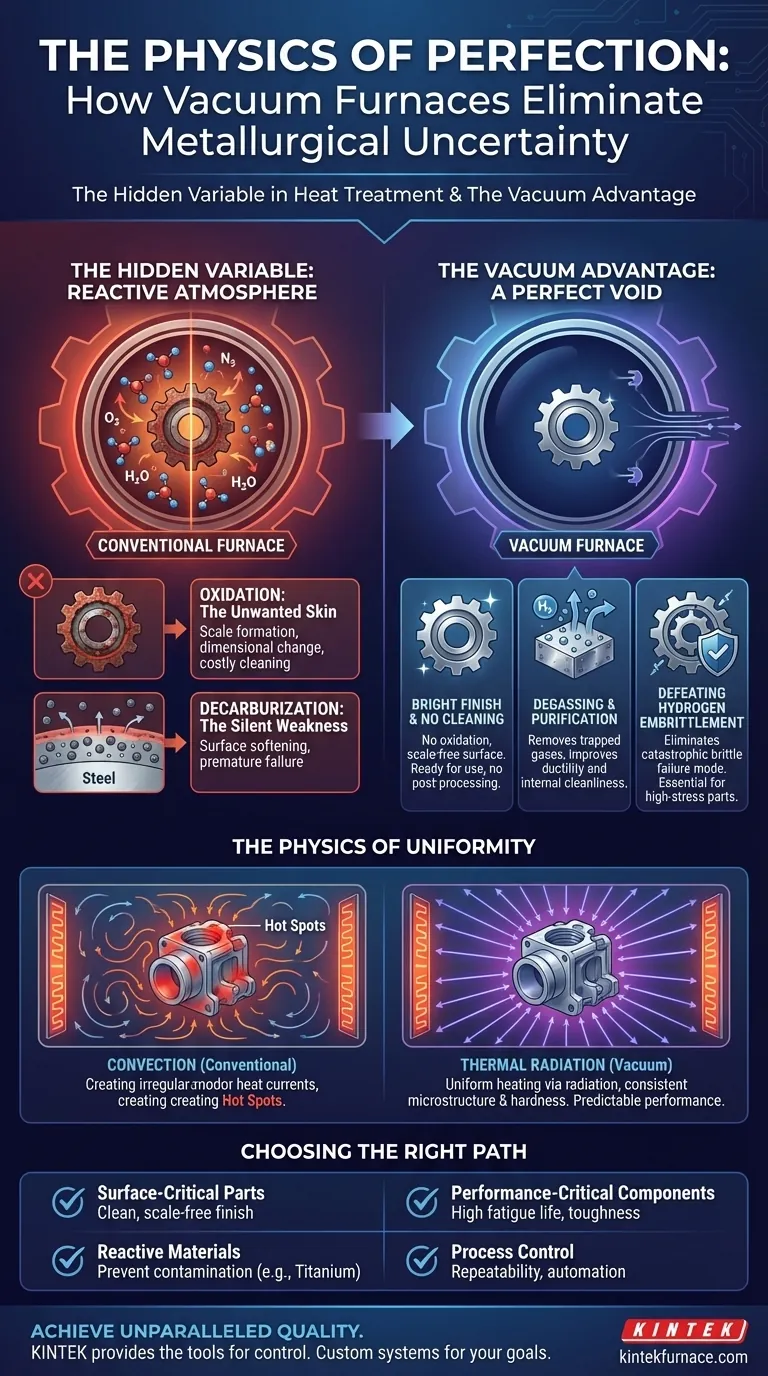
At elevated temperatures, metal becomes highly reactive. The seemingly benign gases in the air—oxygen, nitrogen, water vapor—aggressively attack the component's surface, leading to two fundamental problems.
Oxidation: The Unwanted Skin
Oxygen reacts with the hot metal surface to form a layer of oxide scale. This isn't just a cosmetic issue. This scale changes the part's dimensions, can flake off and contaminate sensitive assemblies, and must be removed through costly, aggressive secondary operations like sandblasting or acid pickling.
Each of these cleaning steps adds time, cost, and another opportunity for error or surface damage. The part you carefully machined is no longer the part you have.
Decarburization: The Silent Weakness
For steels, another insidious reaction occurs. Carbon, the element crucial for hardness, is drawn out of the surface and reacts with oxygen. This "decarburization" creates a soft, weak outer layer.
A component with a decarburized surface will fail prematurely under fatigue and wear. It’s a hidden flaw that compromises the integrity of the entire design, a weakness introduced at the final stage of manufacturing.
Creating a Perfect Void: The Vacuum Advantage
By removing the atmosphere, a vacuum furnace creates an exceptionally pure, non-reactive environment. This fundamentally changes the outcome of the heat treatment process, addressing the problems of the atmosphere at their source.
The Promise of a "Bright" Finish
Without oxygen, oxidation cannot occur. Parts emerge from a vacuum furnace with the same clean, bright surface they had going in.
This isn't merely an aesthetic benefit; it's an economic one. The elimination of post-treatment cleaning operations dramatically simplifies the production workflow, reduces lead times, and preserves the precise dimensions of the component. The part is often ready for immediate use.
Purifying from Within: The Degassing Effect
The power of a vacuum extends deep into the material itself. At high temperatures and low pressures, trapped gases within the metal—primarily hydrogen—are drawn to the surface and pumped away.
This degassing effect purifies the material, improving its internal cleanliness and ductility. You are not just hardening the component; you are fundamentally improving the quality of the material itself.
Averting Catastrophe: Defeating Hydrogen Embrittlement
Hydrogen is the enemy of high-strength steels. Even in trace amounts, it can lead to hydrogen embrittlement, a phenomenon causing sudden, catastrophic brittle failure in components under stress.
Vacuum heat treatment actively removes this hydrogen from the metal, completely eliminating this critical failure mode. For high-stress applications in aerospace, automotive, or medical devices, this is not a luxury—it's a prerequisite for safety and reliability.
The Physics of Uniformity
In a vacuum, the primary mode of heat transfer is thermal radiation. Unlike convection, which can create hot spots, radiation heats all surfaces—even those in complex internal geometries—in a slow, gentle, and exceptionally uniform manner.
This uniform heating and subsequent controlled cooling (quenching) results in a more consistent microstructure and hardness throughout the entire part. This translates directly to predictable and reliable mechanical properties, such as improved fatigue life and toughness. You gain certainty over the final performance.
Acknowledging the Trade-Offs
No technology is without context, and a clear-eyed view acknowledges the practicalities.
- Pace vs. Throughput: While initial heating can be slower due to reliance on radiation, the total process time is often faster. You eliminate lengthy purge cycles and all post-processing, significantly increasing overall throughput.
- Cost vs. Investment: The upfront capital cost for vacuum furnaces is higher. However, this is an investment in certainty. The long-term savings from eliminating process gases, reducing scrap, and removing secondary operations often provide a rapid return on investment.
Choosing the Right Path
The decision to use vacuum heat treatment is driven by the demands of the application.
- For Surface-Critical Parts: When a clean, scale-free finish is paramount, vacuum is the superior choice.
- For Performance-Critical Components: For high-stress parts where fatigue life and toughness are non-negotiable, the degassing and uniform quenching of a vacuum process are essential.
- For Reactive Materials: For metals like titanium or specialty alloys, a vacuum is often the only viable environment to prevent surface contamination.
- For Process Control: When part-to-part consistency and automation are key, the highly repeatable nature of a modern vacuum furnace is unmatched.
Ultimately, vacuum heat treatment is about taking control. By removing the unpredictable variable of the atmosphere, you gain direct, precise control over the final properties of your components. At KINTEK, we provide the tools for that control. Our deep expertise in R&D and manufacturing allows us to engineer custom vacuum furnace systems—from lab-scale to production—that are tailored to your specific materials and process goals.
To achieve unparalleled quality and consistency in your components, the solution starts with the perfect environment. Contact Our Experts
Visual Guide
Related Products
- Vacuum Hot Press Furnace Machine Heated Vacuum Press Tube Furnace
- Vacuum Hot Press Furnace Machine Heated Vacuum Press
- 600T Vacuum Induction Hot Press Vacuum Heat Treat and Sintering Furnace
- 2200 ℃ Tungsten Vacuum Heat Treat and Sintering Furnace
- Vacuum Heat Treat Sintering Furnace with Pressure for Vacuum Sintering
Related Articles
- How Vacuum Hot Press Furnaces Transform Advanced Material Engineering
- How to Select the Right Vacuum Hot Pressing Furnace Temperature for Your Materials
- Beyond the Parts List: The Real Reason Your Vacuum Hot Press Fails (And How to Fix It)
- Why Your High-Temperature Materials Fail: The Hidden War Inside Your Furnace
- Is Your Material Data Real? Why Temperature Gradients Are Sabotaging Your Cu2Se Resistivity Measurements



















