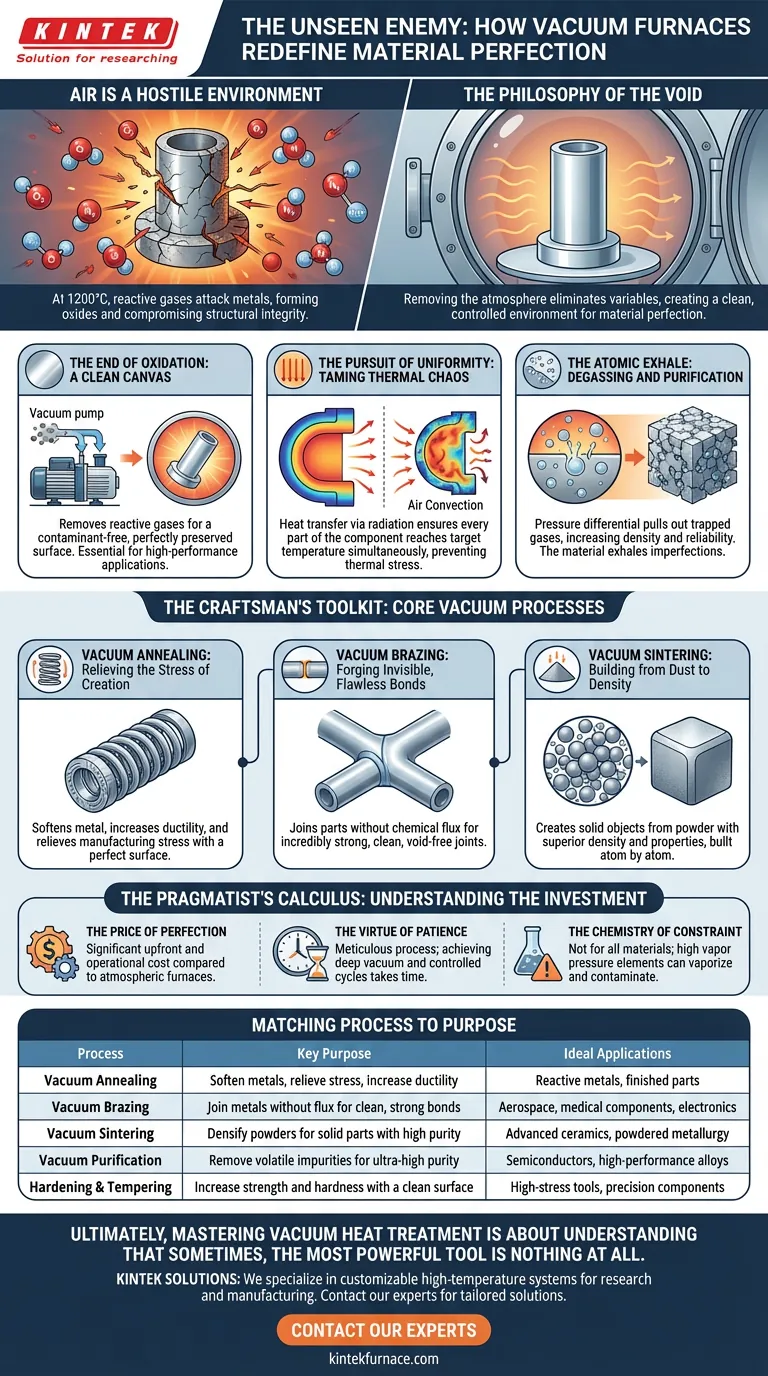
The Air is a Hostile Environment
In our daily lives, the air is essential. For a materials scientist working at 1200°C, it is a relentless enemy.
At high temperatures, the oxygen, nitrogen, and water vapor we take for granted become aggressive contaminants. They attack the surface of metals, forming brittle oxide layers, introducing impurities, and silently compromising the structural integrity of a meticulously designed component.
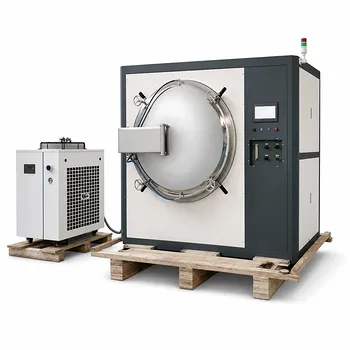
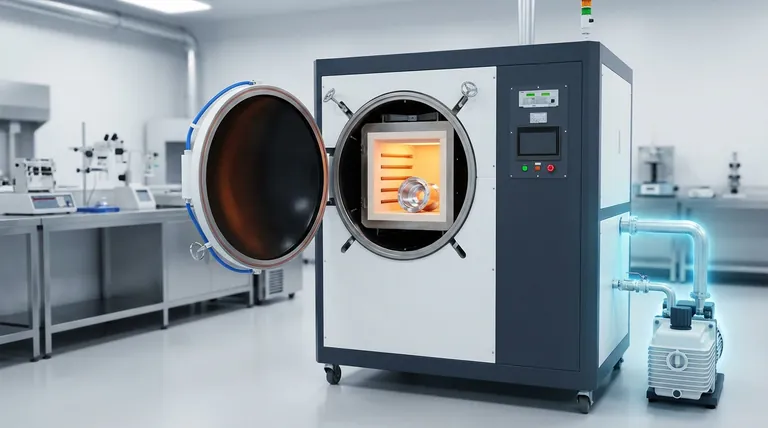
The conventional furnace fights a losing battle against this enemy. The high-temperature vacuum furnace, however, does not fight. It simply removes the battlefield. Its essential value is not just achieving extreme heat, but creating an exceptionally clean, controlled void—a perfect stage for manipulating matter at its most fundamental level.
The Philosophy of the Void
Understanding vacuum heat treatment is less about metallurgy and more about the psychology of control. It’s about eliminating the variables you can, to perfect the variables you can’t. Removing the atmosphere is the ultimate act of control.
The End of Oxidation: A Clean Canvas
Imagine trying to paint a masterpiece on a dirty canvas. That is what heat-treating in atmosphere is like. The vacuum pump removes the reactive gases, creating a pristine environment. The material emerges from the heating and cooling cycle bright, clean, and uncontaminated, with its surface properties perfectly preserved. This isn't just an aesthetic benefit; it's a functional necessity for high-performance applications.
The Pursuit of Uniformity: Taming Thermal Chaos
Air creates convection currents, leading to hot and cold spots that introduce thermal stress and can warp a part. In a vacuum, heat transfer is primarily through radiation—a far more gentle and uniform process. This ensures the entire component, from its thickest core to its thinnest edge, reaches the target temperature at the same time. It’s the difference between a chaotic process and a predictable, repeatable science.
The Atomic Exhale: Degassing and Purification
Many materials contain trapped gases like hydrogen, remnants from their manufacturing process. These microscopic bubbles are points of weakness. As a material is heated in a vacuum, the pressure differential literally pulls these dissolved gases out. The material exhales its imperfections, resulting in a denser, stronger, and more reliable final product.
The Craftsman's Toolkit: Core Vacuum Processes
Within this controlled void, a series of precise processes can be executed to achieve specific, remarkable outcomes. Each one leverages the absence of air to accomplish what would otherwise be impossible.
Vacuum Annealing: Relieving the Stress of Creation
Manufacturing processes like forging or machining create immense internal stress. Annealing is a heat treatment designed to soften the metal, increase its ductility, and relieve this stress. Performing it in a vacuum ensures the part's surface remains perfect, making it ideal for finished components or reactive metals like titanium.
Vacuum Brazing: Forging Invisible, Flawless Bonds
Brazing joins two parts with a filler metal. In the open air, this requires a chemical flux to clean the surfaces, which can be corrosive and difficult to remove. Vacuum brazing needs no flux. The pristine environment allows the filler metal to wet and flow perfectly, creating a joint that is incredibly strong, clean, and void-free—a requirement for critical aerospace and medical devices.
Vacuum Sintering: Building from Dust to Density
Sintering creates a solid, dense object from compacted metal or ceramic powder by heating it to just below its melting point. In a vacuum, the particles bond without the interference of trapped air or surface oxides. The result is a part with superior density and mechanical properties, built atom by atom from the ground up.
The Pragmatist's Calculus: Understanding the Investment
This level of control is not without its trade-offs. The decision to use a vacuum furnace is a conscious investment in certainty and quality.
- The Price of Perfection: Vacuum furnaces are complex systems. The robust chambers, powerful pumps, and advanced control systems represent a significant upfront and operational cost compared to atmospheric furnaces.
- The Virtue of Patience: Achieving a deep vacuum and executing a precisely controlled heating and cooling cycle takes time. The process is meticulous and deliberate, not rushed.
- The Chemistry of Constraint: Not all materials are suitable. Elements with high vapor pressure, like zinc or magnesium, can vaporize under a deep vacuum at high temperatures, contaminating the furnace and destroying the part. The process demands a respect for the laws of physics.
Matching Process to Purpose
Choosing the right path depends entirely on your objective. The vacuum furnace is a versatile platform, but its power lies in applying the correct process to the correct problem.
| Process | Key Purpose | Ideal Applications |
|---|---|---|
| Vacuum Annealing | Soften metals, relieve stress, increase ductility | Reactive metals, finished parts |
| Vacuum Brazing | Join metals without flux for clean, strong bonds | Aerospace, medical components, electronics |
| Vacuum Sintering | Densify powders for solid parts with high purity | Advanced ceramics, powdered metallurgy |
| Vacuum Purification | Remove volatile impurities for ultra-high purity | Semiconductors, high-performance alloys |
| Hardening & Tempering | Increase strength and hardness with a clean surface | High-stress tools, precision components |
Ultimately, mastering vacuum heat treatment is about understanding that sometimes, the most powerful tool is nothing at all. It is the controlled emptiness that allows us to create materials with a level of perfection the natural world can't match.
At KINTEK, we specialize in building the systems that give you this control. Backed by expert R&D and manufacturing, our customizable muffle, tube, vacuum, and CVD furnace systems are engineered for the most demanding applications. We thrive on unique challenges and deep customization to ensure your equipment is perfectly aligned with your research goals. To explore how a precisely tailored high-temperature solution can elevate your material performance, Contact Our Experts
Visual Guide
Related Products
- Vacuum Hot Press Furnace Machine Heated Vacuum Press Tube Furnace
- Vacuum Hot Press Furnace Machine Heated Vacuum Press
- 600T Vacuum Induction Hot Press Vacuum Heat Treat and Sintering Furnace
- 2200 ℃ Tungsten Vacuum Heat Treat and Sintering Furnace
- Vacuum Heat Treat Sintering Furnace with Pressure for Vacuum Sintering
Related Articles
- How Vacuum Hot Press Furnaces Transform Advanced Material Engineering
- How to Select the Right Vacuum Hot Pressing Furnace Temperature for Your Materials
- Beyond the Parts List: The Real Reason Your Vacuum Hot Press Fails (And How to Fix It)
- Why Your High-Temperature Materials Fail: The Hidden War Inside Your Furnace
- Is Your Material Data Real? Why Temperature Gradients Are Sabotaging Your Cu2Se Resistivity Measurements