The Invisible Flaw
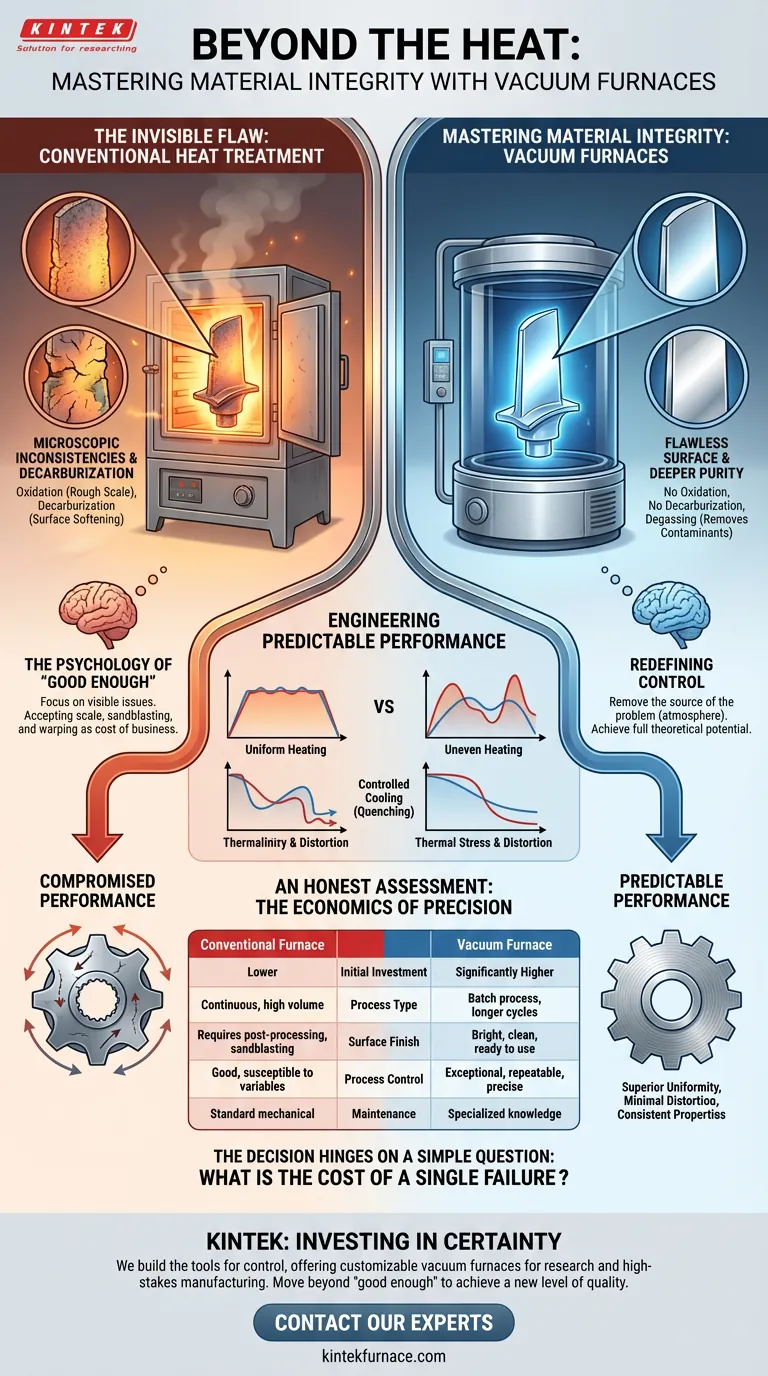
Imagine an aerospace engineer inspecting a mission-critical turbine blade. It looks perfect. Dimensions are precise. But deep within the metal's surface, an invisible process has already begun. During its conventional heat treatment, oxygen reacted with the superheated alloy, creating microscopic inconsistencies and a slightly decarburized surface.
This isn't a dramatic failure. It's a quiet compromise. A small, hidden vulnerability that can compound under extreme stress.
This scenario reveals a fundamental truth about metallurgy: the most significant battles are often fought against an invisible enemy—the atmosphere itself.
The Psychology of "Good Enough"
For decades, traditional atmosphere furnaces have been the workhorses of manufacturing. They are effective and relatively inexpensive. The side effects—oxide scale, the need for sandblasting, a certain percentage of parts lost to warping—are often accepted as the cost of doing business.
This is a powerful psychological bias. We tend to focus on solving visible problems (like grinding off scale) rather than preventing the invisible ones (like preserving the material's inherent surface chemistry).
Vacuum heat treatment challenges this acceptance of compromise. It operates on a different philosophy: what if you could remove the source of the problem entirely?
Redefining Control: Removing the Atmosphere
By performing the heat treatment process in a near-perfect vacuum, we are not just heating metal. We are creating an ideal environment where the material can achieve its full theoretical potential, free from atmospheric interference.
The Physics of a Flawless Surface
In a traditional furnace, oxygen is the enemy of a clean finish. It causes:
- Oxidation: The formation of a rough, discolored layer of scale on the part's surface.
- Decarburization: The loss of carbon from the surface of steel alloys, making them softer and weaker than intended.
A vacuum environment is virtually free of reactants. This simple, elegant solution completely prevents these issues, preserving the material's integrity.
The Economic Value of a Bright Finish
Parts emerge from a vacuum furnace with a bright, clean, often mirror-like finish. This isn't just an aesthetic benefit; it's a direct economic one.
- No secondary cleaning: Eliminates costly and time-consuming steps like sandblasting, chemical pickling, or grinding.
- No material loss: Post-processing can remove surface material, potentially altering precise dimensions. Vacuum treatment avoids this.
Degassing: A Deeper Form of Purity
The vacuum doesn't just prevent contamination; it actively cleans the part. It pulls volatile contaminants and trapped gases (like hydrogen) out from within the material itself. This degassing effect creates a metallurgically purer surface, which is critical for applications like high-strength brazing or medical implants where bonding is paramount.
From Surface to Substance: Engineering Predictable Performance
A pristine surface is a sign of a well-controlled process. That control extends deep into the material's structure, translating into superior and, most importantly, predictable mechanical properties.
The Pursuit of Uniformity
Vacuum furnaces excel at uniform heating. With no air currents to create hot and cold spots, every part of a component—from thin edges to the thick core—reaches temperature at the same rate. This uniformity is crucial for achieving a consistent grain structure and predictable hardness.
Winning the War on Distortion
Controlled cooling (quenching) is just as important as heating. Vacuum furnaces often use high-pressure inert gas quenching. This method is far less severe than plunging a hot part into oil or water, dramatically reducing thermal stress.
The result is minimal distortion and warping. For complex, high-precision gears or intricate molds, this means parts that meet spec the first time, every time.
An Honest Assessment: The Economics of Precision
While its advantages are clear, vacuum heat treatment is a strategic choice, not a universal replacement. It represents a deliberate investment in quality over sheer volume.
| Consideration | Conventional Furnace | Vacuum Furnace |
|---|---|---|
| Initial Investment | Lower | Significantly Higher |
| Process Type | Often continuous, suited for high volume | Batch process, longer cycle times |
| Surface Finish | Requires post-processing (e.g., sandblasting) | Bright, clean, and ready to use |
| Process Control | Good, but susceptible to atmospheric variables | Exceptional, highly repeatable and precise |
| Maintenance | Standard mechanical and electrical | Specialized knowledge for pumps, seals, and controls |
The decision hinges on a simple question: What is the cost of a single failure?
For high-volume, non-critical parts, a traditional furnace may be the most cost-effective solution. But for components where performance is non-negotiable—in aerospace, medical devices, or high-performance tooling—the precision and predictability of a vacuum environment are essential.
This is an investment in certainty. It's about engineering away the invisible flaws that traditional processes accept as inevitable. With an advanced system, you gain control over the fundamental properties of your materials. At KINTEK, we build the tools for that control, offering a range of customizable vacuum furnaces designed for the unique demands of research and high-stakes manufacturing.
If you are ready to move beyond "good enough" and achieve a new level of quality and performance, we can help you build the right solution. Contact Our Experts
Visual Guide
Related Products
- Vacuum Hot Press Furnace Machine Heated Vacuum Press Tube Furnace
- Vacuum Hot Press Furnace Machine Heated Vacuum Press
- 600T Vacuum Induction Hot Press Vacuum Heat Treat and Sintering Furnace
- 2200 ℃ Tungsten Vacuum Heat Treat and Sintering Furnace
- Vacuum Heat Treat Sintering Furnace with Pressure for Vacuum Sintering
Related Articles
- How Vacuum Hot Press Furnaces Transform Advanced Material Engineering
- How to Select the Right Vacuum Hot Pressing Furnace Temperature for Your Materials
- Beyond the Parts List: The Real Reason Your Vacuum Hot Press Fails (And How to Fix It)
- Why Your High-Temperature Materials Fail: The Hidden War Inside Your Furnace
- Is Your Material Data Real? Why Temperature Gradients Are Sabotaging Your Cu2Se Resistivity Measurements