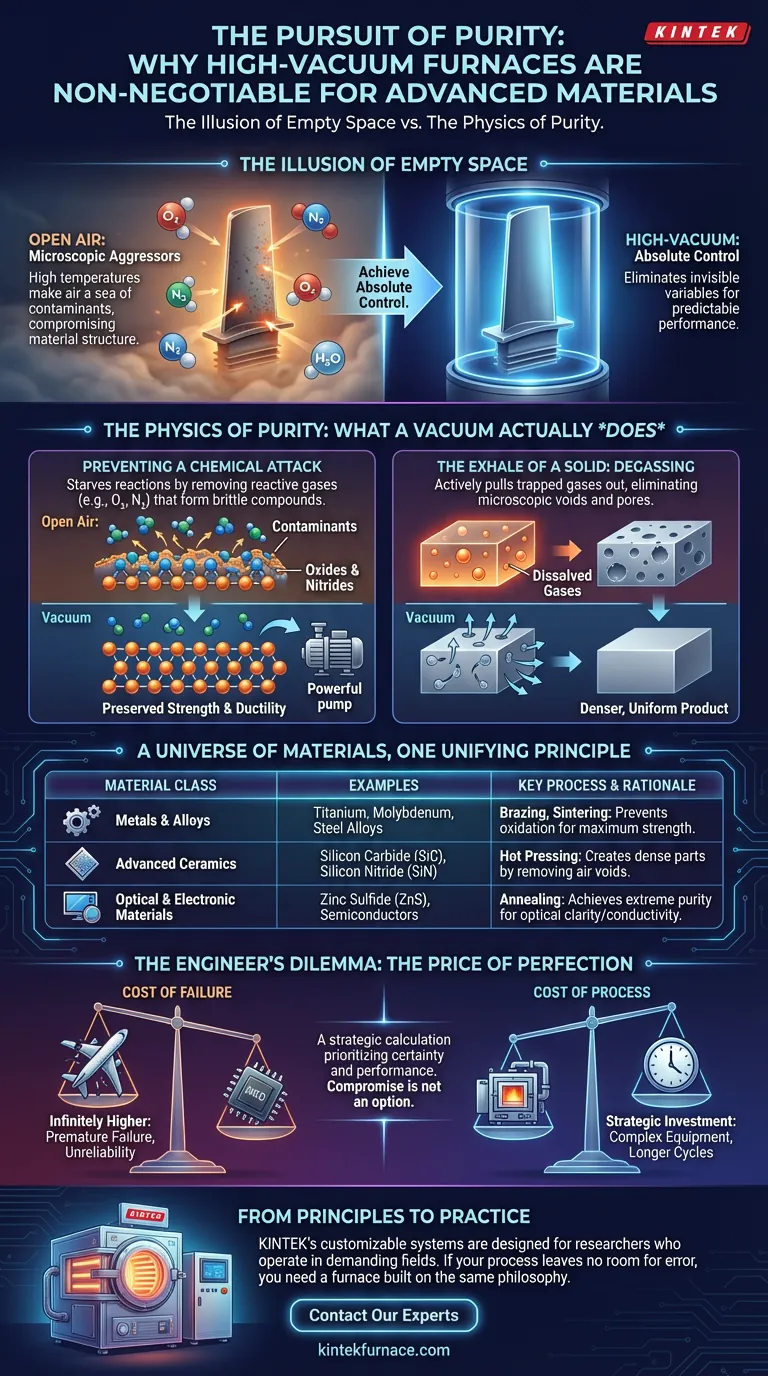
The Illusion of Empty Space
Imagine machining a turbine blade from a block of titanium alloy. Every curve and tolerance is perfect. Now, it must be heat-treated to give it the final strength needed to withstand thousands of hours of stress inside a jet engine.
The problem? The air we breathe, so vital to us, becomes a sea of microscopic aggressors at high temperatures. Oxygen, nitrogen, and water vapor—normally harmless—turn into agents of contamination, ready to compromise the very structure you worked so hard to create.
This is the psychological starting point for any engineer working with high-stakes materials. The decision to use a high-vacuum furnace is not just a technical choice; it's a decision to eliminate an entire class of invisible variables. It's about achieving absolute control.
The Physics of Purity: What a Vacuum Actually Does
A high-vacuum furnace's primary function is not what it adds, but what it removes. It creates an environment so pure that the material can be transformed without being corrupted. This is achieved through two fundamental processes.
Preventing a Chemical Attack
At elevated temperatures, a material's atoms are energized and highly receptive to bonding. In open air, this means they will readily react with oxygen and nitrogen, forming brittle oxides and nitrides on the surface and within the material's grain structure.
For a reactive metal like titanium or molybdenum, this is a catastrophic failure. The material becomes weak and unreliable. A high-vacuum environment starves this reaction by removing the reactive gases, preserving the material's innate strength and ductility.
The Exhale of a Solid: The Science of Degassing
Many materials contain dissolved gases trapped within their structure during initial manufacturing. When heated, these gases expand and try to escape, creating microscopic voids and pores.
This is a silent defect. In a medical implant, it could lead to premature failure. In an optical component, it creates imperfections that scatter light. The vacuum acts as a powerful force, actively pulling these trapped gases out of the material as it's heated—a process called degassing. The material essentially exhales its impurities, resulting in a denser, more uniform final product.
A Universe of Materials, One Unifying Principle
From aerospace to electronics, different fields have independently arrived at the same conclusion: for ultimate performance, a vacuum is non-negotiable. The specific materials change, but the underlying principle of purity remains the same.
| Material Class | Examples | Key Process & Rationale |
|---|---|---|
| Metals and Alloys | Titanium, Molybdenum, Steel Alloys | Brazing, Sintering: Prevents oxidation for maximum strength. |
| Advanced Ceramics | Silicon Carbide (SiC), Silicon Nitride (SiN) | Hot Pressing: Creates dense parts by removing air voids. |
| Optical & Electronic Materials | Zinc Sulfide (ZnS), Semiconductors | Annealing: Achieves extreme purity for optical clarity/conductivity. |
The Engineer's Dilemma: The Price of Perfection
Opting for a high-vacuum process is a significant commitment. The equipment is complex and expensive. The process cycles are longer due to the time it takes to pump the chamber down to the required pressure. Maintenance is rigorous.
So why choose this harder path?
Because for these applications, the cost of failure is infinitely higher than the cost of the process. An aircraft component cannot be "mostly" strong. A semiconductor cannot be "mostly" pure. The decision to invest in a vacuum furnace is a strategic calculation that prioritizes certainty and performance over cost and convenience. It's a declaration that compromise is not an option.
From Principles to Practice
Achieving this level of control isn't theoretical; it requires equipment built with an equal commitment to precision. KINTEK's customizable high-vacuum furnace systems are designed for the researchers and engineers who operate in these demanding fields. Whether you are processing reactive metals for aerospace, sintering next-generation ceramics, or developing ultra-pure optical components, our systems provide the stable, pristine environment your work demands.
If your process leaves no room for error, you need a furnace built on the same philosophy. Contact Our Experts
Visual Guide
Related Products
- 2200 ℃ Tungsten Vacuum Heat Treat and Sintering Furnace
- High Pressure Laboratory Vacuum Tube Furnace
- 2200 ℃ Graphite Vacuum Heat Treat Furnace
- Molybdenum Vacuum Heat Treat Furnace
- 9MPa Air Pressure Vacuum Heat Treat and Sintering Furnace
Related Articles
- Why Your High-Strength Titanium Biomaterials Are Brittle—and How Vacuum Heat Treatment Fixes It
- Why Your Alloy Phase Separation Observations Are Inconsistent—And the "Invisible" Variable You’re Missing
- The Unseen Engine: Why Graphite Dominates High-Temperature Vacuum Furnaces
- Heat, Void, and Control: Designing the Heart of a High-Temperature Vacuum Furnace
- The Paradox of Strength: Why Graphite Dominates High-Temperature Vacuum Furnaces