Blog The Hidden Saboteur in Your HT-LiCoO2 Synthesis: Why Precise Ramp Rates Can Make or Break Your Battery Materials
The Hidden Saboteur in Your HT-LiCoO2 Synthesis: Why Precise Ramp Rates Can Make or Break Your Battery Materials

The Hidden Saboteur in Your HT-LiCoO2 Synthesis: Why Precise Ramp Rates Can Make or Break Your Battery Materials

3 hours ago

The Frustration of Inconsistent Crystallinity

You have spent weeks meticulously preparing your HT-LiCoO2 precursors. The stoichiometry is perfect, the chelating agents are balanced, and your hydrothermal synthesis went exactly as planned. Yet, after the final calcination, the results are a disaster. One batch shows excellent crystallinity, while the next suffers from structural collapse or poor electrochemical performance.

Even more baffling, some samples appear to have physically "popped" or expanded uncontrollably during the heating cycle. If you have experienced this inconsistency, you are not alone—and the culprit is likely not your chemistry, but your furnace’s inability to manage the "kinetic path" of your material.

The High Cost of "Fast Enough" Heating

In a high-pressure R&D or production environment, the temptation is always to increase throughput. Many researchers attempt to speed up the calcination process by using rapid ramp rates or standard laboratory ovens that lack fine-tuned PID (Proportional-Integral-Derivative) control.

The consequences of this "fast enough" approach are often hidden until it is too late:

  • Structural Rupture: Rapid gas evolution leads to violent volume expansion, physically degrading the material.
  • Phase Impurity: Incomplete oxidation or dehydration results in residual ions (like Mn3+ or secondary phases) that poison the final crystal lattice.
  • Wasted Resources: Every failed batch represents hundreds of hours of labor and expensive precursor chemicals lost.

The Root Cause: The Volatile Nature of Chelating Agents
The Hidden Saboteur in Your HT-LiCoO2 Synthesis: Why Precise Ramp Rates Can Make or Break Your Battery Materials 1

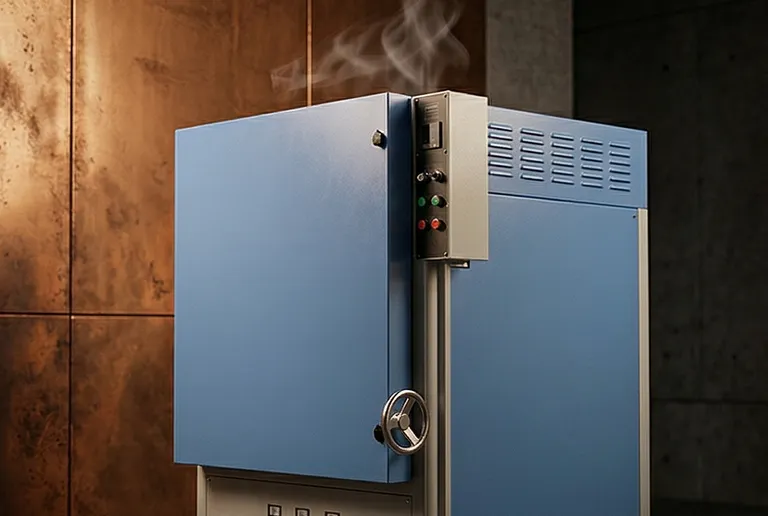
Why is HT-LiCoO2 so sensitive to heating speed? The answer lies in the decomposition of chelating agents, such as polyacrylic acid, used during the precursor stage.

As the temperature rises, these agents must decompose and exit the material. If the heating rate is too high—exceeding the recommended 5°C per minute—the combustion of these agents releases energy and gases (CO and CO2) so violently that the internal pressure causes the precursor to expand.

To achieve high crystallinity, the material requires a "gentle" decomposition. A slow, precise ramp rate ensures:

  1. Controlled Gas Release: CO and CO2 can diffuse out of the material pores without causing structural collapse.
  2. Uniform Phase Transformation: Whether it is the dehydration of gallium oxide hydroxide into alpha-Ga2O3 or the oxidation of LiMnO2, the transition happens at the molecular level across the entire sample simultaneously.
  3. Physical Integrity: Slow heating prevents the "coarsening" of SnO2 grains or the collapse of micropores, maintaining the high surface area necessary for battery performance.

Without a furnace capable of maintaining an exact, repeatable heating curve, you aren't conducting science—you are gambling with your results.

Precision Control: The Foundation of Reliable Synthesis
The Hidden Saboteur in Your HT-LiCoO2 Synthesis: Why Precise Ramp Rates Can Make or Break Your Battery Materials 2

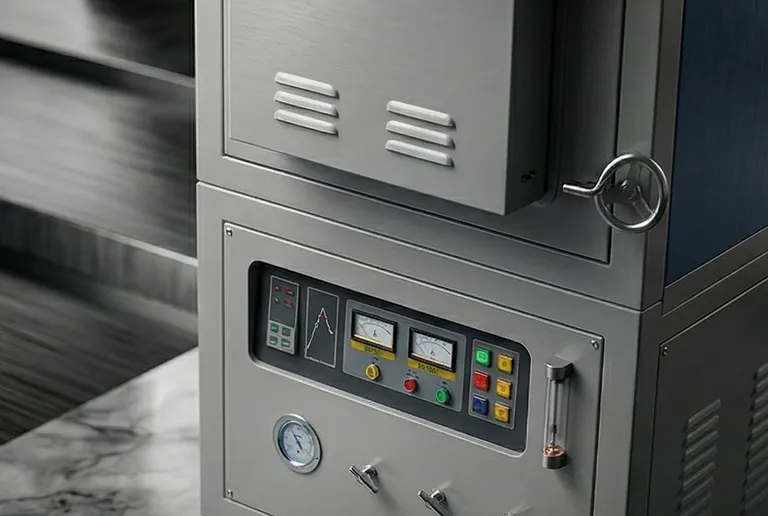
To solve the problem of structural collapse, you need a tool designed for the nuances of thermal kinetics. A KINTEK high-temperature furnace is not simply a heat source; it is a precision instrument engineered to govern the entire thermal environment.

Our furnaces address the root cause of synthesis failure through:

  • Microprocessor-Based Programming: Precisely dial in a 5°C/min (or slower) ramp rate to manage gas evolution without the "overshoot" common in lower-quality equipment.
  • Thermal Uniformity: High-density insulation and optimized heating element placement ensure that every gram of your precursor experiences the exact same temperature, preventing localized "hot spots" that cause uneven decomposition.
  • Atmosphere Integrity: Many precursors, such as Li22Sn5 alloys or SnO2-based electrodes, require inert argon or vacuum environments to prevent unwanted oxidation. KINTEK’s atmosphere-controlled tube and vacuum furnaces maintain these environments with strict stability.

Beyond the Fix: Accelerating Next-Generation Materials
The Hidden Saboteur in Your HT-LiCoO2 Synthesis: Why Precise Ramp Rates Can Make or Break Your Battery Materials 3

When you eliminate the variable of "unreliable heat," you unlock the ability to push the boundaries of material science.

With precise control over the heating rate and isothermal stability, your laboratory can move from "troubleshooting failures" to "optimizing performance." You can achieve the perfect single-phase alpha region for Ti-Al alloys or ensure the high dispersion of iron species across carbon carriers with total confidence.

Consistent results mean faster R&D cycles, higher product quality for battery applications, and a clear path from laboratory-scale synthesis to industrial production.

Whether you are working on HT-LiCoO2 precursors or complex alloy heat treatments, your furnace should be your most reliable partner, not your biggest variable. Our team of experts understands the delicate physics of thermal processing and can help you select or customize a furnace system that guarantees the integrity of your materials.

Contact Our Experts today to discuss your specific temperature control requirements and take the guesswork out of your next synthesis.

Related Products

Related Articles

Related Products

1400℃ High Temperature Laboratory Tube Furnace with Alumina Tube

1400℃ High Temperature Laboratory Tube Furnace with Alumina Tube

KINTEK's Tube Furnace with Alumina Tube: Precision high-temperature processing up to 2000°C for labs. Ideal for material synthesis, CVD, and sintering. Customizable options available.

1700℃ High Temperature Laboratory Tube Furnace with Alumina Tube

1700℃ High Temperature Laboratory Tube Furnace with Alumina Tube

KINTEK's Tube Furnace with Alumina Tube: Precision heating up to 1700°C for material synthesis, CVD, and sintering. Compact, customizable, and vacuum-ready. Explore now!

1800℃ High Temperature Muffle Oven Furnace for Laboratory

1800℃ High Temperature Muffle Oven Furnace for Laboratory

KINTEK Muffle Furnaces: Precision 1800°C heating for labs. Energy-efficient, customizable, with PID control. Ideal for sintering, annealing, and research.

1700℃ High Temperature Muffle Oven Furnace for Laboratory

1700℃ High Temperature Muffle Oven Furnace for Laboratory

KT-17M Muffle Furnace: High-precision 1700°C lab furnace with PID control, energy efficiency, and customizable sizes for industrial & research applications.

1200℃ Muffle Oven Furnace for Laboratory

1200℃ Muffle Oven Furnace for Laboratory

KINTEK KT-12M Muffle Furnace: Precision 1200°C heating with PID control. Ideal for labs needing rapid, uniform heat. Explore models & customization options.

1700℃ Controlled Inert Nitrogen Atmosphere Furnace

1700℃ Controlled Inert Nitrogen Atmosphere Furnace

KT-17A Controlled Atmosphere Furnace: Precise 1700°C heating with vacuum & gas control. Ideal for sintering, research & material processing. Explore now!

High Temperature Muffle Oven Furnace for Laboratory Debinding and Pre Sintering

High Temperature Muffle Oven Furnace for Laboratory Debinding and Pre Sintering

KT-MD Debinding & Pre-Sintering Furnace for ceramics - precise temperature control, energy-efficient design, customizable sizes. Boost your lab efficiency today!

2200 ℃ Tungsten Vacuum Heat Treat and Sintering Furnace

2200 ℃ Tungsten Vacuum Heat Treat and Sintering Furnace

2200°C Tungsten Vacuum Furnace for high-temperature materials processing. Precise control, superior vacuum, customizable solutions. Ideal for research & industrial applications.

1400℃ Muffle Oven Furnace for Laboratory

1400℃ Muffle Oven Furnace for Laboratory

KT-14M Muffle Furnace: Precision 1400°C heating with SiC elements, PID control, and energy-efficient design. Ideal for labs.

2200 ℃ Graphite Vacuum Heat Treat Furnace

2200 ℃ Graphite Vacuum Heat Treat Furnace

2200℃ Graphite Vacuum Furnace for high-temperature sintering. Precise PID control, 6*10⁻³Pa vacuum, durable graphite heating. Ideal for research & production.

Laboratory Muffle Oven Furnace with Bottom Lifting

Laboratory Muffle Oven Furnace with Bottom Lifting

Boost lab efficiency with KT-BL Bottom Lifting Furnace: precise 1600℃ control, superior uniformity, and enhanced productivity for material science and R&D.

1200℃ Split Tube Furnace Laboratory Quartz Tube Furnace with Quartz Tube

1200℃ Split Tube Furnace Laboratory Quartz Tube Furnace with Quartz Tube

Discover KINTEK's 1200℃ Split Tube Furnace with quartz tube for precise high-temperature lab applications. Customizable, durable, and efficient. Get yours now!

Vertical Laboratory Quartz Tube Furnace Tubular Furnace

Vertical Laboratory Quartz Tube Furnace Tubular Furnace

Precision KINTEK Vertical Tube Furnace: 1800℃ heating, PID control, customizable for labs. Ideal for CVD, crystal growth & materials testing.

Vacuum Heat Treat Sintering Furnace Molybdenum Wire Vacuum Sintering Furnace

Vacuum Heat Treat Sintering Furnace Molybdenum Wire Vacuum Sintering Furnace

KINTEK's Vacuum Molybdenum Wire Sintering Furnace excels in high-temperature, high-vacuum processes for sintering, annealing, and material research. Achieve precise 1700°C heating with uniform results. Custom solutions available.

High Pressure Laboratory Vacuum Tube Furnace Quartz Tubular Furnace

High Pressure Laboratory Vacuum Tube Furnace Quartz Tubular Furnace

KINTEK High Pressure Tube Furnace: Precision heating up to 1100°C with 15Mpa pressure control. Ideal for sintering, crystal growth, and lab research. Customizable solutions available.

1200℃ Controlled Inert Nitrogen Atmosphere Furnace

1200℃ Controlled Inert Nitrogen Atmosphere Furnace

KINTEK 1200℃ Controlled Atmosphere Furnace: Precision heating with gas control for labs. Ideal for sintering, annealing, and material research. Customizable sizes available.

9MPa Air Pressure Vacuum Heat Treat and Sintering Furnace

9MPa Air Pressure Vacuum Heat Treat and Sintering Furnace

Achieve superior ceramic densification with KINTEK's advanced air pressure sintering furnace. High-pressure up to 9MPa, precise 2200℃ control.

600T Vacuum Induction Hot Press Vacuum Heat Treat and Sintering Furnace

600T Vacuum Induction Hot Press Vacuum Heat Treat and Sintering Furnace

600T Vacuum Induction Hot Press Furnace for precise sintering. Advanced 600T pressure, 2200°C heating, vacuum/atmosphere control. Ideal for research & production.

Vacuum Hot Press Furnace Machine Heated Vacuum Press Tube Furnace

Vacuum Hot Press Furnace Machine Heated Vacuum Press Tube Furnace

Discover KINTEK's advanced Vacuum Tube Hot Press Furnace for precise high-temperature sintering, hot pressing, and material bonding. Customizable solutions for labs.

Vacuum Hot Press Furnace Machine Heated Vacuum Press

Vacuum Hot Press Furnace Machine Heated Vacuum Press

KINTEK Vacuum Hot Pressing Furnace: Precision heating & pressing for superior material density. Customizable up to 2800°C, ideal for metals, ceramics, and composites. Explore advanced features now!


Leave Your Message



















