Why Do Perfect Recipes Produce Flawed Glass?
Imagine you have followed every protocol to the letter. You have sourced the highest-purity germanium, selenium, tellurium, and indium. You have meticulously cleaned your quartz ampoules and achieved a perfect vacuum seal. You set your furnace to 800 °C and wait the required 12 hours.
Yet, when the glass is quenched and analyzed, the results are disheartening. The composition isn't uniform. The subsequent thin-film fabrication fails because the material properties vary from one millimeter to the next. You adjust the chemical ratios, you extend the heating time, but the "ghost in the machine" remains—your data is as unpredictable as a roller coaster.
If this sounds familiar, the problem likely isn't your chemistry. It is the invisible thermal "breathing" of your furnace.
The Common Struggle: Chasing Shadows in the Lab
When glass synthesis fails, many researchers instinctively look at their raw materials or their cleaning processes. They might attempt to "fix" the issue by:
- Slightly overshooting the temperature to ensure a "complete" melt.
- Extending the dwell time by several hours, hoping for better homogenization.
- Frequent recalibration of external thermocouples.
While these steps seem logical, they often fail to address the underlying issue. In the world of high-tech glass and semiconductor materials, "close enough" is never enough. Inconsistent thermal environments lead to micro-segregation in the melt. The commercial consequences are severe: expensive raw materials are wasted, project timelines slip by weeks, and the resulting glass lacks the structural density required for high-performance applications.
The Science of the "Thermal Field"
The synthesis of complex chalcogenide glasses like Ge-Se-Te-In isn't just about heat; it’s about thermal equilibrium.
Inside a vacuum-sealed quartz ampoule, these high-purity elements must undergo a precise solid-phase reaction followed by a transition into a completely homogeneous liquid state. If a muffle furnace fluctuates by even a few degrees during the critical 12-hour reaction period, it creates a "shimmering" thermal field.
Standard furnaces often suffer from "temperature cycling"—they turn on and off to maintain a set point, causing the temperature to wave up and down. This prevents the atoms of Germanium and Tellurium from distributing evenly throughout the Selenium-Indium matrix. Furthermore, without a high-precision "constant temperature zone," the top of your ampoule might be at 802 °C while the bottom is at 795 °C. This tiny gradient is enough to cause compositional drifting, ensuring your final glass is a cocktail of different phases rather than a single, uniform material.
The Precision Advantage: Engineering the Solution
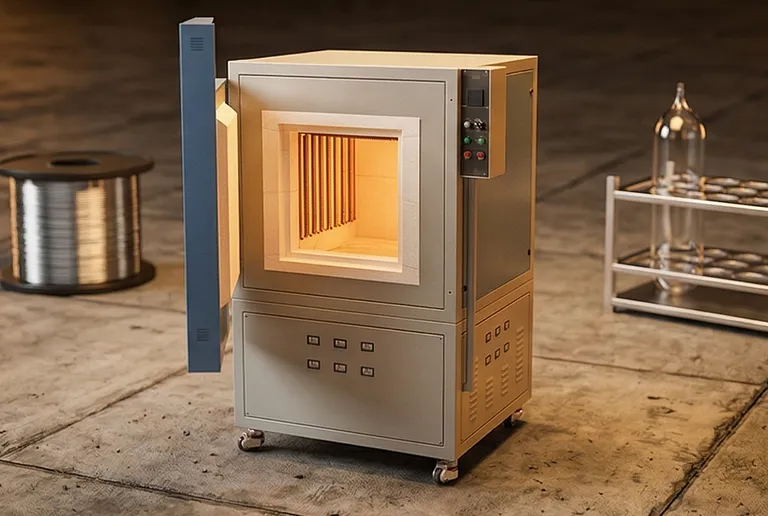
To solve this, a muffle furnace must be more than just a heating box; it must be a precision instrument designed for microstructural stability. This is where KINTEK’s high-precision muffle furnaces change the narrative.
Our furnaces are engineered to solve the "thermal field" problem through three specific mechanisms:
- Multi-Stage Programmable Logic: Instead of a simple "on/off" heat, our systems use advanced PID controllers to provide smooth, multi-stage heating. This allows for the complete decomposition of volatiles and the escape of internal stresses before reaching the peak melt temperature.
- Exceptional Uniformity: By optimizing the heating element placement and insulation, we create an ultra-stable constant temperature zone. Whether your ampoule is in the center or slightly offset, it experiences the exact same thermal environment.
- Long-Term Reliability: Our furnaces are built to maintain 800 °C (or up to 1500 °C for silicate-based glasses) for 12, 24, or 48 hours without a flicker of deviation.
By stabilizing the environment, the furnace allows the chemical laws of diffusion to work perfectly, ensuring that every batch of Ge-Se-Te-In glass is identical to the last.
Unlocking New Possibilities in Material Science
When you eliminate thermal instability, you stop troubleshooting your equipment and start advancing your science.
With a stable, high-precision thermal environment, researchers can move beyond basic synthesis. You can begin exploring more complex high-entropy alloys, develop thinner and more resilient infrared-transmitting films, or accelerate the production of high-performance phosphate glass powders. When the "thermal variable" is removed from the equation, your yield increases, your costs drop, and your path from the laboratory to industrial application becomes clear and predictable.
At KINTEK, we don't just provide heat; we provide the control necessary to master material transformation. Whether you are dealing with chalcogenide glasses, ceramic pre-calcination, or the incineration of contaminated waste, our team is ready to help you engineer a solution that addresses your most complex thermal challenges. Contact Our Experts today to discuss how we can tailor a high-precision furnace to your unique project requirements.
Related Products
- 1700℃ High Temperature Muffle Oven Furnace for Laboratory
- 1800℃ High Temperature Muffle Oven Furnace for Laboratory
- 1400℃ Muffle Oven Furnace for Laboratory
- High Temperature Muffle Oven Furnace for Laboratory Debinding and Pre Sintering
- 1200℃ Muffle Oven Furnace for Laboratory
Related Articles
- Why High-Purity Gas Fails Your High-Temp Brazing—And How Mono-Silane Doping Fixes It
- Why Your High-Temperature Experiments Fail: The Hidden Flaw in Your Furnace
- The Hidden Saboteur in Your HT-LiCoO2 Synthesis: Why Precise Ramp Rates Can Make or Break Your Battery Materials
- Beyond the Alarm: The Hidden Safety Risks in Your High-Temperature Furnace
- Your Furnace Meets Spec, So Why Are Your Results Inconsistent?



















