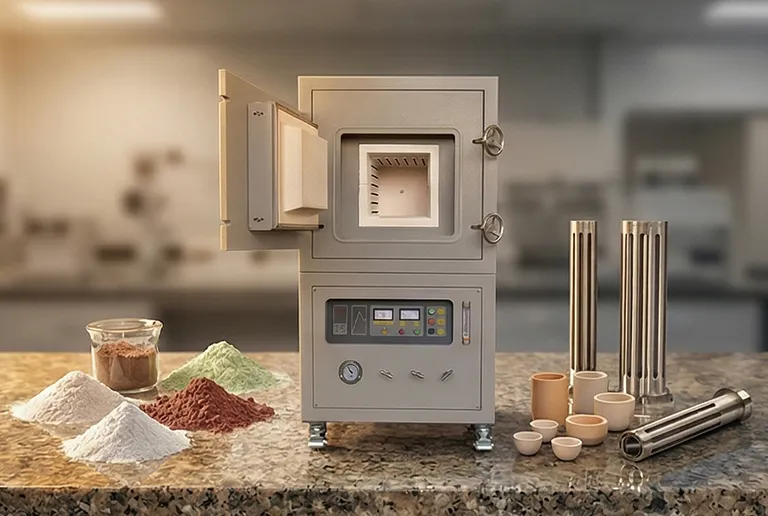
The Invisible Flaw in the Perfect Sintering Cycle
You have perfected your sintering schedule, calibrated your high-pressure hot press, and meticulously weighed your high-purity nanopowders. Yet, when the furnace door opens, the result is disheartening: inconsistent transparency in your Ce:YAG ceramics, micro-cracks in your BaTiO3 targets, or interfacial failures in your composites.
For many researchers and manufacturers, the instinct is to "fix it in the final sinter"—to tweak the peak temperature or extend the soaking time. However, the root of the problem often lies hours before the final sintering cycle even begins. The failure is not in how you are finishing the material, but in how you prepared the "ingredients."
The Trap of Premature Synthesis
The most common struggle in advanced ceramic production is the unpredictability of raw materials. Even at 99.9% purity, nanopowders like alumina ($Al_2O_3$) and yttria ($Y_2O_3$) are often chemically "restless." They contain metastable phases and volatile impurities—remnants of their own manufacturing process—that act as wildcards during solid-state reactions.
When these untreated powders are fired directly, they undergo unpredictable volume changes and chemical shifts at the same time they are supposed to be densifying. This leads to:
- Dimensional Instability: Uncontrolled shrinkage that causes warping.
- Chemical Heterogeneity: "Hot spots" of reactivity that prevent a uniform ceramic phase.
- Outgassing: Trapped volatile impurities (like nitrates or sizing agents) that create internal porosity, ruining the mechanical and optical integrity of the final product.
The cost is more than just a ruined sample; it is weeks of lost R&D time and the prohibitive expense of wasted high-purity precursors.
The Science of Stability: Why Pre-Calcination is Non-Negotiable
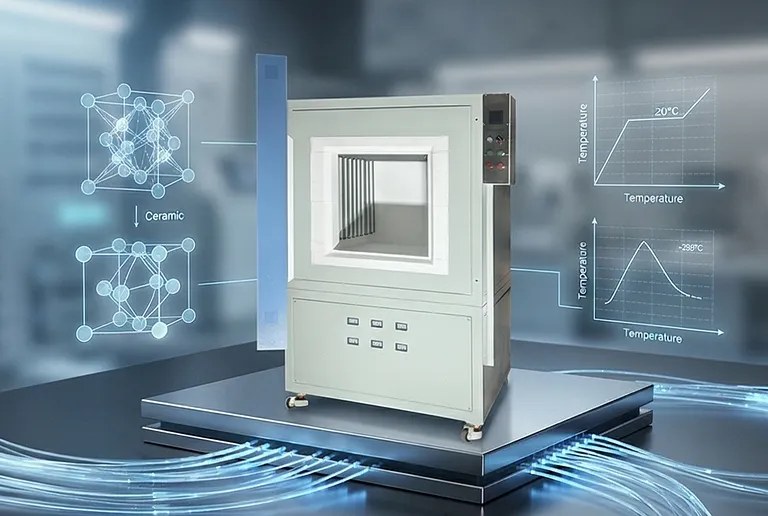
To understand why these failures happen, we must look at the underlying material science. In the synthesis of Ce:YAG (Cerium-doped Yttrium Aluminum Garnet) ceramics, for example, the goal is a perfectly ordered crystal structure. However, raw alumina and yttria nanopowders often exist in metastable states that are highly reactive and unstable.
The solution is a transition phase known as High-Temperature Calcination or Annealing. By subjecting these powders to a stable environment between 900°C and 1200°C in a muffle furnace, we achieve three critical objectives:
- Phase Stabilization: We "reset" the powders, eliminating metastable phases and ensuring they enter the solid-state reaction with predictable reactivity.
- Impurity Removal: Volatile nitrates and carbon residues are thermally decomposed and evacuated, leaving behind a "clean" chemical foundation.
- Controlled Bonding: In cases like BaTiO3, this pre-calcination facilitates a preliminary solid-phase reaction, forming the initial ceramic phase (barium titanate) before the final molding ever takes place.
Without this stabilization, you aren't engineering a ceramic; you are officiating a chaotic chemical race where the finish line is a failed part.
Precision Engineered for Pretreatment: The KINTEK Solution
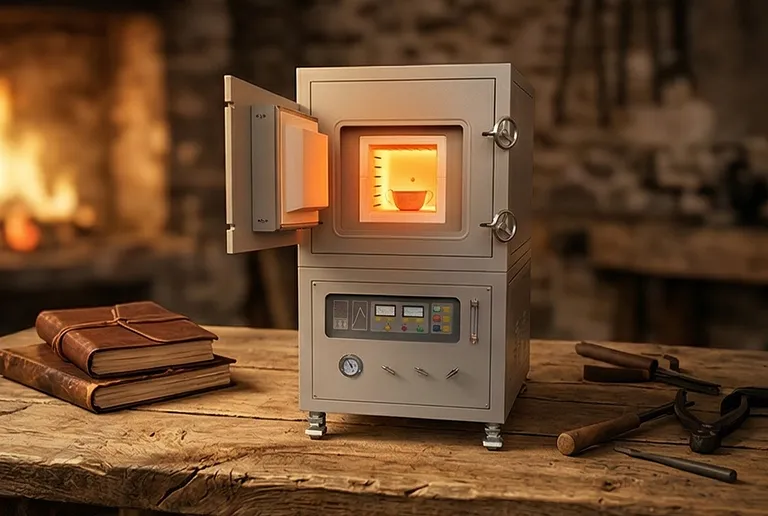
If the "diagnosis" is the need for thermal stability, the "prescription" is an industrial-grade muffle furnace designed for precision at these critical intermediate temperatures. This is where Silicon Carbide (SiC) heating elements become the unsung heroes of the laboratory.
At KINTEK, our muffle furnaces are engineered to leverage the unique properties of SiC elements. While these elements can reach surface temperatures of up to 1600°C, they are exceptionally effective in the 900°C to 1550°C range required for ceramic pretreatment. Here is why this configuration is the ideal tool for the job:
- Uniform Thermal Zones: SiC elements are wired in parallel to account for their aging characteristics, ensuring that your Alumina or Yttria powders receive a uniform thermal "soak" without cold spots.
- High-Temperature Versatility: Whether you are de-sizing SiC fibers at a gentle 400°C or pre-calcining BaTiO3 at 1000°C, the furnace provides the stable atmospheric environment needed to induce crystal transformation without premature densification.
- Durability and Cleanliness: Our furnaces are designed to mitigate the contamination risks associated with SiC aging, providing a clean environment essential for the synthesis of sensitive compounds like phosphorus-containing supports or optical ceramics.
Beyond the Fix: Unlocking New Material Potential
When you resolve the "hidden" problem of raw material instability, your production process shifts from defensive troubleshooting to proactive innovation. By mastering the pretreatment stage with a KINTEK furnace, you unlock capabilities that were previously out of reach:
- Sub-Micron Control: Achieve higher transparency and superior optical properties in Ce:YAG by ensuring the chemical foundation is 100% stable.
- Increased Production Speed: Reliable pre-calcined powders allow for more aggressive final sintering schedules with lower risk of failure.
- Superior Interfacial Bonding: In metal-matrix composites, effective de-sizing of fibers leads to significantly higher mechanical strength and durability.
The difference between a "good" ceramic and a "world-class" material often comes down to what happened in the furnace at 1000°C the day before the final sintering.
Ready to move beyond inconsistent results and achieve absolute thermal control? Our technical team specializes in matching the right furnace configuration to your specific material challenges—from Ce:YAG synthesis to complex composite pretreatment. Let us help you build the foundation for your next material breakthrough.
Contact Our Experts to discuss your unique project requirements and discover how our customizable high-temperature solutions can transform your lab's output.
Related Products
- 1400℃ Muffle Oven Furnace for Laboratory
- 1700℃ High Temperature Muffle Oven Furnace for Laboratory
- 1800℃ High Temperature Muffle Oven Furnace for Laboratory
- 1200℃ Muffle Oven Furnace for Laboratory
- High Temperature Muffle Oven Furnace for Laboratory Debinding and Pre Sintering
Related Articles
- Why Your Muffle Furnace Might Be Masking Your Alloy Kinetics—And How to Fix It
- The Hidden Saboteur in Your HT-LiCoO2 Synthesis: Why Precise Ramp Rates Can Make or Break Your Battery Materials
- Why High-Purity Gas Fails Your High-Temp Brazing—And How Mono-Silane Doping Fixes It
- Why Your High-Temperature Experiments Fail: The Hidden Flaw in Your Furnace
- Why Your High-Temperature Experiments Fail—And How to Fix Them for Good



















