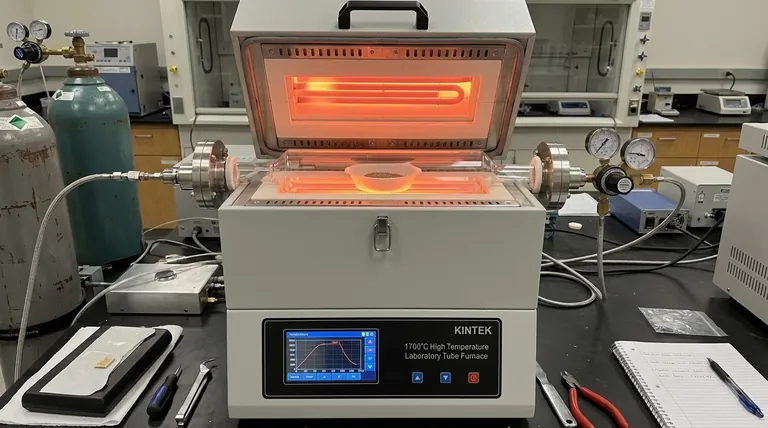
The Unseen Battle Inside the Tube
Imagine a materials scientist synthesizing a new perovskite solar cell. The process requires heating precursor materials to over 800°C in a perfectly inert atmosphere. Even a few stray molecules of oxygen—invisible and abundant in our air—could contaminate the crystal lattice, rendering the entire batch useless.
This isn't just heating. It's a carefully orchestrated battle at the molecular level. The arena for this battle is the tube furnace.
A tube furnace is more than an oven; it is a self-contained universe where the laws of physics and chemistry can be precisely dictated. And its dimensions, like the 70mm diameter, are not arbitrary. They represent a deliberate, thoughtful choice about the scale of ambition.
The Physics of Perfection: Deconstructing Control
The value of a tube furnace is measured in control. It isolates a sample from the chaotic world and subjects it to conditions of extreme order. The "70mm" simply defines the size of that ordered universe.
The Tyranny of the Uniform Hot Zone
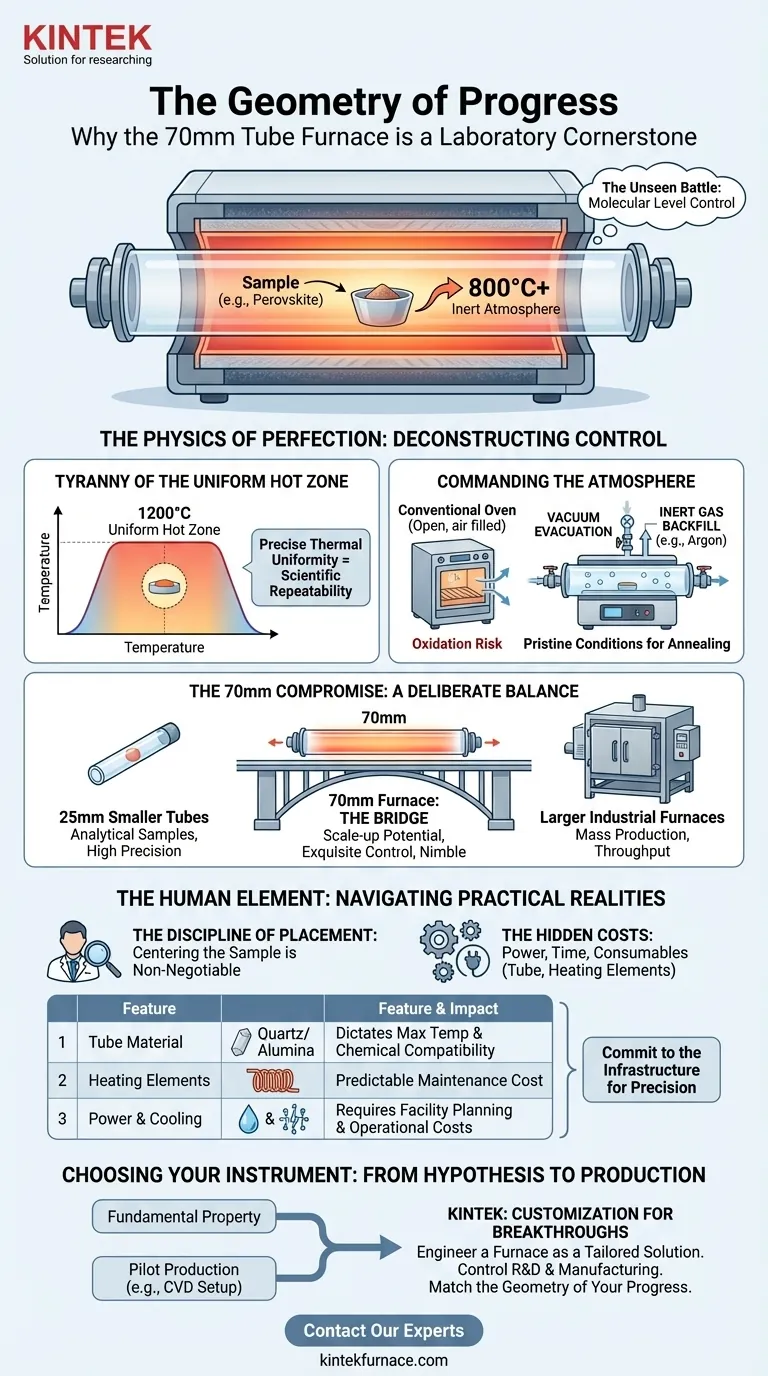
At the heart of the furnace is the "hot zone"—a central region engineered for near-perfect thermal uniformity. Outside this zone, temperatures naturally drop.
This isn't a design flaw; it's a law of thermodynamics. But inside that zone, a modern controller can hold a temperature of 1200°C with breathtaking stability. This uniformity is the bedrock of scientific repeatability. Without it, an experiment is just an anecdote. With it, you can build a discovery.
Commanding the Atmosphere: From Vacuum to Noble Gas
A conventional oven constantly floods your sample with reactive air. A sealed tube furnace does the opposite. It allows you to evacuate the chamber, pulling a vacuum to remove contaminants, and then backfill it with a specific gas.
This capability is the difference between alchemy and modern materials science. By introducing an inert gas like argon, you can perform processes like annealing without the risk of oxidation. You create a pristine environment where your reaction can proceed exactly as intended.
The 70mm Compromise: A Deliberate Balance
The 70mm inner diameter is a critical specification that represents a strategic trade-off.
- Smaller tubes (e.g., 25mm) are perfect for tiny, purely analytical samples where material cost is high and precision is everything.
- Larger industrial furnaces are built for mass production, sacrificing some granular control for immense throughput.
The 70mm furnace is the bridge. It’s the space where a laboratory discovery proves it has the potential to scale. It’s large enough to process substantial samples or run pilot production batches, yet small and nimble enough to maintain exquisite control without the massive power and infrastructure costs of a full-scale factory.
The Human Element: Navigating Practical Realities
A furnace is a powerful instrument, but its success depends on the partnership between the operator and the machine. Understanding its physical realities is key to mastering it.
The Discipline of Placement
Because the uniform hot zone is finite, the researcher must develop the discipline of precise sample placement. Centering the crucible or substrate in that zone, every single time, is a non-negotiable part of the process. It's a reminder that even in highly automated science, human skill and attention remain critical.
The Hidden Costs of Power and Time
High-temperature furnaces are power-hungry. They require careful facility planning, and their consumables—the process tubes and heating elements—are part of the total cost of ownership.
| Feature | Consideration | Impact on Research |
|---|---|---|
| Tube Material | Quartz (to ~1200°C) or Alumina (to ~1700°C). Quartz is clear but more fragile. | Dictates the maximum operating temperature and chemical compatibility. |
| Heating Elements | Have a finite lifespan; replacement is a predictable maintenance cost. | Factoring this in prevents unexpected downtime. |
| Power & Cooling | High-temp models need specialized circuits and often water cooling. | Requires upfront facility planning and impacts operational costs. |
Viewing these not as burdens but as part of the system's ecosystem is a psychological shift. You don’t just buy the furnace; you commit to the infrastructure that enables its precision.
Choosing Your Instrument: From Hypothesis to Production
The furnace you choose is a reflection of your scientific goals. Are you exploring a fundamental property of a new material, or are you trying to produce enough of it to build a working prototype?
For a team moving from theoretical models to pilot production, a standard furnace often falls short. Their process might require unique temperature ramps, specific gas flow rates, or integration with other systems like in a CVD setup. The instrument must adapt to the science, not the other way around.
This is where the ability to customize—a core principle at KINTEK—becomes the difference between a stalled project and a breakthrough. Our expertise in Muffle, Tube, Vacuum, and CVD systems allows us to engineer a furnace that isn't just a product, but a tailored solution. By controlling our own R&D and manufacturing, we can build a 70mm tube furnace that perfectly matches the geometry of your progress.
The right tool doesn't just perform a task; it expands what's possible. To build a system precisely matched to your unique research goals, you need a partner with deep engineering expertise. Contact Our Experts
Visual Guide
Related Products
- Vertical Laboratory Quartz Tube Furnace Tubular Furnace
- Vacuum Sealed Continuous Working Rotary Tube Furnace Rotating Tube Furnace
- Split Multi Heating Zone Rotary Tube Furnace Rotating Tube Furnace
- High Pressure Laboratory Vacuum Tube Furnace
- Magnesium Extraction and Purification Condensing Tube Furnace
Related Articles
- Mastering the Micro-Environment: The Art and Science of the Laboratory Tube Furnace
- Beyond Heat: Mastering the Controlled Universe Inside a Tube Furnace
- Mastering the Void: How Tube Furnaces Forge the Atoms of Innovation
- Why Your Crystal Growth Experiments Are Failing: The Hidden Culprit in Your Tube Furnace
- Clarity Under Fire: The Psychological Case for Quartz Tube Furnaces



















