The Illusion of Emptiness
Imagine a workshop floor. A batch of freshly machined steel parts, representing days of work, is ready for heat treatment. The greatest risk isn't the heat itself, but the invisible air surrounding them. At high temperatures, oxygen becomes an aggressive adversary, capable of turning a precision component into a scaled, unusable piece of metal.
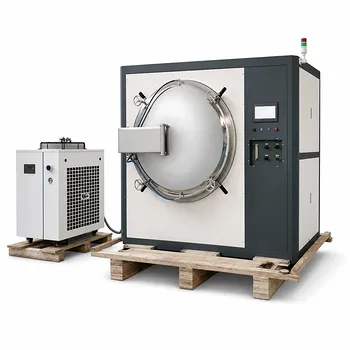
The solution is often a "low vacuum atmosphere furnace." But this name creates a psychological trap.
The word "vacuum" evokes images of the void of space—of absolute emptiness. We instinctively assume the goal is to remove everything. This is a fundamental misunderstanding. For these furnaces, the vacuum is not the destination; it is merely the vehicle.
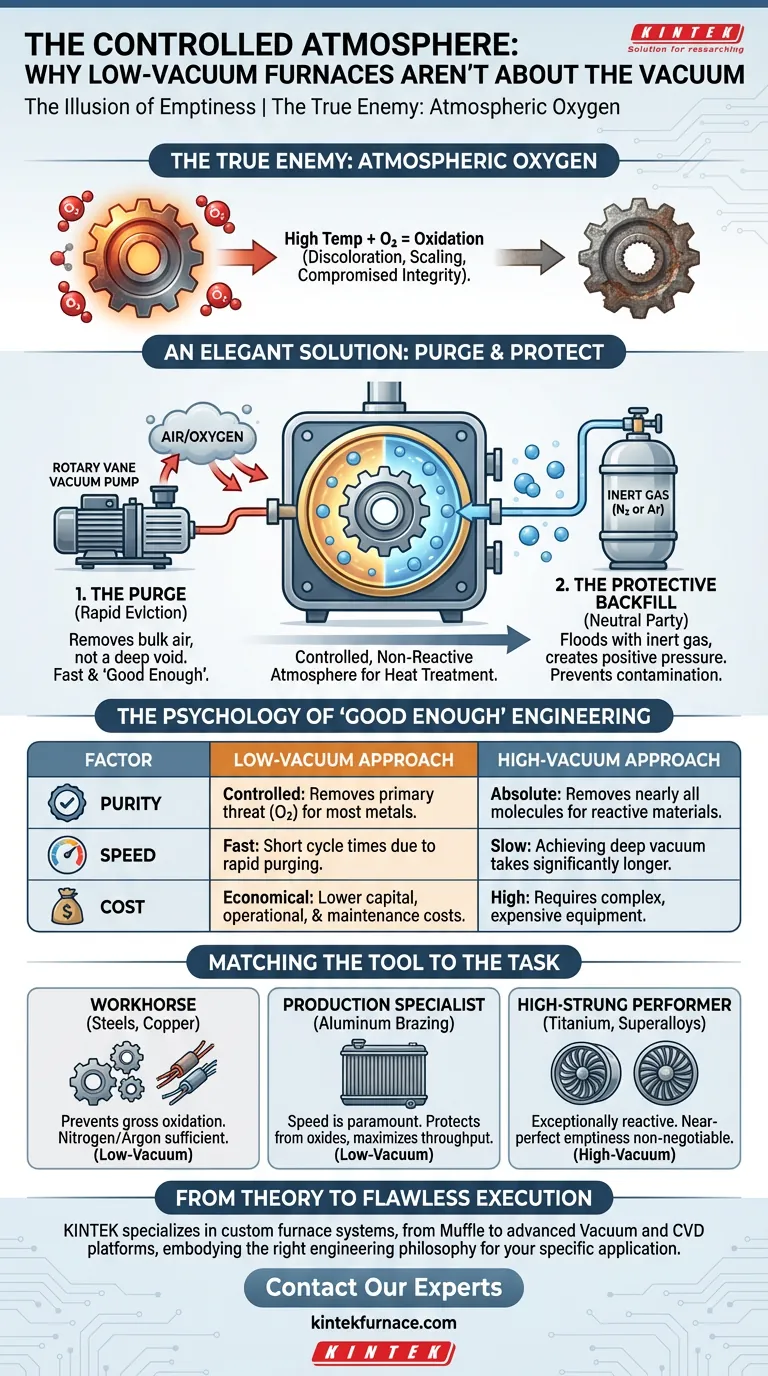
The True Enemy: Atmospheric Oxygen
At room temperature, the air is benign. But when you heat a metal, you’re not just changing its physical properties; you're dramatically increasing its chemical reactivity.
The 21% oxygen in our atmosphere, essential for life, becomes a corrosive agent. It bonds with the metal's surface, forming oxides. This process, oxidation, leads to discoloration, scaling, and a compromised surface finish that can ruin a material's structural integrity.
The core challenge of heat treatment isn't just about applying heat uniformly. It's about creating a chemically safe space for the material to undergo its transformation.
An Elegant Solution: Purge and Protect
Instead of trying to achieve a perfect, and costly, vacuum, the low-vacuum furnace employs a brilliant two-step strategy. It's a pragmatic dance of removal and replacement.
Step 1: The Purge
A mechanical vacuum pump, typically a robust rotary vane pump, engages. Its job isn't to create a deep void but to perform a rapid eviction, quickly removing the vast majority of the air—and with it, the oxygen. This pump-down is fast precisely because it doesn't need to be perfect. It just needs to be good enough.
Step 2: The Protective Backfill
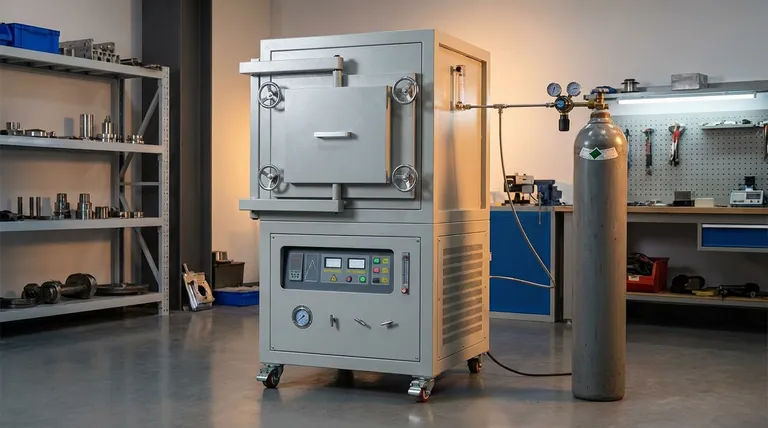
Once the chamber is purged, the vacuum pump's job is done. The system then introduces a neutral party: an inert gas, most commonly nitrogen or argon. This gas floods the chamber, bringing it back to a slight positive pressure.
This controlled, non-reactive atmosphere is where the real work of heat treatment happens. The positive pressure acts as a final security measure, ensuring that no outside air can leak in and contaminate the process.
The Psychology of 'Good Enough' Engineering
Choosing a low-vacuum atmosphere furnace isn't a compromise; it's a strategic decision rooted in understanding the principle of diminishing returns. It represents a philosophy where the goal is not absolute perfection, but optimal efficiency for a specific task.
This approach balances three critical factors:
| Factor | Low-Vacuum Atmosphere Furnace Approach | High-Vacuum Furnace Approach |
|---|---|---|
| Purity | Controlled: Removes the primary threat (oxygen) for most metals. | Absolute: Removes nearly all molecules for reactive materials. |
| Speed | Fast: Cycle times are short due to rapid purging. | Slow: Achieving a deep vacuum takes significantly more time. |
| Cost | Economical: Lower capital, operational, and maintenance costs. | High: Requires more complex, expensive equipment. |
The low-vacuum system isn't a "lesser" high-vacuum furnace. It is a different tool, designed for a different, and often more common, set of problems.
Matching the Tool to the Task
This understanding is crucial for applying the technology correctly. The choice depends entirely on the material's sensitivity.
-
The Workhorse (e.g., Steels, Copper): For most common metals, the primary goal is simply to prevent gross oxidation. The nitrogen or argon atmosphere in a low-vacuum system is more than sufficient, providing robust protection with the speed needed for production.
-
The Production Specialist (e.g., Aluminum Brazing): In high-volume applications like automotive brazing, speed is paramount. A low-vacuum purge and backfill cycle provides the necessary protection from oxides while maximizing throughput.
-
The High-Strung Performer (e.g., Titanium, Superalloys): These materials are exceptionally reactive. Even trace amounts of residual oxygen or nitrogen can cause embrittlement and catastrophic failure. For them, the near-perfect emptiness of a high-vacuum furnace is non-negotiable.
From Theory to Flawless Execution
Making the right choice is about more than just reading a spec sheet; it's about understanding the deep chemical and operational needs of your process. You need a system built not just for a temperature, but for a material and a workflow.
This is where expert design and manufacturing become critical. At KINTEK, we specialize in building furnace systems—from Muffle and Tube to advanced Vacuum and CVD platforms—that embody the right engineering philosophy for your specific application. Our deep customization capability ensures that the system you get is perfectly matched to your materials, whether you need the pragmatic efficiency of a controlled atmosphere or the absolute purity of a high vacuum.
For a system tailored not just to your materials, but to your operational philosophy, Contact Our Experts.
Visual Guide
Related Products
- Small Vacuum Heat Treat and Tungsten Wire Sintering Furnace
- Vacuum Heat Treat Sintering Furnace with Pressure for Vacuum Sintering
- Vacuum Heat Treat Sintering Furnace Molybdenum Wire Vacuum Sintering Furnace
- 2200 ℃ Graphite Vacuum Heat Treat Furnace
- 600T Vacuum Induction Hot Press Vacuum Heat Treat and Sintering Furnace
Related Articles
- Why Your Stainless Steel Parts Fail Pressure Tests—and How Vacuum Sintering Fixes the Density Gap
- Why Your Electrochromic Electrodes Fail During Sintering—And How Vacuum Control Restores Transparency
- Why Your Sintered Parts Fail: It’s Not Just About Heat, But Pressure and Purity
- Beyond the Program: Why Your Sintering Fails and How to Guarantee Uniformity
- Why Your 3D-Printed Maraging Steel Parts Aren't Performing—And How to Fix the Structural Weakness