The Unseen Battle Inside the Furnace
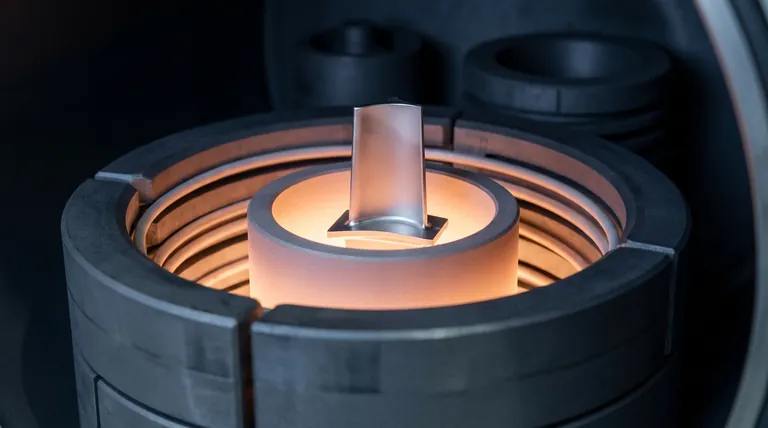
Imagine a flawless aerospace turbine blade, heat-treated to perfection. Hours later, under stress testing, a microscopic fracture appears. The cause? Not a flaw in the design, but a single, unwanted atom—a chemical stowaway from the furnace itself.
We obsess over temperature curves and vacuum pressures, the visible dials of thermal processing. Yet, the most critical battle inside a high-temperature furnace is often invisible. It's a silent, chemical war against contamination, where the very components of the furnace can become the enemy.
In this environment, graphite isn't just a structural material. It's the silent guardian, a neutral referee whose primary job is to do nothing at all. Its value comes not from what it does, but from what it doesn't do.
The Virtue of Doing Nothing
The psychological appeal of an active solution is strong, but in high-purity manufacturing, the greatest virtue is often passivity. Graphite's chemical stability is the foundation of predictable, repeatable results.
A Wall Against Contamination
The most direct benefit of graphite is its refusal to "leach" atoms or form unwanted compounds on a workpiece. For a medical implant or a semiconductor wafer, where purity is measured in parts-per-million, this chemical aloofness is non-negotiable. It ensures the material you put into the furnace is the same material you take out, only stronger.
Ignoring the Background Noise
No vacuum is perfect. Trace molecules of oxygen, nitrogen, and water vapor are the constant background noise of the system. While many metals would frantically react—oxidizing or forming nitrides—graphite remains stable, ignoring these residual gases.
This prevents the furnace components from degrading and, more importantly, from releasing their own reaction byproducts, which would poison the pristine vacuum environment.
The Non-Stick Rule of Molten Metals
In processes like brazing or casting, graphite demonstrates another powerful form of inaction. It resists dissolving into most molten metals or forming low-melting-point alloys. This prevents expensive fixtures from welding themselves to the parts, ensuring a clean release and dramatically extending the life of the furnace's tooling.
The Rules of Engagement: When the Guardian Acts
To master a material, an engineer must understand its rules. Graphite is overwhelmingly inert, but it's not universally so. Its few reactions are not weaknesses, but hard-and-fast rules that govern the entire process design.
The Achilles' Heel: Oxygen
Graphite’s primary vulnerability is oxygen. Above 450°C (842°F), it will react with oxygen and essentially vanish into CO and CO2 gas.
This is the entire reason it is used in vacuum or inert gas furnaces. The vacuum is not just for the workpiece; it is the life-support system for the furnace's graphite heart. A catastrophic air leak during a high-temperature cycle doesn't just ruin a part; it can destroy all internal graphite components.
The Carbide Handshake
As pure carbon, graphite can react with certain metals like titanium, tungsten, and zirconium at high temperatures. This forms a hard, stable carbide layer on the metal's surface.
This reaction is a "chemical handshake." Sometimes it's intentional, a desired outcome for surface hardening. Other times, it's an undesirable contamination. Acknowledging this potential interaction is critical for process design, sometimes requiring protective ceramic washes to act as a barrier.
The Ghost of Impurities
Not all graphite is created equal. Standard industrial grades contain mineral impurities (ash). At extreme temperatures, this ash can vaporize and become a microscopic saboteur, settling on and contaminating the workpiece.
For the most demanding applications, the solution is purified graphite, where ash content is reduced to negligible levels. Choosing the right grade is like choosing the right guardian for the job—you must match its purity to the value of what it protects.
Designing for Chemical Purity: From Material to Machine
Harnessing graphite's properties requires a system-level approach. The furnace itself must be designed to respect graphite's chemical rules. This decision-making process can be broken down by the goal.
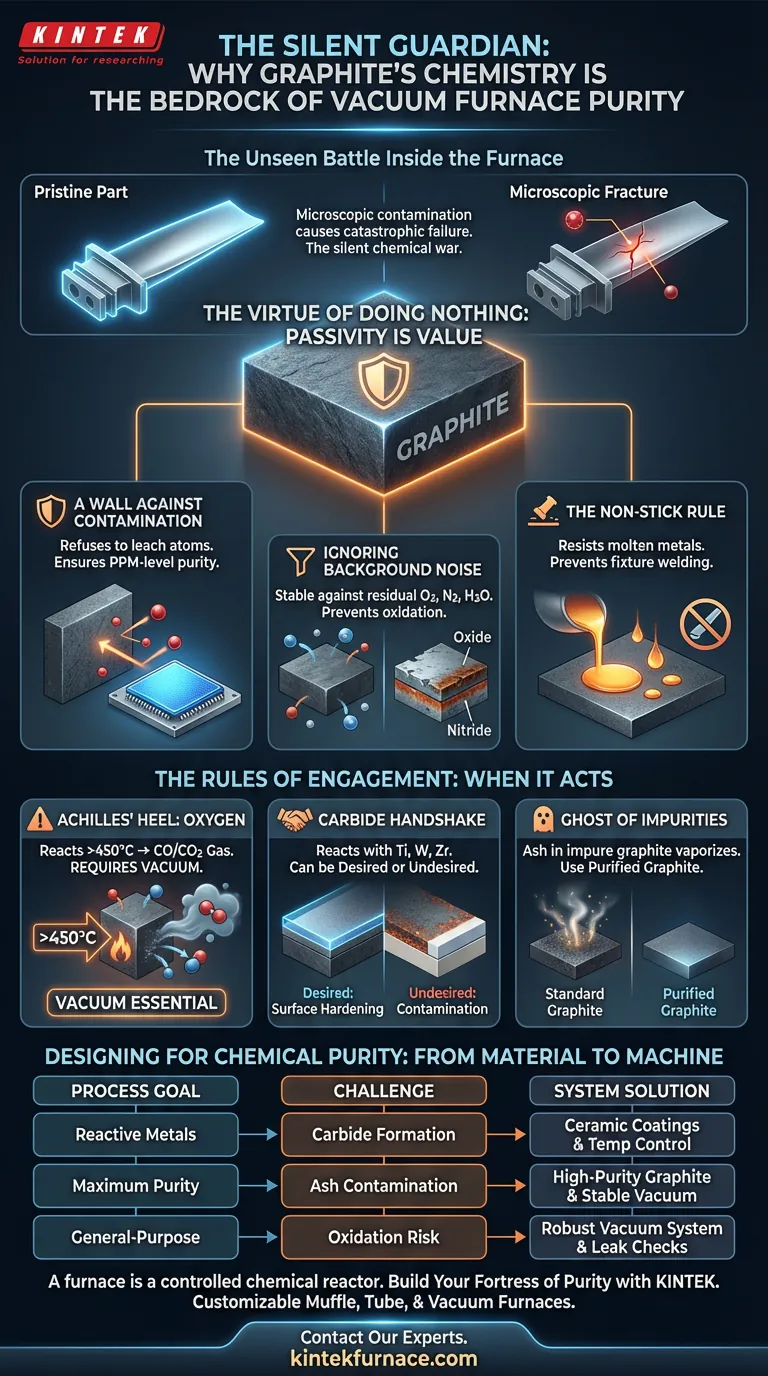
| Process Goal | Primary Chemical Challenge | System-Level Solution |
|---|---|---|
| Processing Reactive Metals | Carbide Formation | Precise temperature control and fixtures with protective ceramic coatings (e.g., yttria). |
| Achieving Maximum Purity | Ash Contamination | A furnace built with high-purity graphite components and capable of maintaining a high-quality, stable vacuum. |
| General-Purpose Heat Treating | Oxidation Risk | A robust vacuum system with rigorous leak-checking protocols to protect standard industrial-grade graphite. |
This level of process control—managing the vacuum, ensuring component integrity, and allowing for customization based on specific chemical interactions—is the core principle behind advanced laboratory furnaces. A furnace is not a simple oven; it is a controlled chemical reactor.
At KINTEK, our customizable Muffle, Tube, and Vacuum Furnace systems are engineered with these principles in mind. By leveraging our R&D and manufacturing expertise, we build systems where high-purity graphite components are not just parts, but integral elements of a stable, predictable, and contamination-free processing environment.
The silent guardian can only do its job inside the right fortress. If your work demands uncompromising chemical purity and process integrity, let's build that fortress together. Contact Our Experts
Visual Guide
Related Products
- Vacuum Hot Press Furnace Machine Heated Vacuum Press Tube Furnace
- Vacuum Hot Press Furnace Machine Heated Vacuum Press
- 600T Vacuum Induction Hot Press Vacuum Heat Treat and Sintering Furnace
- 2200 ℃ Tungsten Vacuum Heat Treat and Sintering Furnace
- Vacuum Heat Treat Sintering Furnace with Pressure for Vacuum Sintering
Related Articles
- How Vacuum Hot Press Furnaces Transform Advanced Material Engineering
- How to Select the Right Vacuum Hot Pressing Furnace Temperature for Your Materials
- Beyond the Parts List: The Real Reason Your Vacuum Hot Press Fails (And How to Fix It)
- Why Your High-Temperature Materials Fail: The Hidden War Inside Your Furnace
- Is Your Material Data Real? Why Temperature Gradients Are Sabotaging Your Cu2Se Resistivity Measurements