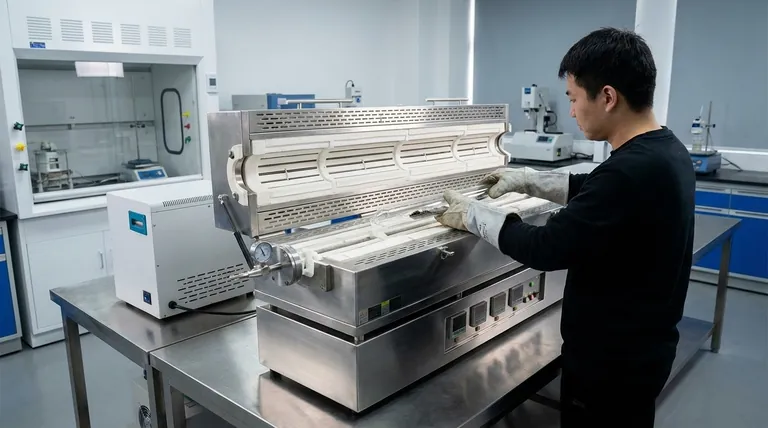
The Psychology of Waiting
Every researcher knows the feeling. The experiment is done, the data is promising, but progress halts. You're waiting for the furnace—a heavily insulated box glowing at 1100°C—to slowly, grudgingly, bleed its heat back to room temperature.
This isn't just downtime. It's a momentum killer. It's the silent thief of laboratory productivity, turning a day that could have held three experimental cycles into a day with only one. This forced pause is more than a technical limitation; it’s a psychological friction point that drains focus and efficiency.
The frustration stems from a design that prioritizes heat retention above all else. But what if a furnace could be brilliant at holding temperature, and equally brilliant at letting it go?
A Deceptively Simple Mechanical Solution
The split tube furnace addresses this challenge with an act of elegant mechanical simplicity: it opens.
Built on a robust hinge, the furnace body unlatches and separates lengthwise into two halves. This isn't just a door; it's a transformation. The furnace changes from a sealed, inaccessible chamber into an open, accessible platform. This design choice is rooted in empathy for the user, acknowledging that what happens between heating cycles is just as important as the heating itself.
Eliminating the Friction of Access
Consider the subtle anxiety of loading a traditional, solid-body tube furnace. You carefully slide a long, fragile quartz tube, potentially holding a complex and valuable sample, into a narrow opening. The risk of a costly slip or crack is always present.
The split design completely removes this friction.
- You open the furnace.
- You place the work tube directly and securely in the lower half.
- You close the top half over it.
This simple workflow protects delicate materials and complex experimental setups. It replaces a high-risk maneuver with a confident, straightforward action, reducing the operator's cognitive load.
Conquering the Cooldown Tyranny
The most profound impact of the split design is on workflow speed. Once a heating cycle is complete, opening the furnace body immediately exposes the hot work tube to ambient air.
The physics are simple but the effect is dramatic. Instead of being trapped within layers of insulation, the heat radiates away rapidly. Cooling time is no longer measured in hours, but in minutes. This single feature can double or triple a lab's daily throughput. For teams focused on rapid iteration and material screening, this isn't a minor convenience—it's a competitive advantage.
The Honest Engineering Trade-offs
No design is without its considerations. An elegant solution acknowledges its trade-offs and engineers around them.
The Phantom of Heat Loss
The seam where the two furnace halves meet is a potential path for minor heat loss. However, this is a well-understood challenge. High-quality systems, like those from KINTEK, are engineered with overlapping insulation and precision-machined surfaces to create a tight thermal seal, ensuring excellent temperature uniformity during operation.
The Question of Complexity
Adding hinges and latches introduces mechanical components not found on a solid furnace. But in a well-built furnace, these are not points of failure. They are robust, reliable mechanisms that enable a fundamentally more efficient workflow. It is complexity in the service of simplicity.
Choosing Your Workflow, Not Just Your Furnace
The decision between a split and a solid tube furnace isn't about which is technically superior, but which one aligns with the rhythm of your work.
| Scenario | Recommended Design |
|---|---|
| High Throughput & Rapid Iteration | Split Tube Furnace. The rapid cooling cycle is the single greatest accelerator for labs that need to run multiple tests per day. |
| Delicate Materials or Complex Setups | Split Tube Furnace. The direct, open access for placing and removing the work tube minimizes the risk of damaging expensive quartz tubes or disturbing the sample arrangement. |
| Long-Duration, Continuous Processes | Solid Tube Furnace. If your experiments involve a single, long heating cycle where rapid cooling is not a priority, a solid furnace offers excellent thermal performance and can be a more economical choice. |
Ultimately, the best tool is one that feels like an extension of your intent. It should remove obstacles, not create them. As process needs become more unique, the ability to tailor a solution becomes critical. At KINTEK, our deep R&D and manufacturing expertise allows us to customize our Muffle, Tube, and Vacuum furnace systems to the specific demands of your research. We help you choose and configure a system—split or solid—that solves your specific workflow bottleneck.
If you're ready to move beyond just heating materials and start optimizing your entire experimental process, let's talk about the right tool for the job. Contact Our Experts
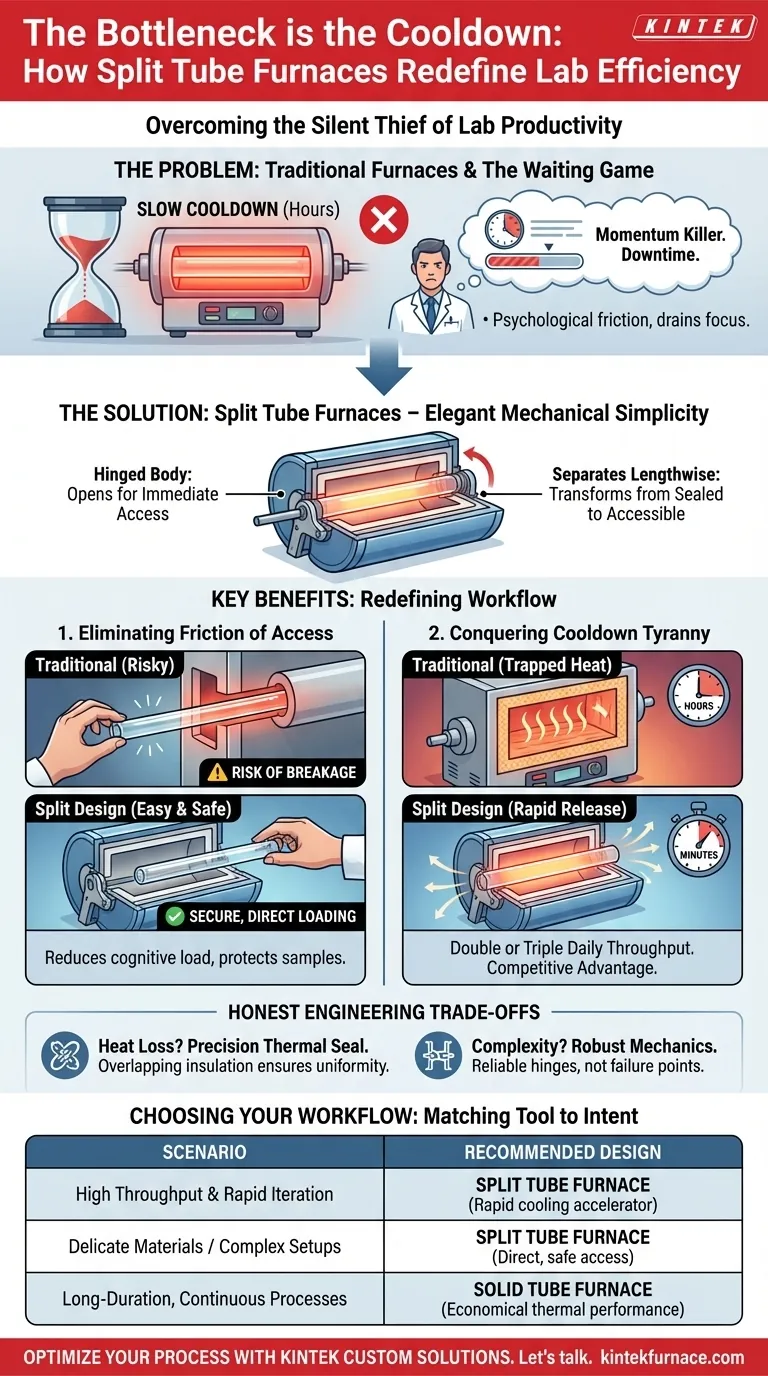
Visual Guide
Related Products
- 1200℃ Split Tube Furnace Laboratory Quartz Tube Furnace with Quartz Tube
- Split Multi Heating Zone Rotary Tube Furnace Rotating Tube Furnace
- Split Chamber CVD Tube Furnace with Vacuum Station CVD Machine
- Vacuum Sealed Continuous Working Rotary Tube Furnace Rotating Tube Furnace
- Multi Zone Laboratory Quartz Tube Furnace Tubular Furnace
Related Articles
- More Than a Hot Box: The Art and Science of Configuring a Split Tube Furnace
- Beyond Max Temp: The Systems Thinking Approach to Selecting a High-Temperature Tube Furnace
- The Alchemy of Control: Mastering Material Properties with High-Temperature Tube Furnaces
- Mastering the Micro-Environment: The Art and Science of the Laboratory Tube Furnace
- Clarity Under Fire: The Psychological Case for Quartz Tube Furnaces



















