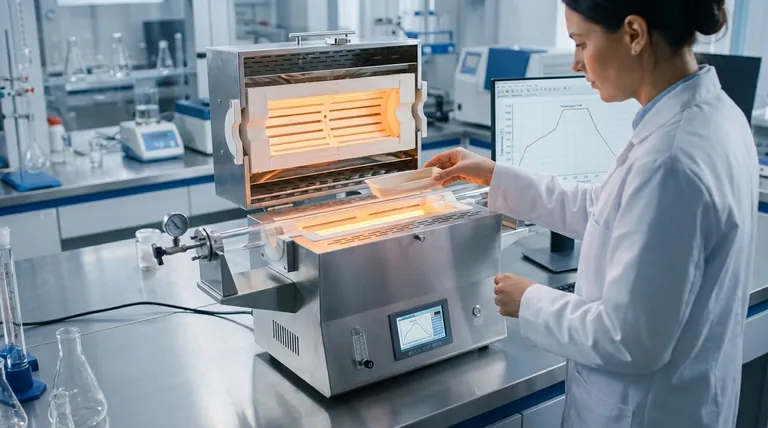
A researcher can spend months perfecting a synthesis protocol, only to see the results vary wildly from one batch to the next. They check their precursors, calibrate their sensors, and re-verify every step. Often, the culprit hides in plain sight: the furnace.
We tend to think of a furnace as a simple box that gets hot. But a modern laboratory furnace is a precision instrument. It’s a controlled microcosm where new materials are born. Its configuration isn't a footnote; it's the foundational parameter of your experiment.
Choosing the right configuration is less about maximizing every specification and more about deeply understanding the problem you're trying to solve.
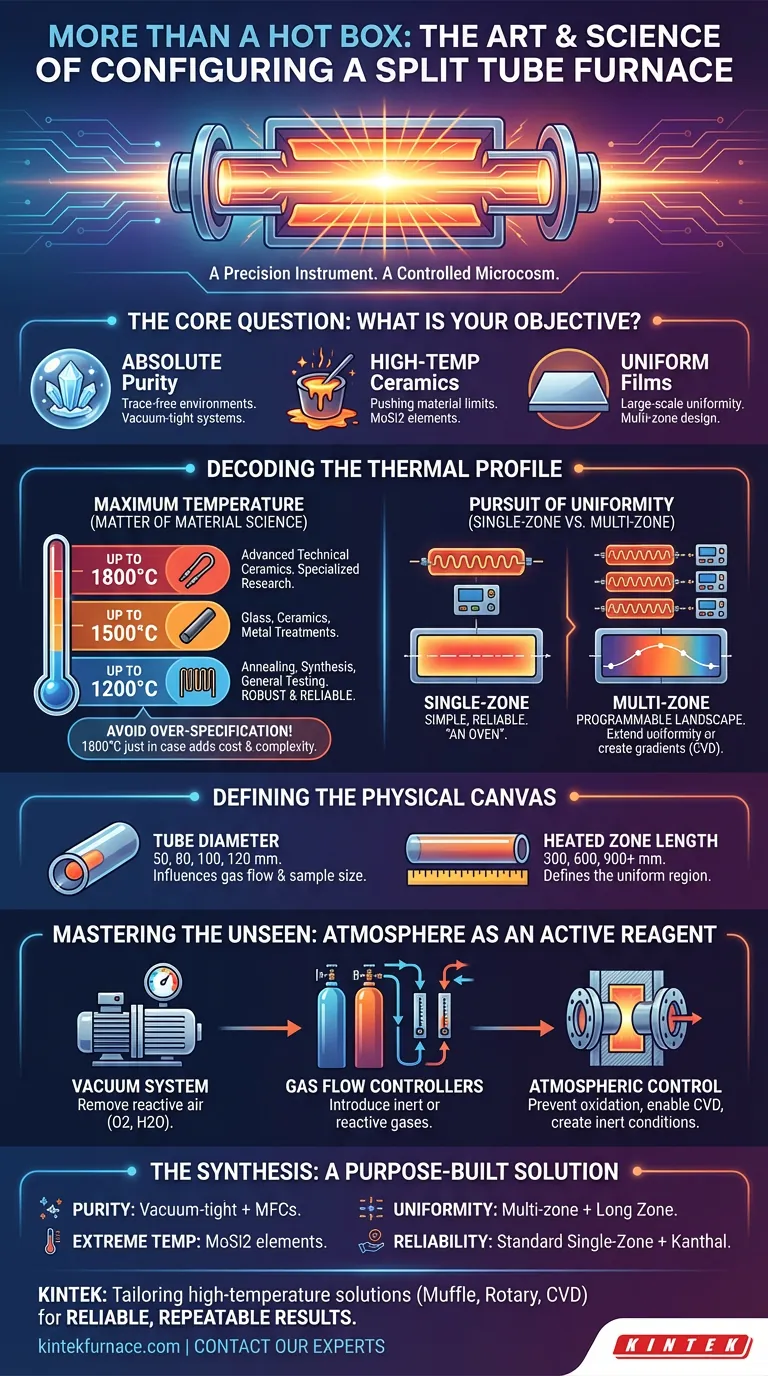
The Core Question: What Is Your Objective?
Before looking at spec sheets, the first step is to define the primary goal. The entire configuration flows from this answer.
- Are you aiming for absolute material purity, where any trace of oxygen is a contaminant?
- Are you exploring the frontiers of high-temperature ceramics, pushing materials to their limits?
- Are you focused on growing a perfectly uniform crystalline film over a large substrate?
Each of these goals demands a different architecture. The temptation is to build a furnace that can do everything. The wisdom is to build a furnace that does your specific thing, perfectly.
Decoding the Thermal Profile: Temperature and Uniformity
The heart of the furnace is its ability to deliver a precise thermal profile. This is governed by two fundamental choices.
Maximum Temperature: A Matter of Material Science
The peak temperature dictates the heating element material, which is a core design decision.
- Up to 1200°C: Kanthal (FeCrAl) alloys are the workhorse. They are robust, reliable, and cost-effective for a vast range of annealing, synthesis, and general testing.
- Up to 1500°C: This domain requires Silicon Carbide (SiC) elements, designed for processes involving glass, certain ceramics, and metal treatments.
- Up to 1800°C: The highest temperatures demand Molybdenum Disilicide (MoSi2) elements. This is the realm of advanced technical ceramics and specialized material research.
The psychological trap is over-specification—choosing an 1800°C furnace "just in case" when 99% of your work happens at 1100°C. This decision significantly increases initial cost, energy consumption, and complexity for a capability you may never use.
The Pursuit of Uniformity: Single-Zone vs. Multi-Zone
This choice determines your control over the temperature profile along the tube's length.
- Single-Zone: One controller and one set of heating elements. It creates a single, stable, uniform temperature zone in the center. It’s simple, reliable, and perfect for holding a sample at one consistent temperature.
- Multi-Zone: Multiple independent heating zones and controllers. This architecture allows you to either extend the length of the uniform temperature zone or intentionally create a temperature gradient—essential for applications like chemical vapor deposition (CVD) or certain types of crystal growth.
A single-zone furnace is an oven. A multi-zone furnace is a programmable thermal landscape.
Defining the Physical Canvas
The furnace must physically accommodate your work. The dimensions are about more than just fitting your sample; they define the operational space.
| Dimension | Standard Options | Key Consideration |
|---|---|---|
| Tube Diameter | 50, 80, 100, 120 mm | Dictated by sample size, but also influences gas flow dynamics. |
| Heated Zone Length | 300, 600, 900+ mm | Determines the length of the uniform thermal region. |
Standard dimensions offer the best value and lead times. However, pioneering research sometimes requires non-standard sizes. A partner with deep manufacturing capabilities can create custom dimensions without compromising performance.
Mastering the Unseen: Atmosphere as an Active Reagent
Many of today's most advanced materials cannot be created in ambient air. The atmosphere inside the furnace is not a passive background condition; it's an active component of the reaction.
Equipping a furnace with a vacuum system and gas flow controllers transforms it. You gain the ability to remove the reactive atmosphere (primarily oxygen and water vapor) and backfill the process tube with a precisely controlled mixture of inert or reactive gases.
This capability is essential for:
- Preventing oxidation of metals and sensitive compounds.
- Creating the specific chemical environment needed for CVD.
- Studying material behavior in inert conditions (e.g., using Argon).
Proper seals, flanges, and high-quality insulation are not minor details—they are the components that make this atmospheric control stable and repeatable.
The Synthesis: A Purpose-Built Solution
A correctly configured furnace feels less like an off-the-shelf product and more like a custom-built instrument. The final specification is a direct reflection of your primary research objective.
- For Material Purity: Prioritize a vacuum-tight system with mass flow controllers.
- For Extreme Temperatures: MoSi2 elements are non-negotiable.
- For Large-Scale Uniformity: A multi-zone design with a long heated zone is required.
- For General-Purpose Reliability: A standard single-zone furnace with Kanthal elements offers the best balance of performance and cost.
Your tools should not be a source of uncertainty. With expert R&D and in-house manufacturing, KINTEK specializes in tailoring high-temperature solutions—from Muffle and Rotary furnaces to advanced CVD systems—to the specific demands of your research. By starting with your objective, we help engineer a furnace that empowers your work, ensuring that your results are reliable, repeatable, and a true reflection of your science.
To configure a furnace that precisely matches your experimental needs, Contact Our Experts.
Visual Guide
Related Products
- 1200℃ Split Tube Furnace Laboratory Quartz Tube Furnace with Quartz Tube
- Split Multi Heating Zone Rotary Tube Furnace Rotating Tube Furnace
- Split Chamber CVD Tube Furnace with Vacuum Station CVD Machine
- Vacuum Sealed Continuous Working Rotary Tube Furnace Rotating Tube Furnace
- Multi Zone Laboratory Quartz Tube Furnace Tubular Furnace
Related Articles
- The Bottleneck is the Cooldown: How Split Tube Furnaces Redefine Lab Efficiency
- Beyond Max Temp: The Systems Thinking Approach to Selecting a High-Temperature Tube Furnace
- The Alchemy of Control: Mastering Material Properties with High-Temperature Tube Furnaces
- Mastering the Micro-Environment: The Art and Science of the Laboratory Tube Furnace
- Clarity Under Fire: The Psychological Case for Quartz Tube Furnaces



















