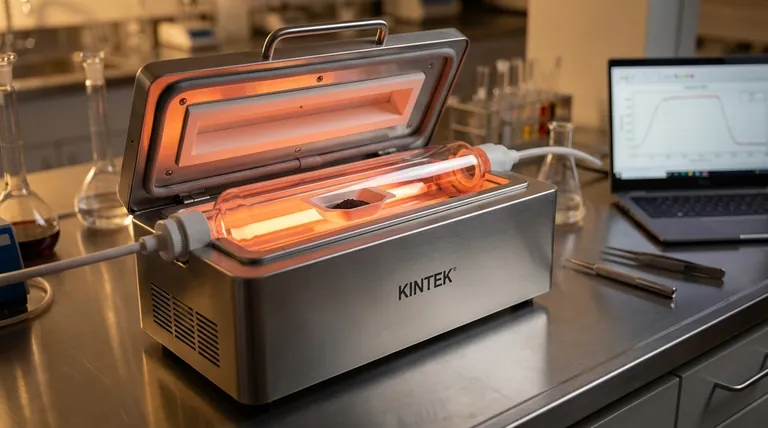
The Black Box Problem in Material Science
Imagine a team of engineers developing a new aerospace alloy. Their simulations are perfect. The elemental composition is precise. Yet, batch after batch fails quality control, exhibiting unexpected brittleness.
The problem lies hidden within the furnace—a "black box" where the material undergoes its transformation. A subtle, premature phase change, invisible to thermocouples alone, is ruining the crystalline structure.
This scenario isn't hypothetical; it's a familiar frustration in labs and production floors worldwide. The most advanced thermal process is rendered useless if you cannot truly understand what is happening inside. This is where the choice of equipment becomes a choice about insight itself.
The Power of Direct Observation
The single greatest advantage of a quartz tube furnace is its profound, elegant simplicity: you can see inside.
This isn't a minor feature. It's a fundamental shift from blind faith in instrumentation to empirical, real-time feedback. For a researcher or process engineer, this visual access provides an immense psychological advantage—the reduction of uncertainty.
You can directly witness critical transformations:
- The precise moment of melting or sintering.
- Subtle color shifts indicating a chemical reaction.
- The first signs of decomposition or unexpected outgassing.
This direct feedback loop accelerates development, simplifies failure analysis, and builds an intuitive understanding of a material that raw data can never replicate.
The Assurance of Absolute Purity
Every experiment is a search for truth, and that requires controlling the variables. When you heat a sample, you want the only variable to be temperature—not a subtle chemical reaction with the container itself.
Quartz is chemically inert to an vast range of materials, even at extreme temperatures. It acts as a silent, invisible partner in your process. It doesn't interfere, react, or contaminate.
This guarantee of purity is non-negotiable in fields like:
- Semiconductor Manufacturing: Where a few rogue atoms can destroy the function of a microchip.
- Advanced Materials Science: Where the goal is to create novel materials with precisely defined properties.
- Specialty Glass Formulation: Where trace contaminants can ruin optical clarity or structural integrity.
Using a quartz tube isn't just about preventing contamination; it's about building a foundation of trust in your results.
Engineered for Practicality and Progress
Beyond its core material properties, the design of a quartz tube furnace addresses the practical realities of laboratory work and production.
Uniformity Creates Repeatability
A well-designed tube furnace creates a highly uniform temperature zone. This ensures every part of your sample is exposed to the exact same thermal conditions, eliminating ambiguity and making your results consistent and repeatable.
Efficiency Accelerates Discovery
Compared to larger batch furnaces, the thermal mass of a quartz tube system is low. This allows for rapid heating and cooling cycles. In a research environment, this means more experiments per day. It creates momentum, shortens the path to discovery, and keeps teams engaged and productive.
Accessibility Lowers the Stakes
Quartz is relatively inexpensive compared to exotic ceramics like alumina. This pragmatic reality has a powerful psychological effect: it lowers the fear of failure. When the cost of an accidental tube fracture is manageable, researchers are more willing to push boundaries and test aggressive new thermal profiles.
Knowing Your Tool's Boundaries
An expert doesn't just know what a tool can do; they know what it cannot do. Understanding the limitations of quartz is key to using it effectively.
- Temperature Ceiling: Quartz begins to soften and devitrify above 1200°C. For higher temperatures, ceramics like alumina are necessary.
- Mechanical Fragility: It is, after all, a type of glass. It is brittle and demands careful handling. This isn't a flaw, but a characteristic that requires respect.
- Chemical Reactivity: While broadly inert, it can be attacked by strong alkaline solutions and specific acids (like hydrofluoric acid) at high temperatures. Always verify chemical compatibility.
The Right Furnace Is a Strategic Choice
Selecting a furnace is more than a line item on a purchase order; it's a decision about how you approach your work. Do you need absolute clarity, unimpeachable purity, or the ability to reach extreme temperatures?
The answer dictates the ideal tool for the job.
| Feature | The Strategic Advantage |
|---|---|
| Visual Clarity | Directly monitor transformations to prevent errors and speed up R&D. |
| Chemical Purity | Eliminate contamination as a variable for trustworthy, repeatable results. |
| Thermal Stability | Handle temperatures up to 1200°C with good shock resistance for high throughput. |
| Heating Uniformity | Ensure your entire sample experiences the same conditions, guaranteeing data integrity. |
| Efficiency | Achieve faster heating/cooling cycles and adapt to various atmospheres (vacuum, inert gas). |
| Cost-Effectiveness | Reduce the financial risk of experimentation, encouraging innovation. |
Navigating these trade-offs requires a partner who understands not just the equipment, but the science behind it. At KINTEK, we leverage our deep R&D and manufacturing expertise to build systems—from Muffle and Tube Furnaces to advanced CVD platforms—that are precisely tailored to your research goals. We believe the right tool doesn't just perform a task; it unlocks new possibilities.
If your work demands clarity, purity, and precision, we can build the system to match. Contact Our Experts
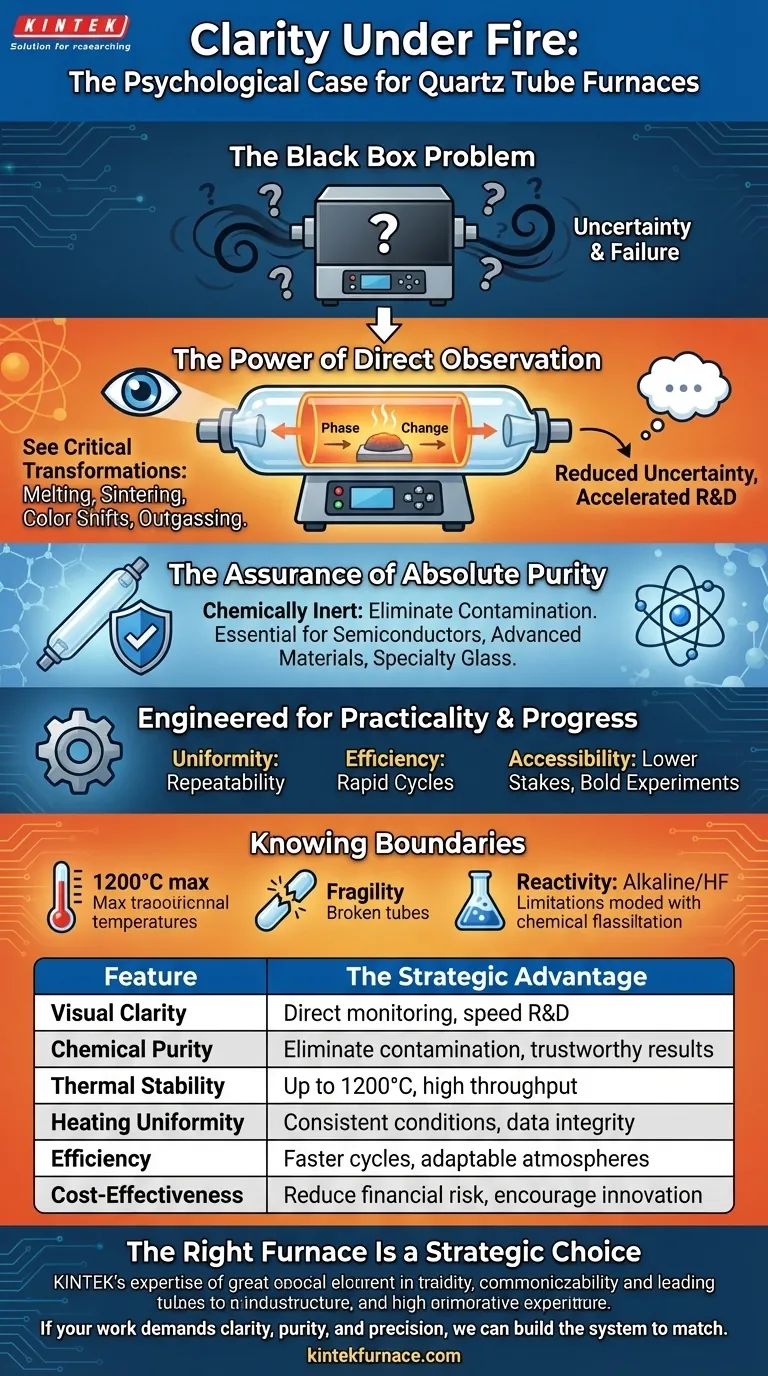
Visual Guide
Related Products
- Laboratory Quartz Tube Furnace RTP Heating Tubular Furnace
- 1200℃ Split Tube Furnace Laboratory Quartz Tube Furnace with Quartz Tube
- Vertical Laboratory Quartz Tube Furnace Tubular Furnace
- Multi Zone Laboratory Quartz Tube Furnace Tubular Furnace
- High Pressure Laboratory Vacuum Tube Furnace
Related Articles
- Mastering the Micro-Environment: The Art and Science of the Laboratory Tube Furnace
- The Alchemy of Control: Mastering the Micro-Environment in a Lab Tube Furnace
- Beyond Heat: Mastering the Controlled Universe Inside a Tube Furnace
- Mastering the Void: How Tube Furnaces Forge the Atoms of Innovation
- Why Your Crystal Growth Experiments Are Failing: The Hidden Culprit in Your Tube Furnace



















