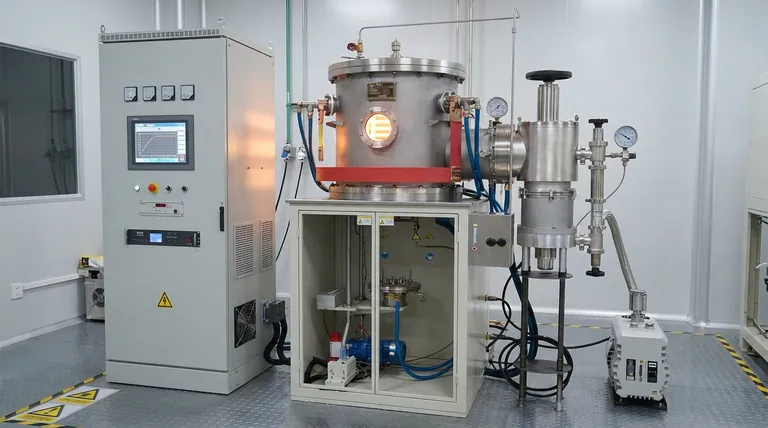
The Illusion of Emptiness
A vacuum furnace appears to be a simple machine. You place a metal part inside a steel box, remove the air, and turn up the heat. But this simplicity is an illusion.
The goal isn't to create nothing. The goal is to create the perfect something: a pristine, controlled environment, free from the chaotic and reactive elements of our atmosphere.
Achieving this level of control is not the job of a single component, but a symphony of five integrated systems working in concert. It's a process less like baking and more like composing—every note, every pause, is deliberate.
The Five Pillars of a Controlled Universe
To master the properties of a material, you must first master its environment. A vacuum furnace achieves this through the seamless interaction of five core pillars, each solving a critical piece of the metallurgical puzzle.
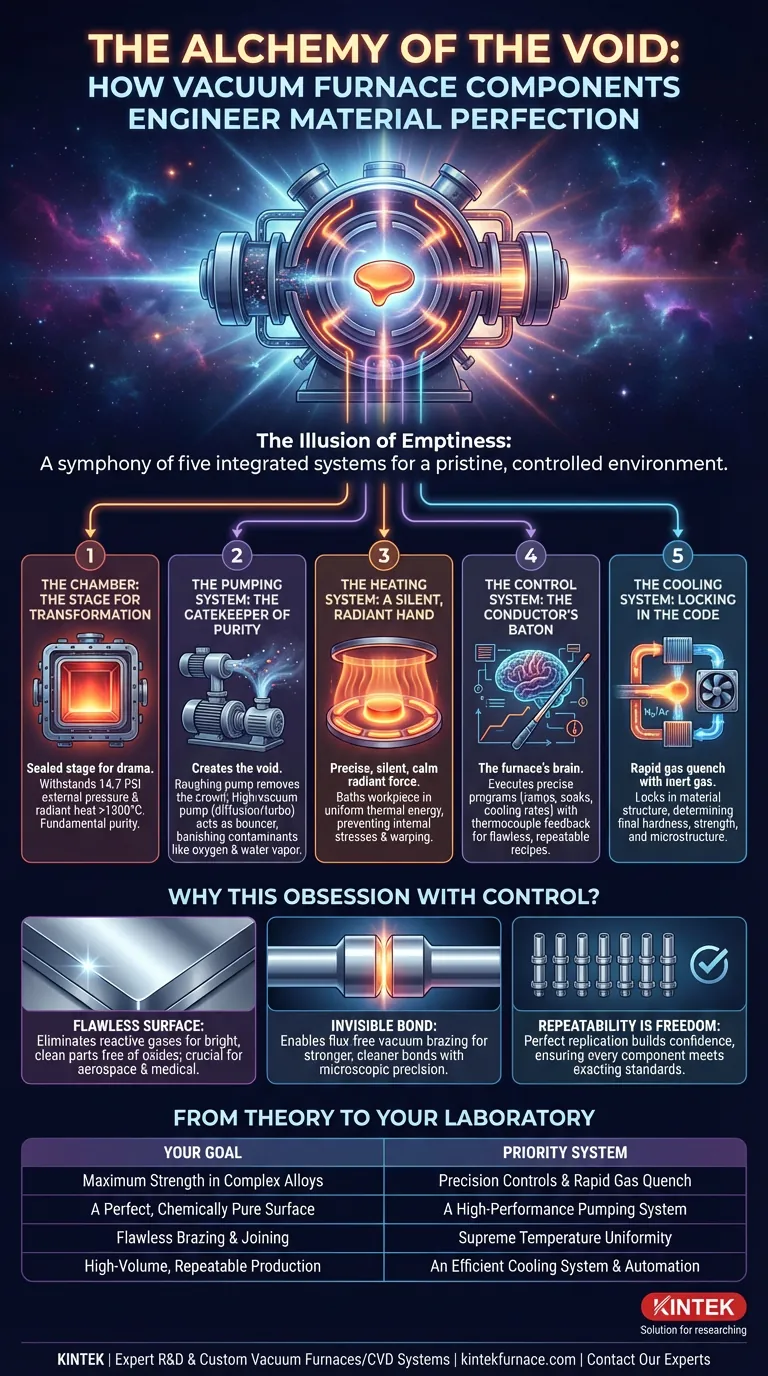
H3: The Chamber: The Stage for Transformation
The vacuum chamber is more than a container; it's the sealed stage where the entire drama of heat treatment unfolds. It is engineered not only to hold the part but to withstand a relentless battle—the crushing force of 14.7 pounds per square inch of atmospheric pressure trying to get in, while its internal walls endure radiant temperatures that can exceed 1300°C. Its integrity is the first and most fundamental requirement for purity.
H3: The Pumping System: The Gatekeeper of Purity
The heart of the furnace is its ability to create a void. This is the work of the pumping system, a duo that first removes the crowd, then the stragglers.
- A mechanical "roughing" pump acts as the bouncer, ejecting the vast majority of air molecules from the chamber.
- A high-vacuum pump (like a diffusion or turbomolecular pump) then takes over, meticulously removing the remaining few.
This isn't just about removing air. It's about banishing the uninvited guests—oxygen, water vapor, and other contaminants—that cause the oxidation and scaling that plague conventional furnaces.
H3: The Heating System: A Silent, Radiant Hand
In the atmosphere, heat is a chaotic storm of convection. In a vacuum, it is a calm, silent, and incredibly precise force: radiation.
Heating elements, often crafted from graphite or refractory metals like molybdenum, glow red-hot, bathing the workpiece in uniform thermal energy. Think of the difference between warming your hands over a bonfire versus feeling the sun on your face. That perfect, even exposure is what prevents internal stresses and warping in complex, high-value components.
H3: The Control System: The Conductor's Baton
Heat without control is just brute force. The control system is the furnace's brain, translating a metallurgist's intent into a flawless, repeatable recipe.
Using thermocouple feedback, this system executes a precise program of temperature ramps, "soaks" at specific temperatures, and controlled cooling rates. This is where the art of metallurgy becomes a science. It ensures that the thousandth part is identical to the first, a level of consistency that is the bedrock of modern manufacturing.
H3: The Cooling System: Locking in the Code
Heating a metal unlocks its crystalline structure, but it is the cooling that defines its final properties. The cooling system, or "gas quench," is what locks the new material code into place.
Once the heating cycle is complete, the chamber is backfilled with a high-purity inert gas like nitrogen or argon. A powerful fan then circulates this gas through a heat exchanger, rapidly and uniformly cooling the part. The speed and uniformity of this quench determine the final hardness, strength, and microstructure of the alloy.
Why This Obsession with Control?
The intricate dance of these five systems delivers benefits that are impossible to achieve in open air. This pursuit of control is driven by the demand for perfection in the world's most critical applications.
H3: The Promise of a Flawless Surface
By eliminating reactive gases, the vacuum furnace guarantees a bright, clean surface, free of oxides or decarburization. For an aerospace turbine blade or a medical implant, a surface flaw isn't a cosmetic defect; it's a potential point of catastrophic failure. The vacuum is an insurance policy against that risk.
H3: The Art of the Invisible Bond
In processes like vacuum brazing, the pristine environment allows filler metals to flow into joints with microscopic precision, creating bonds that are stronger and cleaner than any welded alternative. No corrosive flux is needed, ensuring the internal integrity of the joined components.
H3: Repeatability Is Freedom
A sophisticated control system doesn't create constraints; it creates freedom from uncertainty. When you can perfectly replicate a complex heat treatment, you can build with confidence, knowing that every single component meets the same exacting standards.
From Theory to Your Laboratory
Understanding the system is the first step. Building or choosing the right one requires aligning its capabilities with your specific goal. The ideal furnace is never a generic box; it's a tailored solution.
| If Your Primary Goal Is... | ...Your Priority Should Be a System With |
|---|---|
| Maximum Strength in Complex Alloys | Precision Controls & a Rapid Gas Quench |
| A Perfect, Chemically Pure Surface | A High-Performance Pumping System |
| Flawless Brazing & Joining | Supreme Temperature Uniformity |
| High-Volume, Repeatable Production | An Efficient Cooling System & Automation |
This is where theory meets application. At KINTEK, our foundation in expert R&D and in-house manufacturing allows us to move beyond standard equipment. We specialize in creating custom vacuum furnaces and CVD systems that are precisely matched to the unique material challenges of demanding industries.
Building a furnace is just the start; engineering a solution requires a deep understanding of your unique scientific objectives. If you're ready to move from theory to tangible results, Contact Our Experts.
Visual Guide
Related Products
- Vacuum Hot Press Furnace Machine Heated Vacuum Press Tube Furnace
- Vacuum Hot Press Furnace Machine Heated Vacuum Press
- 600T Vacuum Induction Hot Press Vacuum Heat Treat and Sintering Furnace
- 2200 ℃ Tungsten Vacuum Heat Treat and Sintering Furnace
- Vacuum Heat Treat Sintering Furnace with Pressure for Vacuum Sintering
Related Articles
- How Vacuum Hot Press Furnaces Transform Advanced Material Engineering
- How to Select the Right Vacuum Hot Pressing Furnace Temperature for Your Materials
- Beyond the Parts List: The Real Reason Your Vacuum Hot Press Fails (And How to Fix It)
- Why Your High-Temperature Materials Fail: The Hidden War Inside Your Furnace
- Is Your Material Data Real? Why Temperature Gradients Are Sabotaging Your Cu2Se Resistivity Measurements



















