The Unseen Enemy in Heat Treatment
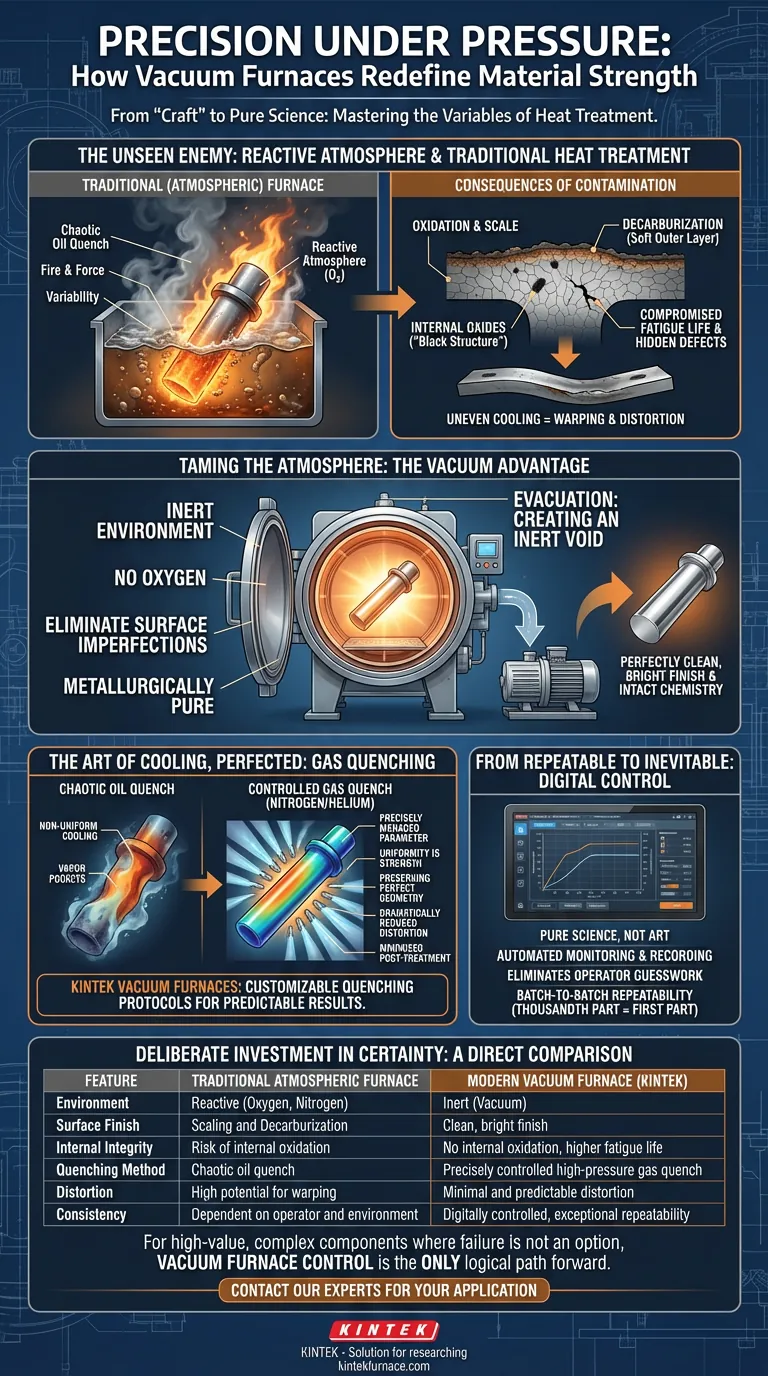
For decades, the image of heat treatment has been one of fire and force. A glowing steel part plunged into a turbulent oil bath, met with a violent hiss and plumes of smoke. It's a process rooted in tradition, often feeling more like a craft than a science.
But in high-performance engineering—from aerospace to medical implants—"craft" is a synonym for "variability." And variability is the enemy of reliability. The core challenge isn't just heating and cooling metal; it's controlling every single variable that can compromise the final part's integrity.
The most significant and often overlooked variable is the very air inside the furnace.
Taming the Atmosphere: The Power of a Vacuum
A conventional furnace is filled with a reactive atmosphere. At high temperatures, oxygen wages a relentless war on the surface of the steel, creating problems that persist deep within the material.
Vacuum carburizing changes the rules of engagement by removing the battlefield itself. By evacuating the chamber, we create an inert environment where the steel can be treated without interference.
Eliminating Surface Imperfections
In a normal atmosphere, two things happen:
- Oxidation: Oxygen bonds with the hot steel, forming a layer of scale. This must be cleaned off later, an extra, costly step.
- Decarburization: The surface of the steel loses carbon to the surrounding atmosphere, creating a soft, weak outer layer.
A vacuum prevents these reactions entirely. Parts emerge from the furnace perfectly clean, with a bright metallic finish and their surface chemistry intact.
Fortifying from Within
The most insidious damage occurs beneath the surface. Oxygen can penetrate the steel's grain boundaries, creating microscopic internal oxides. This "black structure" acts as a network of built-in stress points, severely compromising the component's fatigue life. It’s a hidden defect, a failure waiting to happen.
Vacuum processing makes internal oxidation impossible, resulting in a metallurgically pure and exceptionally durable component.
The Art of Cooling, Perfected
The second source of chaos is the quench. Submerging a part in oil is an incredibly non-uniform process. The chaotic boiling and vapor pockets create uneven cooling rates across the part's geometry, leading directly to warping and distortion.
Gas quenching, the standard in vacuum furnaces, replaces this chaos with control.
Uniformity is Strength
Instead of a liquid bath, an inert gas like nitrogen or helium is circulated at high pressure. The cooling rate is no longer a chaotic event; it's a precisely managed parameter, controlled by adjusting gas pressure and velocity.
This ensures every surface of the part, from thick sections to fine details, cools at a near-identical and predictable rate. The result is a perfectly homogeneous hardened case, ensuring consistent performance.
Preserving Perfect Geometry
Because the cooling is so uniform, part distortion is dramatically reduced. This is a game-changer.
- Complex, thin-walled parts can be hardened without warping.
- The need for expensive and time-consuming post-treatment grinding is minimized.
- Scrap rates plummet, and final part geometry is far more predictable.
This level of control requires a system designed for it. An advanced KINTEK vacuum furnace, for example, allows for the customization of quenching protocols tailored to the specific geometry and material of your components, turning a high-risk process into a predictable one.
From Repeatable to Inevitable: The Logic of Digital Control
When you combine a stable environment (the vacuum) with precise, digitally managed inputs (gas flow, pressure, temperature), you fundamentally change the nature of heat treatment.
The process transforms from an art, dependent on an operator's experience and intuition, into a pure science. Every critical parameter is monitored, recorded, and automated. Operator guesswork and atmospheric variability are completely removed from the equation.
This ensures that the thousandth part in a production run has the exact same metallurgical and geometrical properties as the first. For industries where failure is not an option, this level of batch-to-batch repeatability isn't a luxury; it's a necessity.
A Deliberate Investment in Certainty
Advanced vacuum systems represent a higher initial investment than traditional atmospheric furnaces. They require specialized maintenance and a deeper technical understanding.
But viewing this through the lens of cost alone is a mistake. It is an investment in certainty. You are buying the elimination of variables. You are paying to remove the risk of oxidation, distortion, and inconsistency—risks that lead to scrapped parts, field failures, and damaged reputations.
| Advantage | Traditional Atmospheric Furnace | Modern Vacuum Furnace (KINTEK) |
|---|---|---|
| Environment | Reactive (Oxygen, Nitrogen) | Inert (Vacuum) |
| Surface Finish | Scaling and Decarburization | Clean, bright finish |
| Internal Integrity | Risk of internal oxidation | No internal oxidation, higher fatigue life |
| Quenching Method | Chaotic oil quench | Precisely controlled high-pressure gas quench |
| Distortion | High potential for warping | Minimal and predictable distortion |
| Consistency | Dependent on operator and environment | Digitally controlled, exceptional repeatability |
Ultimately, the choice hinges on your requirements. If you are producing high-value, complex components where metallurgical purity and dimensional accuracy are paramount, the control offered by a vacuum furnace isn't just better—it's the only logical path forward.
Achieving this level of process control begins with having the right equipment, designed for your specific application. Contact Our Experts
Visual Guide
Related Products
- Vacuum Hot Press Furnace Machine Heated Vacuum Press Tube Furnace
- Vacuum Hot Press Furnace Machine Heated Vacuum Press
- 600T Vacuum Induction Hot Press Vacuum Heat Treat and Sintering Furnace
- 2200 ℃ Tungsten Vacuum Heat Treat and Sintering Furnace
- Vacuum Heat Treat Sintering Furnace with Pressure for Vacuum Sintering
Related Articles
- How Vacuum Hot Press Furnaces Transform Advanced Material Engineering
- How to Select the Right Vacuum Hot Pressing Furnace Temperature for Your Materials
- Beyond the Parts List: The Real Reason Your Vacuum Hot Press Fails (And How to Fix It)
- Why Your High-Temperature Materials Fail: The Hidden War Inside Your Furnace
- Is Your Material Data Real? Why Temperature Gradients Are Sabotaging Your Cu2Se Resistivity Measurements