The Illusion of Simplicity
At first glance, a furnace is a simple tool. It makes things hot. This is a profoundly useful, but dangerously incomplete, way of thinking.
Engineers and scientists often fall into the psychological trap of focusing on the most obvious variable—temperature. We ask, "How hot does it need to be?" But the more important question is often, "What environment does this process demand?"
The difference between crude heating and precision material science lies in mastering the unseen variable: the atmosphere. This is where the elegant design of a tube furnace reveals its true purpose.
The Physics and Psychology of a Sealed Tube
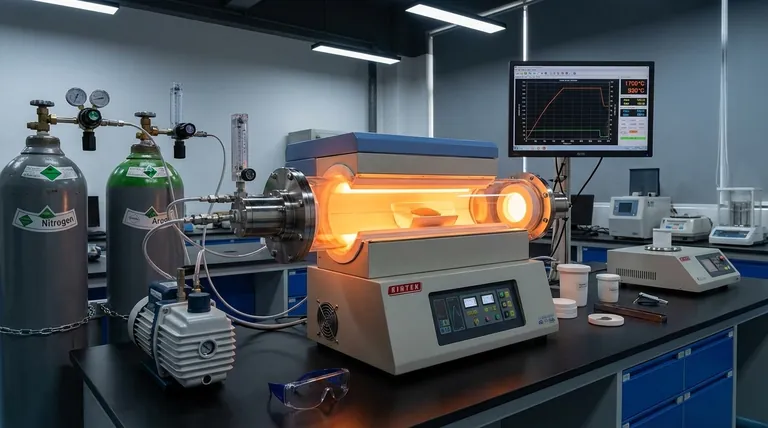
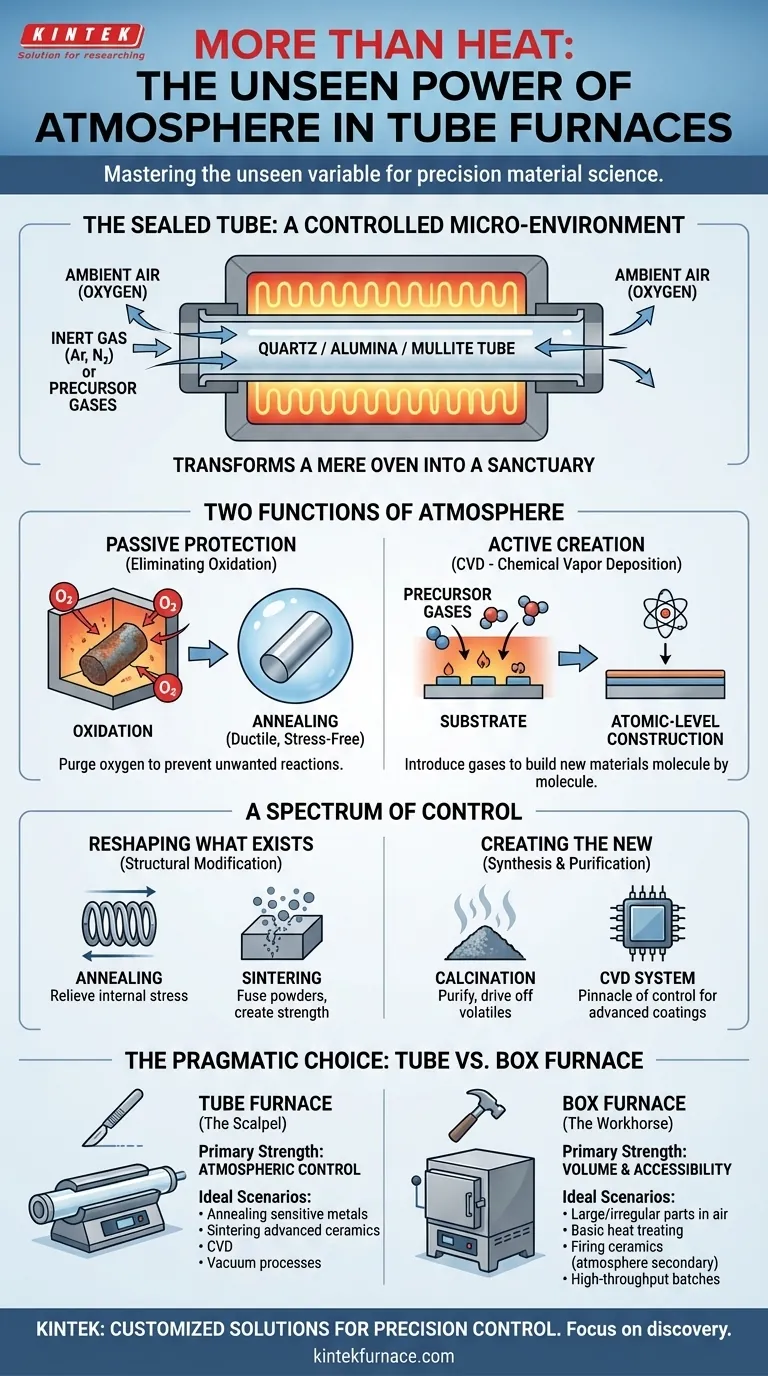
The defining feature of a tube furnace is not its heating element, but the quartz, alumina, or mullite tube that contains the sample. This simple boundary transforms the machine from a mere oven into a controlled micro-environment.
Eliminating the Invisible Enemy: Oxidation
Imagine an engineer trying to anneal a sensitive metal alloy. The goal is to heat it slowly to remove internal stresses, making it more ductile. In the open air of a conventional box furnace, a second, unwanted reaction begins instantly: oxidation. The surface is compromised. The material's properties are altered in ways you didn't intend.
The sealed tube offers a sanctuary. By purging the ambient air and introducing an inert gas like argon or nitrogen, you remove oxygen from the equation. The heat can now do its intended work without a fight. This isn't just heating; it's creating a perfect, non-reactive stage for a physical transformation to unfold.
From Passive Protection to Active Creation
Now, what if the atmosphere isn't an enemy to be excluded, but a critical ingredient to be added?
This is the principle behind Chemical Vapor Deposition (CVD). Here, the furnace becomes a reactor. Precursor gases are intentionally introduced into the hot zone, where they react and decompose to grow a solid, high-purity thin film on a substrate, molecule by molecule.
This is atomic-level construction. It is a process that is fundamentally impossible without the absolute atmospheric control that a sealed tube furnace provides. You are no longer just modifying a material; you are building a new one.
A Spectrum of Control: Matching the Tool to the Task
The synergy of precise heat and atmospheric control enables a wide range of processes, each demanding a different level of environmental mastery.
Reshaping What Exists: Structural Modification
These processes alter a material's physical properties.
- Annealing: Gently heating and cooling to relieve internal stress and reduce brittleness. It’s like allowing the material to forget the trauma of its formation.
- Sintering: The delicate art of fusing compacted powders into a solid mass just below their melting point. It’s about coaxing individual particles to form new bonds, creating strength from dust. Uniform temperature in the "hot zone" is non-negotiable here.
Creating the New: Synthesis & Purification
These processes create new materials or refine existing ones.
- Calcination: A purification ritual. High heat drives off volatile compounds like water or CO2, leaving the essential, stable material behind.
- Chemical Vapor Deposition (CVD): The pinnacle of control, where the furnace becomes a micro-fabrication chamber. This is where a general-purpose furnace is no longer enough and a dedicated CVD System is required for the gas flow precision and uniformity needed for advanced coatings.
The Pragmatic Choice: Tube vs. Box Furnace
The choice between a tube furnace and a box (or muffle) furnace isn't about which is "better." It's a strategic decision based on one question: how much does atmosphere matter to your outcome?
| Furnace Type | Primary Strength | Ideal Scenarios |
|---|---|---|
| Tube Furnace | Atmospheric Control | - Annealing oxygen-sensitive metals - Sintering advanced ceramics - Chemical Vapor Deposition (CVD) - Any process requiring vacuum or specific gas |
| Box Furnace | Volume & Accessibility | - Processing large or irregular parts in air - Basic heat treating of non-reactive metals - Firing ceramics where atmosphere is secondary - High-throughput batch processing |
A box furnace is a workhorse for tasks where volume is king and the air is an acceptable medium. A tube furnace is a scalpel for tasks where the environment is an integral part of the process itself.
From Abstract Theory to Tangible Results
Mastering thermal processing is a journey from understanding the obvious variable of heat to mastering the subtle, powerful variable of atmosphere. The right equipment is not just a purchase; it's an investment in control.
Achieving this level of precision requires a furnace that is not only powerful but also reliable and adaptable to your specific research. KINTEK's deep R&D and manufacturing expertise allows for the customization of Tube Furnaces, CVD Systems, and other high-temperature solutions to meet these unique demands. We provide the control so you can focus on the discovery.
Whether you are refining established processes or pioneering new materials, having a partner who understands the nuances of thermal processing is critical. Contact Our Experts
Visual Guide
Related Products
- 1200℃ Controlled Inert Nitrogen Atmosphere Furnace
- Mesh Belt Controlled Atmosphere Furnace Inert Nitrogen Atmosphere Furnace
- 1700℃ Controlled Inert Nitrogen Atmosphere Furnace
- Controlled Inert Nitrogen Hydrogen Atmosphere Furnace
- High Pressure Laboratory Vacuum Tube Furnace
Related Articles
- The Invisible Contaminant: Why Your Furnace Atmosphere is Sabotaging Your Results
- Why Your High-Temperature Materials Fail: The Hidden Enemy in Your Furnace
- Why Your Galfenol Sheets Fail to Recrystallize—And How Precise Atmosphere Control Unlocks High Performance
- The Hidden Flaw in Your Heat Treatment: It’s Not the Temperature, It’s the Air
- Why Your High-Temp Experiments Fail: It’s Not the Heat, It’s the Atmosphere



















