The Unseen Battle in Every Restoration
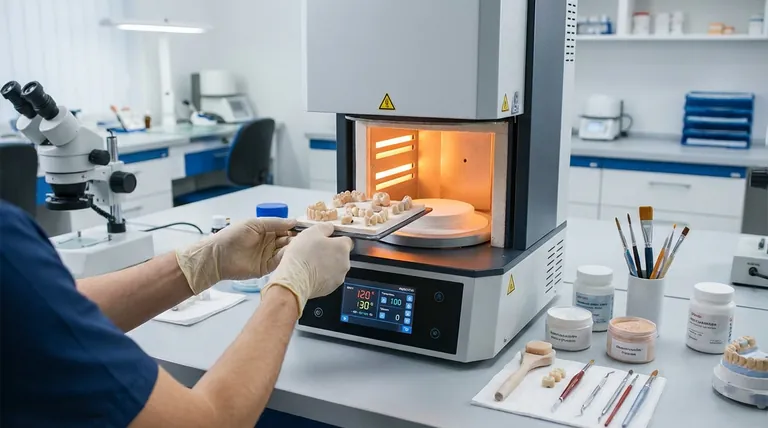
Imagine a dental technician at their bench, meticulously layering porcelain powder onto a die. It is an act of artistry and precision, sculpting a crown that will become an indistinguishable part of a person's smile.
The final, critical stage of this process happens inside a furnace. Here, heat will transform the fragile powder into a hard, durable ceramic.
But an invisible enemy lurks within that furnace chamber: the very air we breathe. At high temperatures, the oxygen and other gases in the atmosphere become saboteurs, threatening to undo the technician's careful work.
The solution is a paradox of engineering. To create something perfectly solid, you must first create a perfect void. This is the mastery of the vacuum furnace.
Why Firing in Open Air is a Gamble
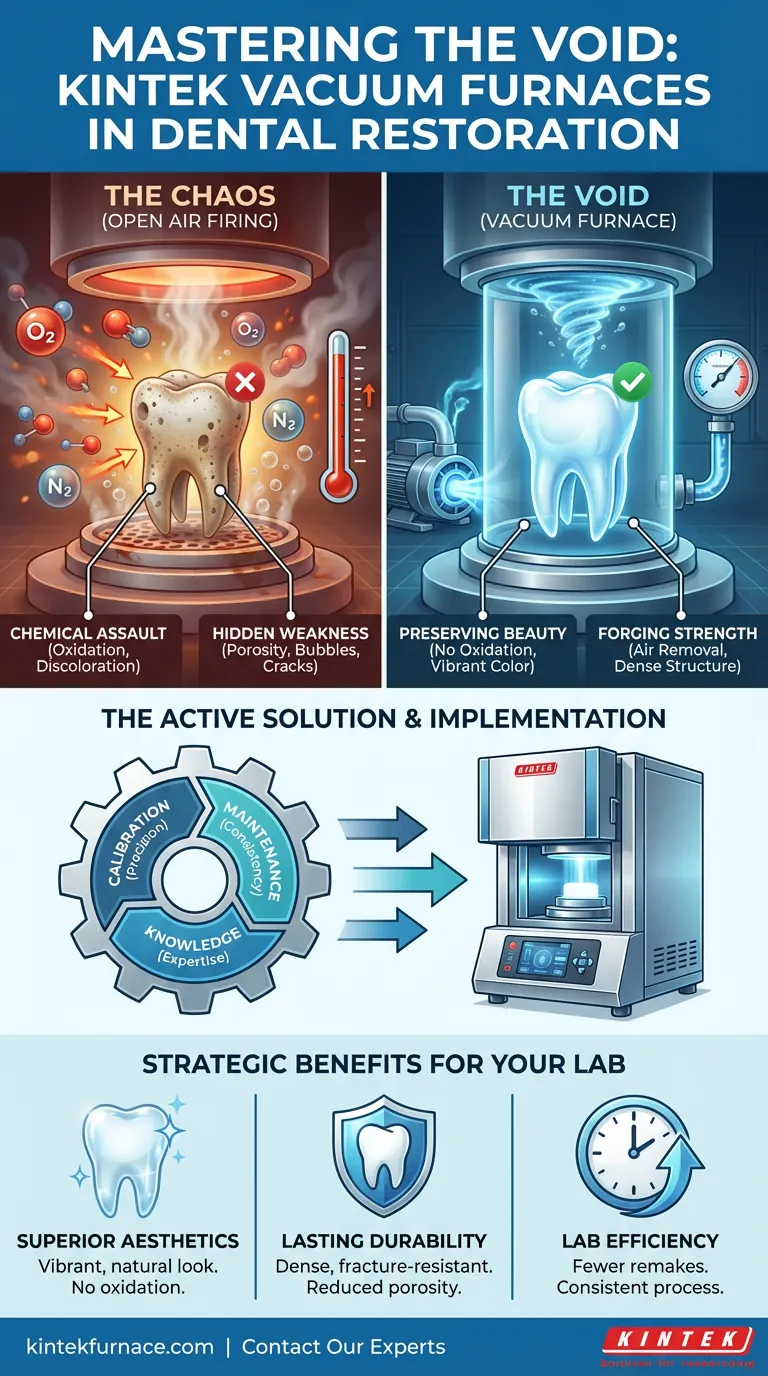
To appreciate the elegance of a vacuum, we must first understand the chaos it prevents. Firing dental ceramics in a conventional, air-filled environment is an exercise in uncontrolled variables.
The Chemical Assault of Oxygen
Air is about 21% oxygen, an element that becomes highly reactive when heated. When it interacts with the metallic oxides and pigments in dental porcelain, it triggers oxidation.
This chemical reaction tarnishes the material on a microscopic level, resulting in a dull, opaque, or discolored restoration. The vibrant, life-like translucency the technician worked to create is lost, replaced by a lifeless approximation.
The Hidden Weakness of Porosity
Dental porcelain begins as a fine powder. No matter how carefully it is condensed, millions of microscopic pockets of air remain trapped between the individual particles.
When heated in a normal atmosphere, this trapped air expands. It pushes the surrounding ceramic aside, forming tiny bubbles, or voids, within the final structure. This is known as porosity. These voids are the seeds of future failure.
The Two-Fold Consequence: Weak and Unnatural
The damage caused by porosity is catastrophic for two reasons.
- Structurally: Each void is a stress point. Under the immense pressures of chewing, these weak spots concentrate force, making the crown or veneer significantly more prone to fracture.
- Aesthetically: These internal bubbles scatter light instead of allowing it to pass through. This destroys the material's natural translucency, making the restoration look flat and artificial.
The Vacuum as an Active Tool
A vacuum furnace isn't just a hotter oven. It is an environmental control system. The vacuum pump isn't a passive feature; it is an active tool that systematically purges the chamber of these atmospheric saboteurs before they can inflict damage.
Preserving Intrinsic Beauty
By pumping the air out of the chamber, the furnace removes the oxygen. Without oxygen, destructive oxidation cannot occur.
This creates a chemically pure, inert environment where the ceramic can sinter and fuse while preserving its intended color, hue, and chroma. The material is allowed to reach its full aesthetic potential, resulting in vibrant, natural-looking restorations.
Forging Strength from Within
Crucially, the vacuum actively pulls the trapped air out from between the porcelain particles before the material reaches its melting point.
This pre-emptive removal of gas allows the particles to fuse into a much denser, less porous, and more homogenous structure. A denser ceramic is a stronger ceramic, one with monolithic integrity capable of withstanding the functional forces of the oral environment for years.
The Intersection of Technology and Craftsmanship
Achieving this level of control requires equipment built for precision and reliability, but the machine is guided by the hand of a master. The best results emerge when superior technology meets expert knowledge.
This is the philosophy behind KINTEK's customizable high-temperature furnaces. We provide the precise, reliable instrument, enabling the technician to execute their vision flawlessly.
Success, however, depends on a non-negotiable trinity:
- Calibration: The furnace must provide accurate temperature and vacuum readings. An uncalibrated instrument is flying blind, turning predictable science into a costly game of chance.
- Maintenance: The vacuum pump, chamber seals, and heating muffle are the front lines in the battle against atmospheric contamination. A strict maintenance schedule is essential for consistent, repeatable results.
- Knowledge: Different ceramics have unique firing schedules. The technician's expertise in selecting the correct program is the intelligence that guides the furnace's power.
A Strategic Choice for Predictable Excellence
By understanding these principles, a dental lab can leverage a vacuum furnace not just as a tool, but as a strategic asset. It transforms the firing process from a source of variability into a cornerstone of quality control.
| Strategic Goal | Core Mechanism | Tangible Outcome |
|---|---|---|
| Superior Aesthetics | Eliminates Chemical Oxidation | Vibrant, natural translucency and stable color matching. |
| Lasting Durability | Drastically Reduces Porosity | Dense, homogenous, and highly fracture-resistant crowns. |
| Lab Efficiency | Ensures Process Consistency | Dramatically fewer remakes, saving time and material. |
Mastering the void is about transforming simple powder into a restoration that is both beautiful and resilient. It's the final, crucial step in delivering on the promise of a perfect smile. At KINTEK, we specialize in building the advanced, customizable furnace systems that make this transformation possible.
If you are ready to elevate your lab's quality and efficiency, we can help you specify the perfect system for your needs. Contact Our Experts
Visual Guide
Related Products
- Vacuum Dental Porcelain Sintering Furnace for Dental Laboratories
- Dental Porcelain Zirconia Sintering Ceramic Vacuum Press Furnace
- Chairside Dental Porcelain Zirconia Sintering Furnace with Transformer for Ceramic Restorations
- Vacuum Heat Treat Sintering Furnace with Pressure for Vacuum Sintering
- Molybdenum Vacuum Heat Treat Furnace
Related Articles
- Cracked Zirconia, Inconsistent Shades: The Real Reason Your Sintering Furnace Is Failing You
- Why Your Sintered Parts Fail: It’s Not Just About Heat, But Pressure and Purity
- Why Your Electrochromic Electrodes Fail During Sintering—And How Vacuum Control Restores Transparency
- Why Your Stainless Steel Parts Fail Pressure Tests—and How Vacuum Sintering Fixes the Density Gap
- Beyond the Program: Why Your Sintering Fails and How to Guarantee Uniformity



















