The Psychology of the Furnace Cycle
Every engineer and researcher who has worked with a high-temperature furnace knows the feeling of waiting. It's the quiet hum during a multi-hour heating cycle, the anxious countdown during the long cool-down phase.
This waiting isn't just passive time. It's a bottleneck. It's the space between one experiment and the next, between a prototype and a production run. We often focus on the peak temperature or the vacuum level, but the hidden variable that governs throughput, energy costs, and even process purity is the furnace's insulation. It is the unsung heart of the machine.
The Old Guard: A Necessary Compromise
For decades, the standard for vacuum furnace insulation was a "board and felt" system. The logic was sound, born from the materials available at the time.
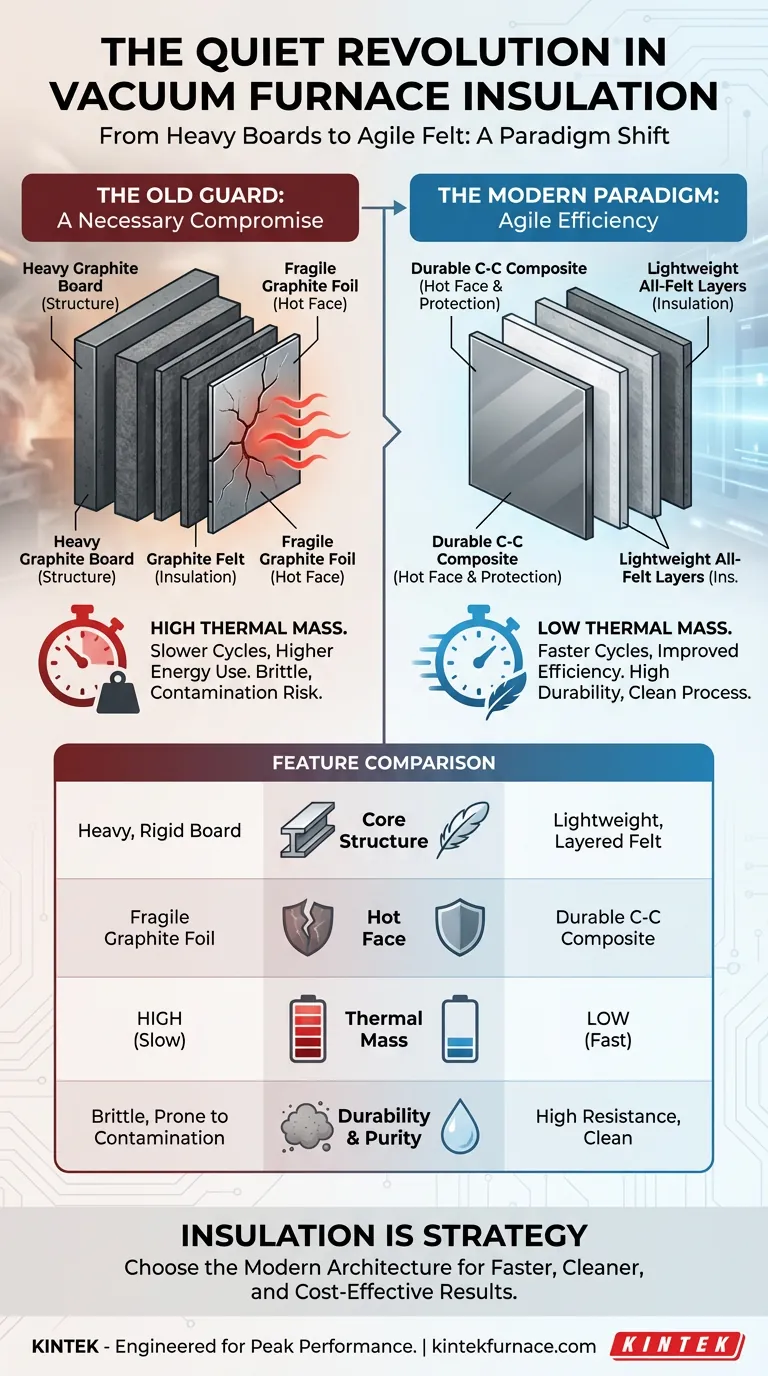
A thick, one-inch graphite board provided the structural skeleton of the hot zone. It was rigid and strong. Behind it, layers of graphite felt did the heavy lifting of thermal insulation. A thin graphite foil acted as a fragile shield, facing the intense heat.
This design worked, but it was a brute-force solution. It carried a hidden tax on every single cycle.
The Hidden Tax of Thermal Mass
The graphite board's primary virtue—its rigid mass—was also its greatest flaw. It acted as a heat sink, absorbing enormous amounts of energy during heating and releasing it slowly during cooling.
This high thermal mass meant longer cycle times and higher energy bills. The furnace was fighting its own insulation just as much as it was heating the payload. It was an accepted inefficiency, a cost of doing business baked into the very structure of the hot zone.
The Fragility Problem
The traditional system was also mechanically vulnerable. Graphite boards are brittle and prone to cracking under thermal stress. The graphite foil hot face could be easily damaged.
This wasn't just a maintenance issue. Cracks and degradation create dust and particulates, a critical source of contamination that can ruin sensitive processes. The insulation, meant to protect the process, could become its primary threat.
A Paradigm Shift: The All-Felt Architecture
The modern insulation package represents a fundamental shift in engineering philosophy—from rigid mass to agile efficiency.
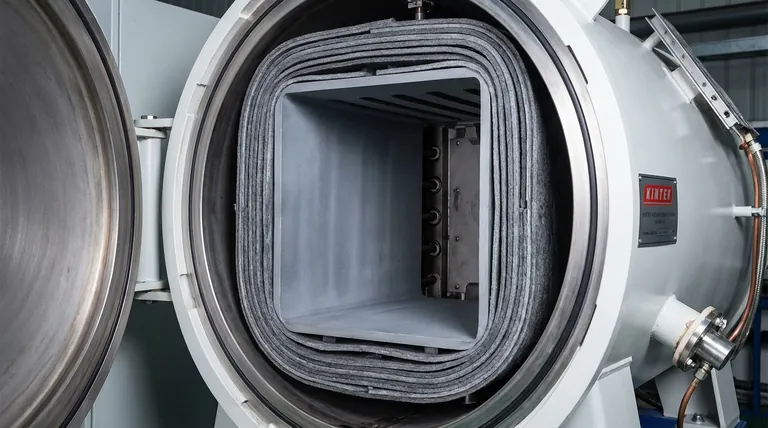
Instead of a heavy board, today’s advanced furnaces use a lighter, more thermally efficient package composed entirely of multiple graphite felt layers. This "all-felt" design dramatically reduces the system's thermal mass.
But this lighter core needs a better shield. The key innovation that makes this possible is the hot face.
The Unsung Hero: The Carbon-Carbon Hot Face
Fragile graphite foil is replaced by a thin, incredibly durable sheet of Carbon-Carbon (C-C) composite.
C-C composite is an engineering marvel. It is lightweight, exceptionally strong, and highly resistant to thermal shock and gas erosion. It provides the structural integrity and protection the all-felt package needs without the thermal penalty of a graphite board. It is the armor that enables the system to be both lightweight and tough.
This combination—the low-mass felt and the high-strength C-C hot face—transforms the furnace's performance. Heating and cooling cycles become significantly shorter. Energy consumption drops. The risk of particulate contamination is virtually eliminated.
Insulation Is Strategy, Not Just Material
Understanding this evolution allows you to make strategic decisions about your thermal processing capabilities. The insulation package is not just a component; it defines the performance envelope of the entire system.
| Feature | Traditional "Board & Felt" | Modern "All-Felt & C-C" |
|---|---|---|
| Core Structure | Heavy, rigid graphite board | Lightweight, layered graphite felt |
| Hot Face | Fragile graphite foil | Durable Carbon-Carbon (C-C) composite |
| Thermal Mass | High: Slower cycles, higher energy use | Low: Faster cycles, improved energy efficiency |
| Durability | Brittle, prone to cracking and dust contamination | High resistance to thermal shock and erosion |
| Primary Goal | Structural Integrity | Thermal Performance & Longevity |
For operations where speed, efficiency, and repeatability are paramount, the modern all-felt system is the definitive choice. Furnaces from specialized manufacturers like KINTEK are engineered around this principle, leveraging advanced R&D and in-house manufacturing to deliver systems built for peak performance. Their ability to deeply customize solutions means this modern architecture can be precisely tailored to unique experimental or production requirements.
For processes demanding the absolute highest purity, where even carbon is a contaminant, other options like all-metal hot zones with molybdenum or tungsten reflective shields exist. But for the vast majority of applications, the C-C-protected all-felt system offers the optimal balance of performance, durability, and efficiency.
Choosing a furnace is choosing a philosophy. By prioritizing a modern insulation strategy, you are investing directly in faster, cleaner, and more cost-effective results. To see how the right furnace architecture can resolve your specific operational bottlenecks, Contact Our Experts.
Visual Guide
Related Products
- Vacuum Sealed Continuous Working Rotary Tube Furnace Rotating Tube Furnace
- Vacuum Heat Treat Sintering Furnace with Pressure for Vacuum Sintering
- Small Vacuum Heat Treat and Tungsten Wire Sintering Furnace
- Vacuum Dental Porcelain Sintering Furnace for Dental Laboratories
- Vacuum Heat Treat Furnace with Ceramic Fiber Liner
Related Articles
- Beyond Heat: Mastering the Controlled Universe Inside a Tube Furnace
- Mastering the Void: How Tube Furnaces Forge the Atoms of Innovation
- Why Your Crystal Growth Experiments Are Failing: The Hidden Culprit in Your Tube Furnace
- The Art of Isolation: Mastering Material Properties with Tube Furnaces
- Beyond Heat: The Art of Control in a Tube Furnace



















