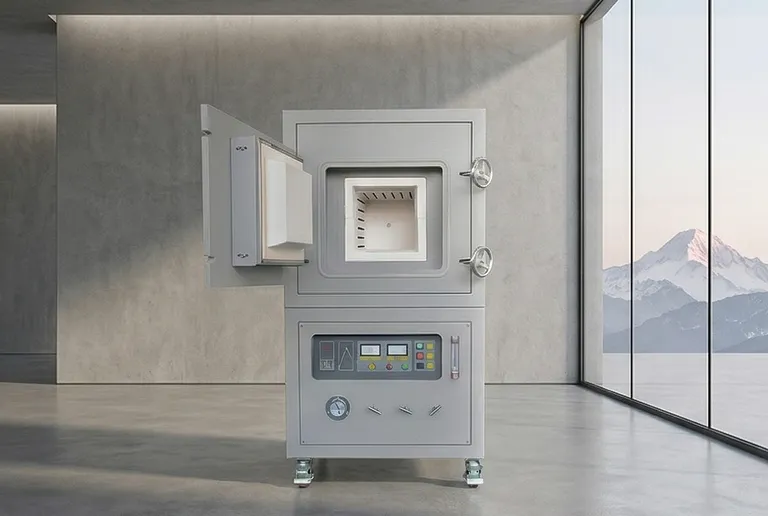
The "Heartbreak" of the Titanium Sintering Cycle
You’ve spent days preparing a high-purity titanium powder compact. The parameters are set, the induction furnace is hummed to life, and the rapid heating phase begins. But when the cycle ends and the part cools, the result is devastating: visible hairline fractures across the surface or, worse, an internal microstructure that is inconsistent and brittle.
For many lab managers and metallurgical engineers, this is a recurring nightmare. Titanium is a "miracle metal" for its strength-to-weight ratio, but in its powder compact form, it is notoriously temperamental. If your experimental data looks like a "fried egg"—over-sintered on the outside and under-dense in the middle—you aren't facing a material failure; you are facing a physics problem.
The Common Struggle: Why "Slowing Down" Isn't the Answer
When faced with cracking or poor density, the most common instinct is to slow the process down. Engineers often try to decrease the ramp rate, hoping that a longer, slower "soak" will allow the heat to migrate to the center of the compact.
While this might seem logical, it creates a new set of business and technical headaches:
- Oxygen Contamination: Titanium is a "getter" material; the longer it stays at high temperatures, the more it absorbs interstitial impurities like oxygen, which ruins ductility.
- Production Bottlenecks: Extending a 15-minute cycle to two hours kills throughput and increases energy costs.
- Thermal Stress: Even with a slower ramp, if the magnetic field is poorly distributed, the thermal gradient—the temperature difference between the core and the skin—remains.
The problem isn't the speed of the heating; it’s the geometry of the energy delivery.
The Root Cause: The "Skin Effect" and Thermal Gradients
To understand why titanium compacts fail, we have to look at the physics of induction. In a standard induction setup, the alternating magnetic field creates eddy currents on the surface of the metal. This is known as the "Skin Effect."
In powder metallurgy, the compact isn't a solid block yet; it’s a collection of particles with varying degrees of electrical contact. If you use a poorly designed or single-turn coil, the magnetic energy concentrates heavily on the outer "skin" of the compact. The exterior expands rapidly while the interior remains relatively cold and static. This massive internal tension is what causes the material to literally pull itself apart, resulting in the cracks you see post-sintering.
To fix this, you don't need more time; you need penetration depth and field uniformity.
The Solution: Precision-Engineered Multi-Turn Copper Coils
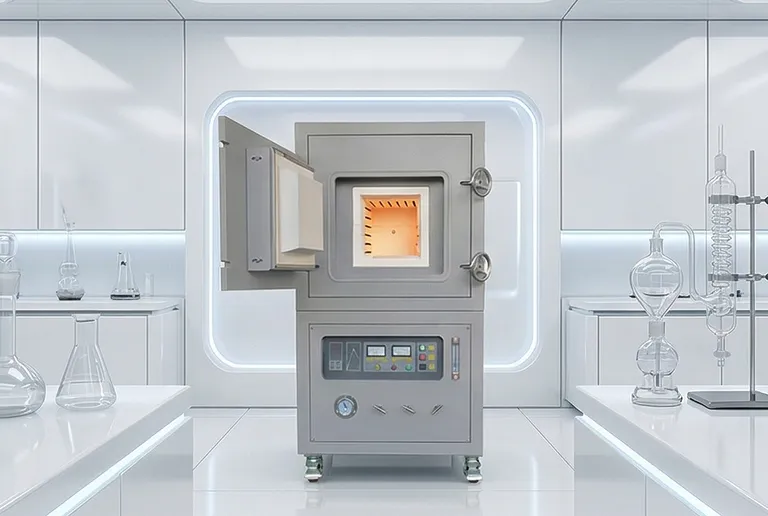
This is where the engineering of the induction coil becomes the deciding factor between a scrap part and a success. Multi-turn copper induction coils are not merely conductors; they are precision instruments designed to shape the magnetic field.
At KINTEK, we design our induction systems around the principle of total immersion. Here is how the right coil architecture solves the root cause:
- Uniform Field Distribution: By using multiple turns that completely surround the powder compact, we generate a balanced alternating magnetic field. This ensures that the magnetic flux lines aren't just hitting the surface but are distributed evenly across the entire volume of the workpiece.
- Simultaneous Core-to-Surface Heating: A well-calculated multi-turn design ensures the magnetic field penetrates to the required depth. This allows the center and the edges of the titanium compact to reach sintering temperatures simultaneously.
- Eliminating the Gradient: Because the heat is generated within the material at both the core and the surface at the same time, the thermal gradient is minimized. No gradient means no internal stress, and no internal stress means no cracks.
Beyond the Fix: Unlocking New Production Potential
Once you solve the "internal gradient crisis" through superior coil design, the transition from experimental lab work to scalable production becomes seamless.
By utilizing KINTEK’s customized induction melting and high-temperature furnace technology, you move beyond "fixing problems" and start "optimizing possibilities." When you can trust the microstructural consistency of your large titanium compacts, you can:
- Shorten R&D Cycles: Stop wasting weeks on failed samples.
- Achieve Near-Theoretical Density: Produce parts with superior mechanical properties that meet aerospace and medical standards.
- Scale with Confidence: What works for a small test compact can be scaled to larger, more complex geometries without the fear of structural failure.
The secret to mastering titanium isn't in fighting the physics of heat—it's in using a tool designed to master it.
Whether you are struggling with inconsistent sintering results or looking to design a custom induction setup for a unique alloy, our team is ready to help you bridge the gap between complex physics and reliable production. Let’s discuss how our precision-engineered induction solutions can stabilize your process and accelerate your project timelines. Contact Our Experts
Related Products
- 600T Vacuum Induction Hot Press Vacuum Heat Treat and Sintering Furnace
- Vacuum Induction Melting Furnace
- Vacuum Heat Treat Sintering Furnace with Pressure for Vacuum Sintering
- Vacuum Heat Treat Sintering Furnace Molybdenum Wire Vacuum Sintering Furnace
- Small Vacuum Heat Treat and Tungsten Wire Sintering Furnace
Related Articles
- How Vacuum Hot Press Furnaces Transform Advanced Material Engineering
- How to Select the Right Vacuum Hot Pressing Furnace Temperature for Your Materials
- How Vacuum Pressure Sintering Furnaces Elevate Material Performance Across Industries
- Beyond the Parts List: The Real Reason Your Vacuum Hot Press Fails (And How to Fix It)
- Why Your High-Temperature Materials Fail: The Hidden War Inside Your Furnace



















