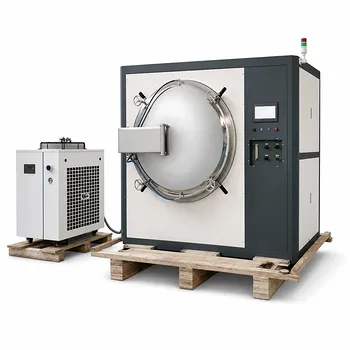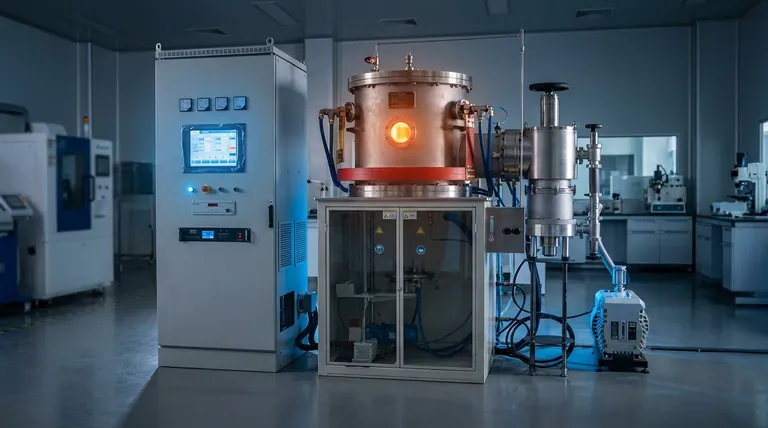
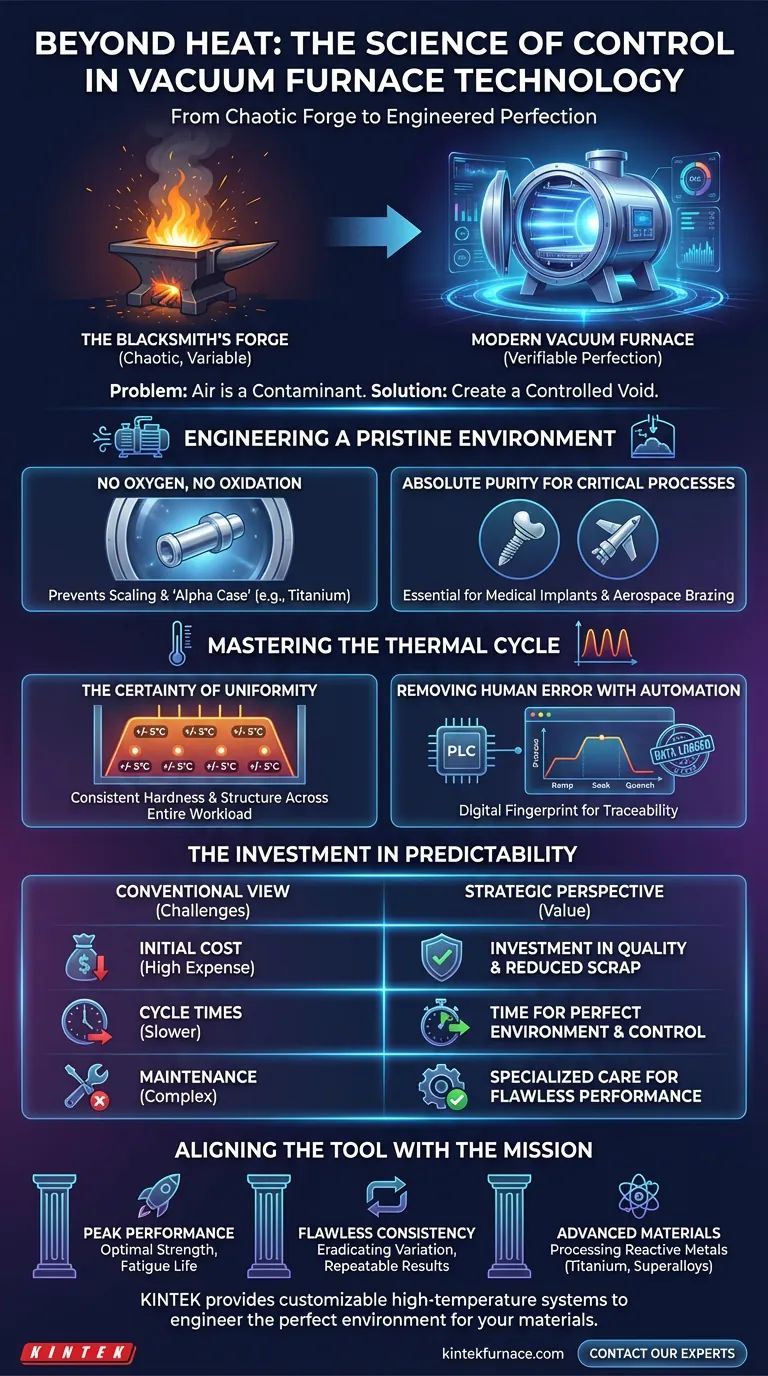
For centuries, the blacksmith’s forge was the heart of material transformation. It was a place of fire, intuition, and brute force—a chaotic dance between heat and the open air. The results were powerful, but variable. Every piece was unique, carrying the unpredictable signature of its creation.
Modern engineering, especially for aerospace, medical, or advanced electronics, cannot tolerate such variability. The goal is not artistry, but absolute, verifiable perfection.
The challenge is that the air itself is a contaminant. At high temperatures, the oxygen we breathe becomes a reactive agent, causing scaling and oxidation that compromise a material's surface and structural integrity.
This is the fundamental problem vacuum furnace technology solves. It isn't just about getting things hot; it's about creating a perfect, controlled void where heat can be applied with surgical precision.
The First Principle: Engineering a Pristine Environment
A vacuum furnace operates on a simple, profound principle: remove the atmosphere, and you remove the unwanted variables. By pumping out air, you eliminate oxygen, water vapor, and other reactive gases.
This act creates a pristine stage for thermal processing.
No Oxygen, No Oxidation
Without oxygen, detrimental surface reactions cannot occur. For materials like titanium, this prevents the formation of a brittle "alpha case" layer, which can lead to premature component failure. Parts emerge from the furnace as clean and bright as they went in.
Absolute Purity for Critical Processes
This engineered void ensures the only elements interacting with your component are the ones you intentionally introduce, like a specific backfill gas (e.g., argon) . This purity is non-negotiable for processes like:
- Medical Implants: Where surface contamination is unacceptable.
- Aerospace Brazing: Where a perfectly clean surface is essential for a strong, void-free joint that can withstand extreme stress.
From Void to Value: Mastering the Thermal Cycle
Once a stable vacuum is established, the furnace's true power is revealed: its ability to control the thermal process with unparalleled accuracy.
This transforms heat treatment from a bulk process into a precise engineering tool.
The Certainty of Uniformity
Modern vacuum furnaces can maintain temperature uniformity of +/- 5°C across an entire workload.
This means a component in the front corner of the furnace experiences the exact same thermal profile as one in the back. This uniformity guarantees consistent hardness, grain structure, and stress relief across every single part, every single time. It's the foundation of reliable performance.
Removing Human Error with Automation
These systems are managed by Programmable Logic Controllers (PLCs) that automate the entire cycle—from pump-down and heating ramps to soak times and controlled gas quenching.
Every cycle is executed identically and meticulously data-logged. This creates a digital fingerprint for each batch, providing the ultimate process control and traceability. It replaces guesswork with certainty.
The Investment in Predictability
Vacuum furnace technology is a deliberate choice, not a universal solution. Understanding its demands is key to appreciating its value.
| Consideration | The Conventional View | The Strategic Perspective |
|---|---|---|
| Initial Cost | High Expense | An investment in capability, quality assurance, and reduced scrap rates. |
| Cycle Times | Slower | The time required to achieve a perfect environment and a precisely controlled cool-down. |
| Maintenance | Complex | Specialized care for a high-precision instrument, ensuring it performs flawlessly. |
Choosing a vacuum furnace is a commitment to quality. It's for applications where the cost of failure is far greater than the cost of the equipment.
Aligning the Tool with the Mission
The decision hinges on your objective. A vacuum furnace becomes essential when your primary goals are:
- Peak Performance: Creating components with optimal strength and fatigue life for industries where failure is not an option.
- Flawless Consistency: Eradicating process variation to deliver perfectly repeatable results, batch after batch.
- Advanced Materials: Processing reactive metals like titanium or superalloys, where a vacuum environment is an absolute requirement.
Achieving this level of control requires a furnace that is not just powerful, but perfectly matched to your application. With deep expertise in R&D and manufacturing, KINTEK provides customizable high-temperature systems—including Muffle, Tube, Rotary, and advanced Vacuum Furnaces—designed for unique material processing needs. We help you engineer the perfect environment to unlock the full potential of your materials.
To explore a solution tailored to your mission-critical process, Contact Our Experts.
Visual Guide
Related Products
- Vacuum Hot Press Furnace Machine Heated Vacuum Press Tube Furnace
- Vacuum Hot Press Furnace Machine Heated Vacuum Press
- 600T Vacuum Induction Hot Press Vacuum Heat Treat and Sintering Furnace
- 2200 ℃ Tungsten Vacuum Heat Treat and Sintering Furnace
- Vacuum Heat Treat Sintering Furnace with Pressure for Vacuum Sintering
Related Articles
- How Vacuum Hot Press Furnaces Transform Advanced Material Engineering
- How to Select the Right Vacuum Hot Pressing Furnace Temperature for Your Materials
- Beyond the Parts List: The Real Reason Your Vacuum Hot Press Fails (And How to Fix It)
- Why Your High-Temperature Materials Fail: The Hidden War Inside Your Furnace
- Is Your Material Data Real? Why Temperature Gradients Are Sabotaging Your Cu2Se Resistivity Measurements