The Allure of the Perfect Void
In materials science and engineering, there's a deep-seated attraction to the idea of a perfect environment. We are conditioned to eliminate variables. A vacuum feels like the ultimate expression of this control—a sterile, predictable space free from the reactive interference of an atmosphere.
This desire is logical. Removing oxygen and other contaminants promises pristine, bright parts with superior metallurgical properties. It’s why we instinctively view a vacuum furnace as the pinnacle of heat treatment technology.
But this pursuit of perfection has a shadow. A vacuum furnace is not a universally superior tool; it is a highly specialized one. The decision to use it isn't just a technical choice but a strategic one, weighed down by hidden costs that can impact everything from your budget to your production schedule.
The Financial Gravity of a Vacuum
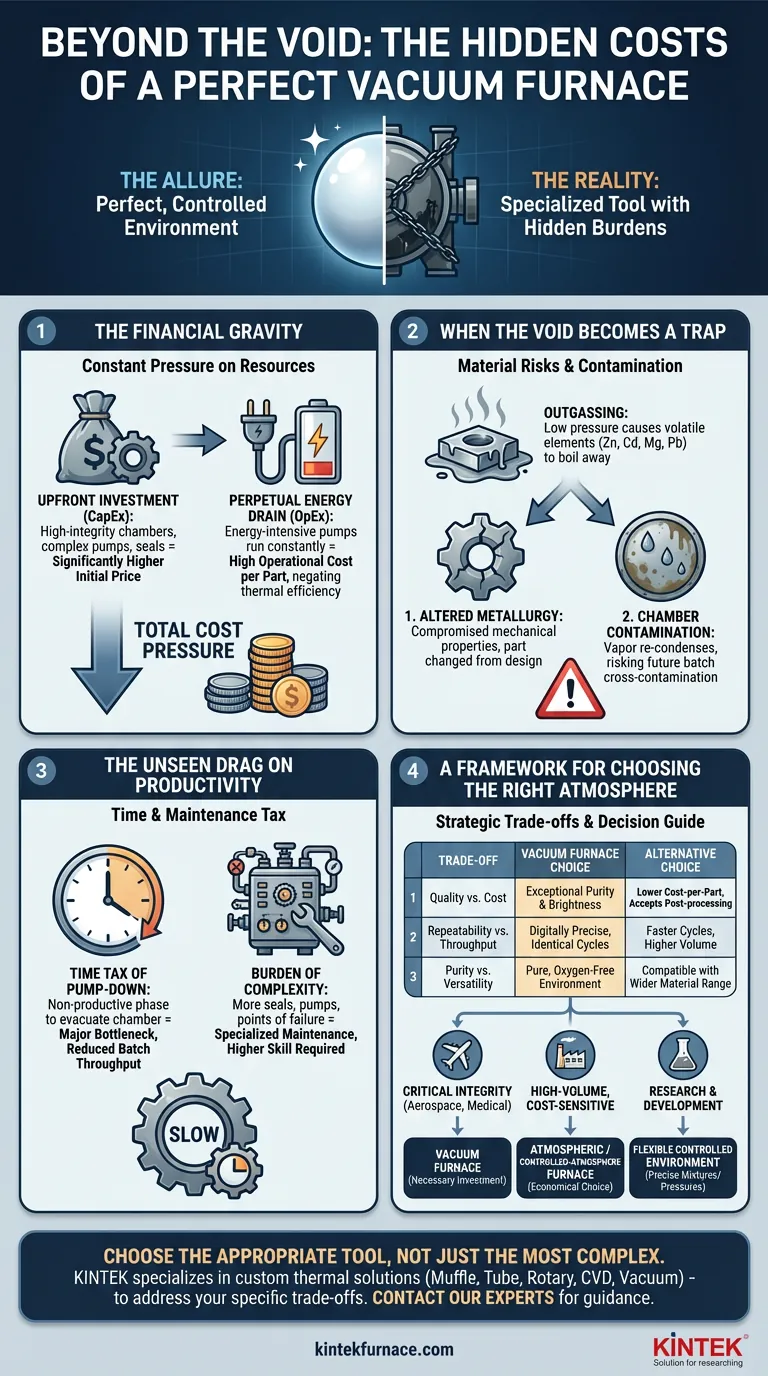
The most immediate and obvious trade-off is financial. The cost isn't a single event but a constant pressure on resources.
The Upfront Investment (CapEx)
Standard atmospheric furnaces are relatively simple systems. A vacuum furnace is an order of magnitude more complex. It requires high-integrity chambers capable of withstanding immense external pressure, sophisticated seals, complex valve arrangements, and powerful, multi-stage pumping systems. This advanced engineering translates directly to a significantly higher initial purchase price.
The Perpetual Energy Drain (OpEx)
The financial gravity continues long after the purchase. While the insulated chamber of a vacuum furnace can be very efficient at retaining heat, the system's total energy consumption is often far higher than its atmospheric counterpart.
The reason? The vacuum pumps. Achieving and maintaining a deep vacuum is an energy-intensive process. These pumps run for a significant portion of every cycle, often negating any thermal efficiencies and driving up the operational cost per part. It's the equivalent of buying a race car for its aerodynamic efficiency but forgetting the cost of high-octane fuel.
When the Void Becomes a Trap
The controlled environment of a vacuum is designed to protect a workpiece, but for certain materials, it becomes an aggressor.
The low-pressure environment can cause elements with high vapor pressures—like zinc, cadmium, magnesium, or lead—to literally boil away from the surface of an alloy, a phenomenon known as outgassing.
This has two disastrous consequences:
- Altered Metallurgy: The workpiece's chemical composition is changed, compromising its intended mechanical properties. The part that emerges is not the part you designed.
- Chamber Contamination: The vaporized elements re-condense on the furnace's cool interior walls, pumps, and fixtures. This contaminates the entire system, threatening to ruin future, unrelated batches with cross-contamination.
This limitation makes vacuum furnaces completely unsuitable for certain common brasses, bronzes, and specialized alloys, narrowing their operational scope.
The Unseen Drag on Productivity
Beyond money and materials, a vacuum furnace introduces a significant tax on a resource that is often the most critical: time.
The Time Tax of Pump-Down
While the ramp rates for heating and cooling in a vacuum can be rapid, the total cycle time is frequently longer than in an atmospheric furnace.
A large, non-productive portion of every cycle is dedicated to the pump-down phase—the time it takes for the pumps to evacuate the chamber to the target vacuum level. For any facility focused on high throughput, this built-in delay is a major bottleneck. It directly reduces the number of batches you can process in a shift, crippling overall productivity.
The Burden of Complexity
The mechanical sophistication of a vacuum furnace is also a maintenance liability. Every additional seal, gasket, valve, and pump is another potential point of failure.
Diagnosing and fixing a vacuum leak requires specialized knowledge and meticulous care. It demands a higher level of operator skill and a more rigorous maintenance schedule. An atmospheric furnace is often forgiving; a vacuum system is not. A single, microscopic leak can compromise an entire cycle, wasting energy, time, and valuable materials.
A Framework for Choosing the Right Atmosphere
The decision to use a vacuum furnace is an exercise in weighing its distinct benefits against its clear disadvantages. The right choice is dictated entirely by the non-negotiable requirements of your final product.
The central trade-offs can be summarized as follows:
| Trade-Off | The Vacuum Furnace Choice | The Alternative Choice |
|---|---|---|
| Quality vs. Cost | Exceptional purity and brightness. | Lower cost-per-part, accepts post-processing. |
| Repeatability vs. Throughput | Digitally precise, identical cycles. | Faster cycles, higher volume. |
| Purity vs. Versatility | Pure, oxygen-free environment. | Compatible with a wider range of materials. |
This leads to a clear decision framework based on your primary objective:
- For maximum material integrity in critical aerospace, medical, or electronic components, the costs and complexities of a vacuum furnace are a necessary investment. The quality is non-negotiable.
- For high-volume, cost-sensitive production, an atmospheric or controlled-atmosphere furnace (like a Tube or Muffle furnace) is almost always the more economical and efficient choice.
- For research and development, flexibility is paramount. The goal isn't just to achieve a vacuum but to precisely control the processing environment, which may require various gas mixtures or pressure levels.
True engineering elegance lies not in choosing the most complex tool, but the most appropriate one. The challenge is that sometimes the lines are blurry, and a standard solution doesn't fit your unique material or process. This is where expertise in customization becomes critical. At KINTEK, we specialize in engineering a wide range of thermal solutions—from Muffle, Tube, and Rotary furnaces to advanced CVD and Vacuum systems—all built to address these specific trade-offs. We help you define the problem, not just sell you a product.
If you're navigating the complex choice of the right furnace technology for your application, let our experience guide you to the most effective and economical solution. Contact Our Experts
Visual Guide
Related Products
- Vacuum Hot Press Furnace Machine Heated Vacuum Press Tube Furnace
- Vacuum Hot Press Furnace Machine Heated Vacuum Press
- 600T Vacuum Induction Hot Press Vacuum Heat Treat and Sintering Furnace
- 2200 ℃ Tungsten Vacuum Heat Treat and Sintering Furnace
- Vacuum Heat Treat Sintering Furnace with Pressure for Vacuum Sintering
Related Articles
- How Vacuum Hot Press Furnaces Transform Advanced Material Engineering
- How to Select the Right Vacuum Hot Pressing Furnace Temperature for Your Materials
- Beyond the Parts List: The Real Reason Your Vacuum Hot Press Fails (And How to Fix It)
- Why Your High-Temperature Materials Fail: The Hidden War Inside Your Furnace
- Is Your Material Data Real? Why Temperature Gradients Are Sabotaging Your Cu2Se Resistivity Measurements