
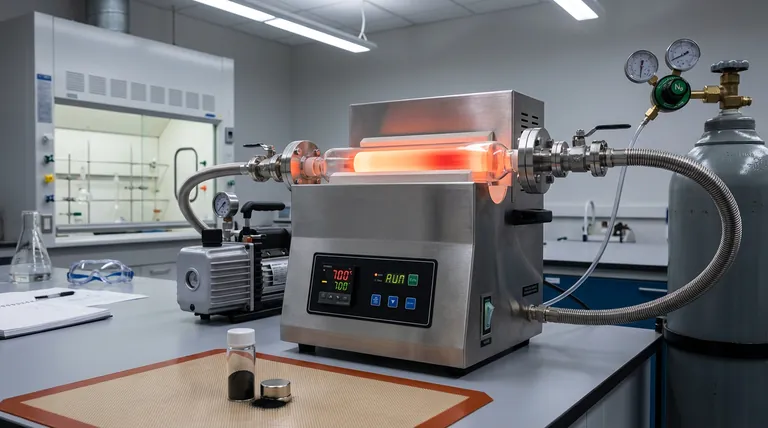
A high-vacuum or atmosphere-controlled environment is non-negotiable for this synthesis because it prevents the immediate oxidation of the carbon source and iron precursors. This controlled environment, typically utilizing nitrogen, creates the specific reduction conditions required to pyrolyze biomass into a porous matrix while simultaneously converting iron precursors into magnetic zero-valent iron (ZVI) nanoparticles.
Core Takeaway The tube furnace acts as a strict chemical gatekeeper, not just a heater. Its primary function is to exclude atmospheric oxygen, allowing the carbon source itself to release reducing gases that transform iron precursors into magnetic particles—a process that would fail completely in an open-air environment.
The Critical Role of Atmosphere Control
Preserving the Carbon Matrix
The synthesis of Mesoporous Magnetic Carbon relies on the pyrolysis of biomass.
If oxygen were present, the biomass would simply burn away (combust) into ash and carbon dioxide.
An atmosphere-controlled tube furnace, often utilizing a stable nitrogen flow, ensures the biomass carbonizes into a stable, porous structure rather than disintegrating.
Enabling Carbothermal Reduction
The core chemical reaction involves reducing iron precursors into zero-valent iron (ZVI) nanoparticles and iron oxides.
This reduction is driven by gases released by the decomposing carbon source within the furnace.
The furnace must maintain a sealed environment to keep these reducing gases concentrated around the iron precursors, facilitating the chemical transformation.
Temperature Control and Material Properties
Defining Magnetic Strength
The precise regulation of temperature directly dictates the magnetization strength of the final composite.
Operating within a specific window, typically between 600°C and 800°C, allows for the correct phase composition of the iron.
Fluctuations outside this range can lead to non-magnetic iron phases or insufficient crystallinity.
Controlling Pore Structure
The "mesoporous" quality of the material is determined by how the biomass decomposes under heat.
The tube furnace's temperature control regulates the grain size of the developing material.
This ensures the final product achieves the high surface area and specific porosity required for its intended application.
Understanding the Trade-offs: Vacuum vs. Atmosphere
The Thermodynamic Advantage of Vacuum
While a flowing nitrogen atmosphere is sufficient for many MMC syntheses, a high-vacuum environment offers distinct thermodynamic benefits.
A vacuum environment can significantly reduce the thermodynamic temperature required for carbothermal reduction reactions.
This allows reactions to occur at lower energy inputs, potentially preserving delicate pore structures that might collapse at higher temperatures.
Operational Complexity
Atmosphere-controlled systems (using inert gas flow) are generally simpler to operate than high-vacuum systems.
However, vacuum systems provide superior removal of volatile impurities.
The choice between the two often depends on whether the priority is process simplicity or maximum thermodynamic efficiency.
Making the Right Choice for Your Goal
To ensure the successful synthesis of Mesoporous Magnetic Carbon, align your equipment settings with your specific objectives:
- If your primary focus is Phase Purity and Magnetism: Prioritize a furnace with high-precision temperature control (600°C–800°C) and a strictly managed nitrogen atmosphere to ensure complete reduction of iron precursors.
- If your primary focus is Energy Efficiency: Consider a vacuum tube furnace, as the reduced pressure lowers the thermodynamic barrier, allowing the reduction reaction to occur at lower temperatures.
Ultimately, the furnace atmosphere is the reagent that dictates whether you produce a high-performance magnetic composite or simply burnt ash.
Summary Table:
| Feature | Atmosphere-Controlled (N2) | High-Vacuum Environment |
|---|---|---|
| Primary Function | Prevents combustion of biomass | Lowers reduction temperature |
| Mechanism | Excludes oxygen via inert gas flow | Thermodynamic reduction of pressure |
| Reaction Focus | High phase purity & magnetism | Energy efficiency & pore preservation |
| Temperature Range | 600°C – 800°C (Standard) | Potentially lower than standard |
| Complexity | Moderate / Simple operation | Higher / Superior impurity removal |
Elevate Your Materials Synthesis with KINTEK Precision
Don't let atmospheric oxygen ruin your Mesoporous Magnetic Carbon research. KINTEK provides industry-leading high-vacuum tube furnaces and atmosphere-controlled systems designed specifically for sensitive carbothermal reduction processes.
Why choose KINTEK?
- Expert R&D & Manufacturing: Our systems offer the high-precision temperature stability (600°C–800°C) required for optimal magnetization.
- Versatile Solutions: Choose from Muffle, Tube, Rotary, Vacuum, and CVD systems tailored to your lab’s unique needs.
- Strict Control: Guaranteed leak-tight performance to ensure your carbon source acts as the reagent, not fuel for combustion.
Ready to achieve superior phase purity and pore structure? Contact KINTEK today for a custom consultation and let our experts help you select the perfect high-temperature furnace for your application.
References
- Shaimaa K. Mohamed, Rasha M. Kamel. Efficient and low-cost mesoporous magnetic carbon composites derived from date palm stones for environmental remediation of hexavalent chromium. DOI: 10.1007/s10934-024-01611-x
This article is also based on technical information from Kintek Furnace Knowledge Base .
Related Products
- 1200℃ Controlled Inert Nitrogen Atmosphere Furnace
- Vacuum Sealed Continuous Working Rotary Tube Furnace Rotating Tube Furnace
- 1700℃ Controlled Inert Nitrogen Atmosphere Furnace
- High Pressure Laboratory Vacuum Tube Furnace
- Laboratory Vacuum Tilt Rotary Tube Furnace Rotating Tube Furnace
People Also Ask
- What controlled-atmosphere furnace conditions are required for sintering powder metallurgy copper alloy compacts? Ideal Setup
- How Sintering Temp Affects Density & Resistivity of Cu-Oxide Composites
- Why is a controlled atmosphere furnace required for 316L debinding? Ensure Structural Integrity & Zero Cracks
- What are the four main types of controlled atmospheres used in these furnaces? Optimize Your Heat Treatment Processes
- What types of gases are used in controlled atmosphere furnaces? Optimize Material Protection and Transformation



















