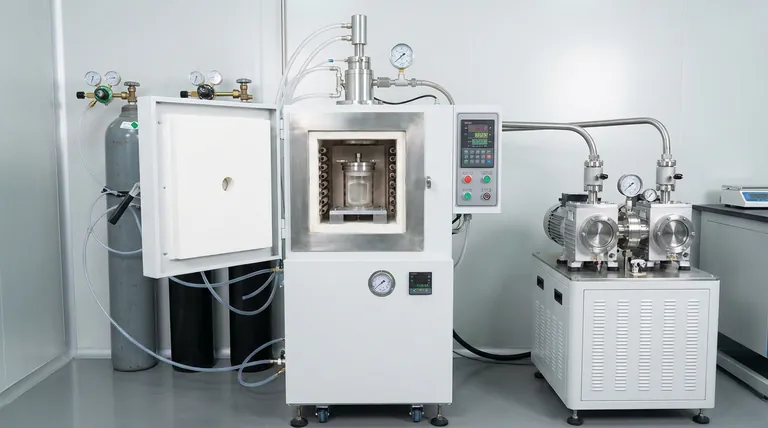
High-vacuum pump groups are essential for establishing a baseline of chemical purity within sealed quartz reaction chambers. By thoroughly evacuating residual air and facilitating argon gas purging, these systems ensure the reaction environment is free from environmental contaminants before the experiment begins.
The reliability of photothermal catalytic data hinges on eliminating uncontrolled variables. High-vacuum pumps remove residual impurities, ensuring that experimental outcomes regarding yield and selectivity are the result of precise reactant ratios rather than atmospheric interference.
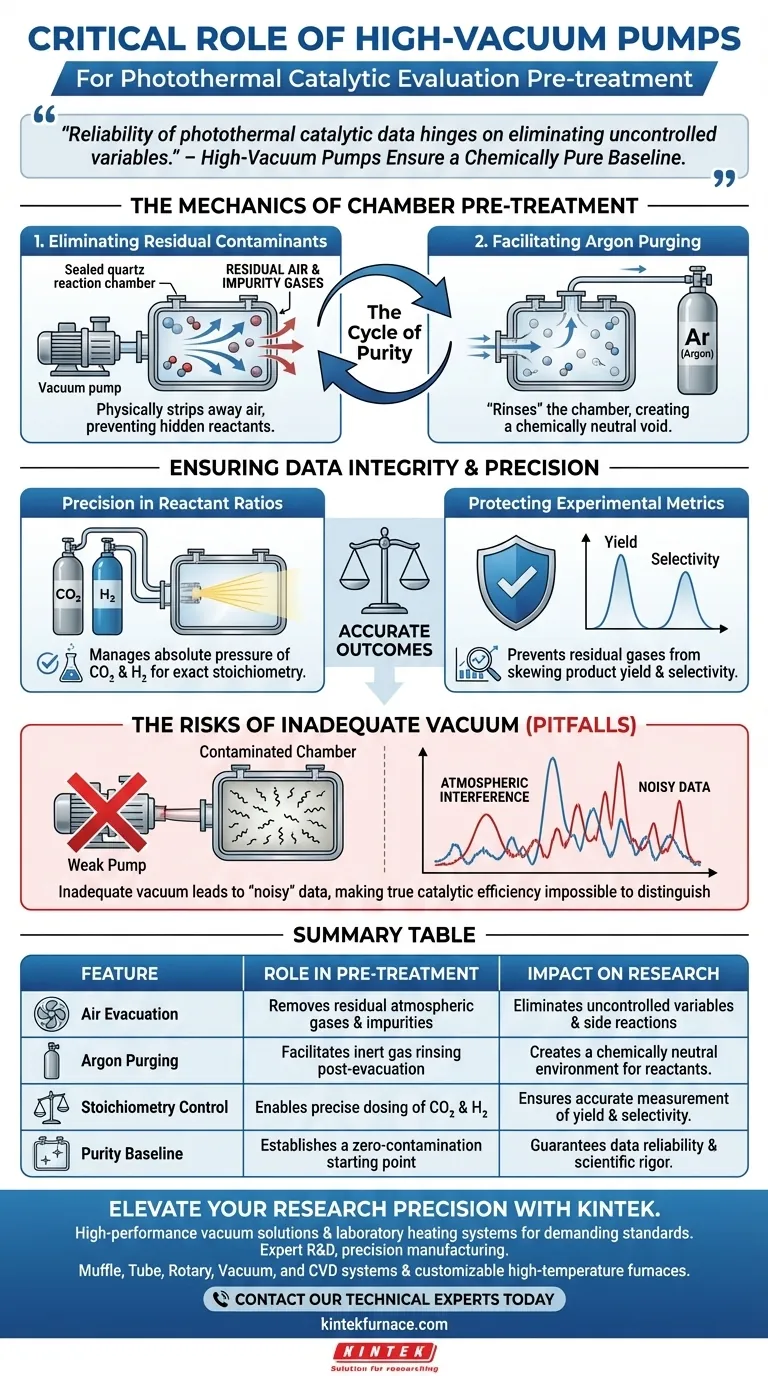
The Mechanics of Chamber Pre-treatment
Eliminating Residual Contaminants
You cannot obtain accurate data if your reaction starts with unknown variables. The primary function of the high-vacuum pump group is to evacuate the sealed quartz reaction chamber.
This process physically strips away residual air and impurity gases that are naturally present in the system. Without this step, these impurities would remain as hidden reactants.
Facilitating Argon Purging
Evacuation is rarely a standalone step; it prepares the stage for inert environments. The pump group allows for effective argon gas purging following evacuation.
This cycle ensures that the chamber is not only empty of air but effectively "rinsed" with inert gas. This creates a chemically neutral void ready for the introduction of active reactants.
Ensuring Data Integrity and Precision
Precision in Reactant Ratios
Photothermal catalysis relies on exact stoichiometry. Once the chamber is cleared of background noise, reactants such as carbon dioxide ($CO_2$) and hydrogen ($H_2$) are introduced.
Because the vacuum process has removed the air, the pressure and concentration of these gases can be managed with absolute control. This ensures the reactant ratios are precise and deliberate.
Protecting Experimental Metrics
The ultimate goal is to validate the catalyst's performance. If residual gases are present, they can skew critical data points, specifically product yield and selectivity.
High-vacuum pre-treatment acts as a firewall against this atmospheric interference. It guarantees that the results observed are due to the photothermal reaction alone, not side reactions caused by impurities.
The Risks of Inadequate Vacuum (Common Pitfalls)
The "Atmospheric Interference" Trap
The most significant trade-off in this process is the operational requirement for rigorous preparation versus the risk of compromised data.
If the vacuum stage is rushed or the pump group is insufficient, residual air will remain. This results in "noisy" data where it becomes impossible to distinguish true catalytic efficiency from the effects of contamination.
Ensuring Reliable Catalytic Evaluations
To maximize the validity of your photothermal catalytic experiments, view the vacuum system as a calibration tool for your chemical environment.
- If your primary focus is Data Accuracy: Prioritize high-vacuum capability to ensure complete removal of residual air, preventing false readings in product yield.
- If your primary focus is Process Control: Use the pump group to establish a precise baseline, allowing for exact control over the ratios of carbon dioxide and hydrogen.
The high-vacuum pump group is the gatekeeper of scientific rigor, transforming a variable-filled environment into a controlled laboratory standard.
Summary Table:
| Feature | Role in Pre-treatment | Impact on Research |
|---|---|---|
| Air Evacuation | Removes residual atmospheric gases and impurities | Eliminates uncontrolled variables and side reactions |
| Argon Purging | Facilitates inert gas rinsing post-evacuation | Creates a chemically neutral environment for reactants |
| Stoichiometry Control | Enables precise dosing of $CO_2$ and $H_2$ | Ensures accurate measurement of yield and selectivity |
| Purity Baseline | Establishes a zero-contamination starting point | Guarantees data reliability and scientific rigor |
Elevate Your Research Precision with KINTEK
Don't let atmospheric interference compromise your photothermal catalytic data. KINTEK provides high-performance vacuum solutions and laboratory heating systems engineered for the most demanding scientific standards.
Backed by expert R&D and precision manufacturing, we offer a comprehensive range of Muffle, Tube, Rotary, Vacuum, and CVD systems. Whether you need standard lab equipment or a fully customizable high-temperature furnace tailored to your unique reaction chamber requirements, KINTEK delivers the reliability your research deserves.
Ready to optimize your experimental environment? Contact our technical experts today to find the perfect vacuum or furnace solution for your laboratory.
Visual Guide
References
- Jinglin Li, Baowen Zhou. Photo-thermal synergistic CO <sub>2</sub> hydrogenation towards CO over PtRh bimetal-decorated GaN nanowires/Si. DOI: 10.1039/d4sc01530d
This article is also based on technical information from Kintek Furnace Knowledge Base .
Related Products
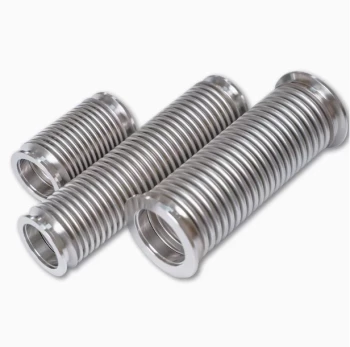
- High Performance Vacuum Bellows for Efficient Connection and Stable Vacuum in Systems
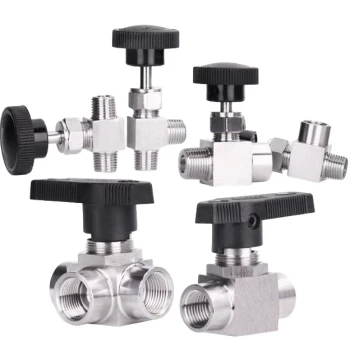
- 304 316 Stainless Steel High Vacuum Ball Stop Valve for Vacuum Systems
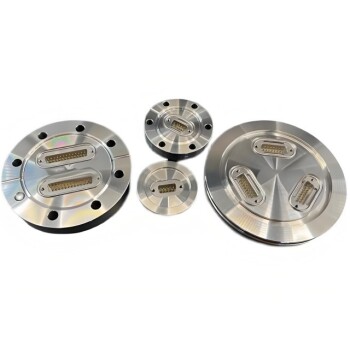
- Ultra-High Vacuum Flange Aviation Plug Glass Sintered Airtight Circular Connector for KF ISO CF
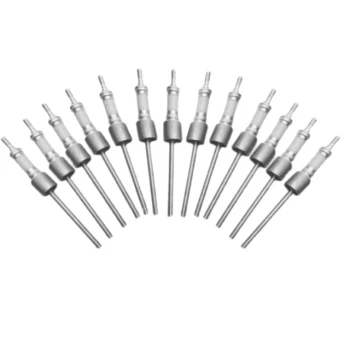
- Ultra Vacuum Electrode Feedthrough Connector Flange Power Lead for High Precision Applications
- Stainless Steel KF ISO Vacuum Flange Blind Plate for High Vacuum Systems
People Also Ask
- Why is an Ultra-High Vacuum (UHV) System Required for In2Se3? Achieving Atomic-Level Ferroelectric Clarity
- Why is an environmental laboratory chamber equipped with an optical window required for synthesizing Hafnium Carbide?
- What role does a closed pressure vessel play during the carbonation of gamma-C2S? Unlock Rapid Mineralization
- Why are desiccators containing saturated salt solutions used when evaluating the hygroscopicity of modified wood?
- How does the pressure environment affect the metallic thermal reduction for titanium? Master Precision Control