Knowledge Why is the first stage of sintering in a tube vacuum sintering furnace necessary? Master the Space-Holder Technique
Author avatar

Tech Team · Kintek Furnace

Updated 1 day ago

Why is the first stage of sintering in a tube vacuum sintering furnace necessary? Master the Space-Holder Technique


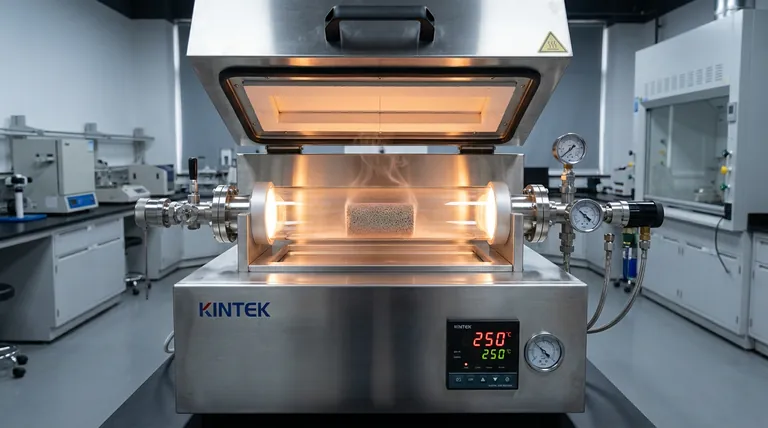
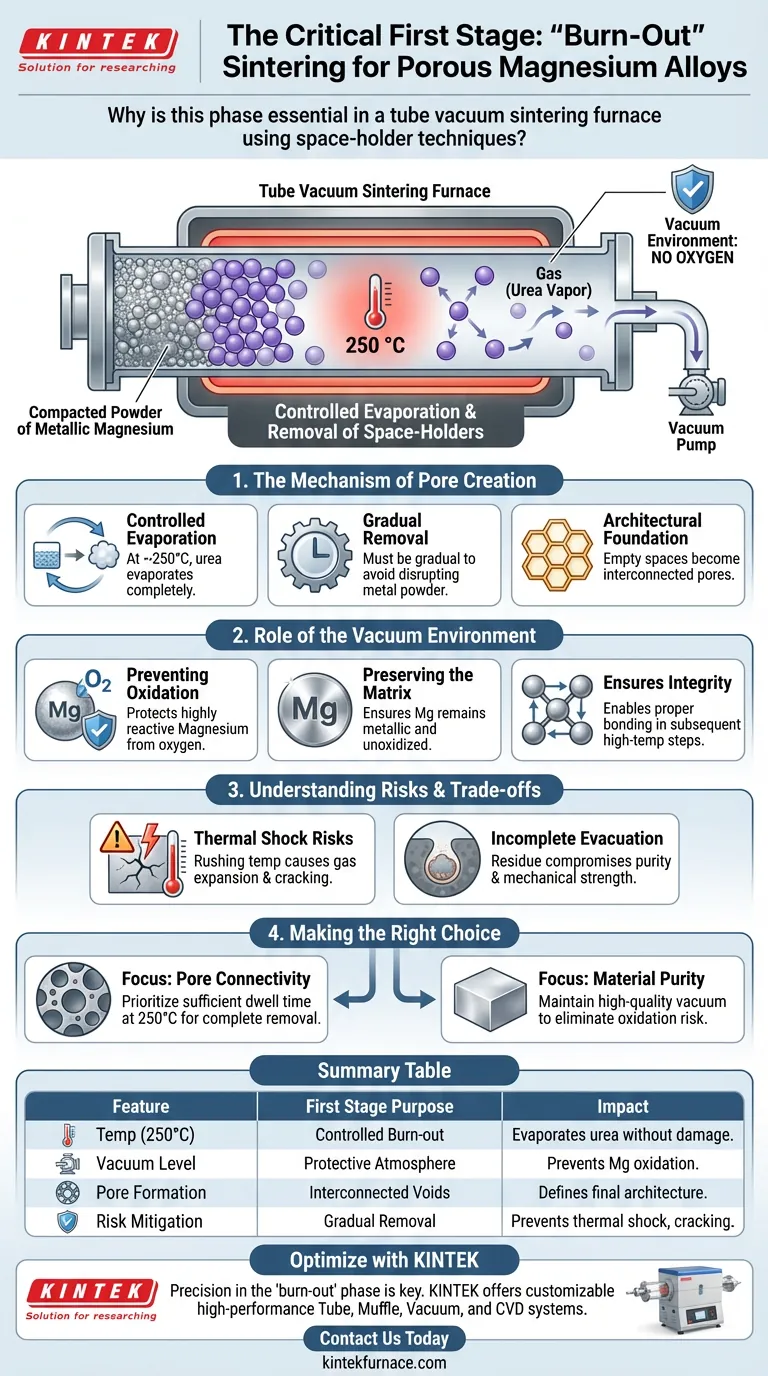
The first stage of sintering is the critical "burn-out" phase essential for structural formation. It is specifically designed to remove space-holding agents, such as urea, through controlled evaporation at lower temperatures like 250 °C. This creates the necessary interconnected pore structure while employing a vacuum to protect the highly reactive magnesium matrix from severe oxidation.

By effectively separating pore formation from the final metal bonding, this stage prevents the magnesium from oxidizing while ensuring the space-holder is completely evacuated.
Why is the first stage of sintering in a tube vacuum sintering furnace necessary? Master the Space-Holder Technique

The Mechanism of Pore Creation

Controlled Evaporation

The primary goal of this initial stage is to facilitate the phase change of the space-holder. At temperatures around 250 °C, agents like urea evaporate.

Gradual Removal

This process must be controlled and gradual. If the agent evaporates too quickly, it can disrupt the surrounding metal powder.

Architectural Foundation

As the urea leaves the system, it creates specific voids. These empty spaces become the interconnected pores that define the material's porous characteristics.

The Role of the Vacuum Environment

Preventing Oxidation

Magnesium is an extremely reactive metal, particularly when heated. Without a protective environment, it would react aggressively with oxygen.

Preserving the Matrix

The vacuum environment is non-negotiable during this phase. It ensures that while the urea is being removed, the magnesium powder remains metallic and unoxidized.

Ensuring Structural Integrity

If oxidation were to occur at this stage, the magnesium particles would develop oxide layers. These layers would prevent proper bonding during the subsequent high-temperature sintering.

Understanding the Risks and Trade-offs

Thermal Shock Risks

This stage requires strict temperature regulation. Rushing to higher temperatures before the space-holder is fully removed can cause rapid gas expansion, cracking the delicate material.

Incomplete Evacuation

If the vacuum pressure is insufficient or the time at 250 °C is too short, residue from the space-holder may remain. This contamination compromises the purity and mechanical strength of the final alloy.

Making the Right Choice for Your Goal

To ensure the success of your porous magnesium alloy project, prioritize the specific parameters of this first stage.

  • If your primary focus is Pore Connectivity: Ensure the dwell time at 250 °C is sufficient to allow for the complete and gentle evacuation of the entire urea content.
  • If your primary focus is Material Purity: Maintain a high-quality vacuum throughout the entire evaporation phase to eliminate any risk of magnesium oxidation.

Mastering this initial low-temperature phase is the only way to guarantee a porous structure that is both mechanically stable and chemically pure.

Summary Table:

Feature First Stage Purpose Impact on Porous Magnesium
Temperature (250°C) Controlled Burn-out Evaporates urea/space-holders without damaging structure.
Vacuum Level Protective Atmosphere Prevents oxidation of reactive magnesium powder.
Pore Formation Interconnected Voids Defines the final material's architectural foundation.
Risk Mitigation Gradual Removal Prevents thermal shock, gas expansion, and cracking.

Optimize Your Advanced Material Synthesis with KINTEK

Precision in the 'burn-out' phase is the difference between a high-performance porous alloy and a failed project. KINTEK provides the specialized equipment needed to master these delicate thermal cycles. Backed by expert R&D and manufacturing, we offer high-performance Tube, Muffle, Vacuum, and CVD systems—all fully customizable to meet your specific research or production requirements.

Don't let oxidation or thermal shock compromise your structural integrity. Contact us today to discover how our high-temperature lab furnaces can enhance your material purity and sintering efficiency.

Visual Guide
Why is the first stage of sintering in a tube vacuum sintering furnace necessary? Master the Space-Holder Technique Visual Guide

References

  1. Divyanshu Aggarwal, Manoj Gupta. Porous Mg–Hydroxyapatite Composite Incorporated with Aloe barbadensis Miller for Scaphoid Fracture Fixation: A Natural Drug Loaded Orthopedic Implant. DOI: 10.3390/app14041512

This article is also based on technical information from Kintek Furnace Knowledge Base .

Related Products

People Also Ask

Related Products

1700℃ High Temperature Laboratory Tube Furnace with Quartz or Alumina Tube

1700℃ High Temperature Laboratory Tube Furnace with Quartz or Alumina Tube

KINTEK's Tube Furnace with Alumina Tube: Precision heating up to 1700°C for material synthesis, CVD, and sintering. Compact, customizable, and vacuum-ready. Explore now!

Vacuum Heat Treat Sintering Furnace Molybdenum Wire Vacuum Sintering Furnace

Vacuum Heat Treat Sintering Furnace Molybdenum Wire Vacuum Sintering Furnace

KINTEK's Vacuum Molybdenum Wire Sintering Furnace excels in high-temperature, high-vacuum processes for sintering, annealing, and material research. Achieve precise 1700°C heating with uniform results. Custom solutions available.

Vacuum Heat Treat Sintering Furnace with Pressure for Vacuum Sintering

Vacuum Heat Treat Sintering Furnace with Pressure for Vacuum Sintering

KINTEK's Vacuum Pressure Sintering Furnace offers 2100℃ precision for ceramics, metals, and composites. Customizable, high-performance, and contamination-free. Get a quote now!

Laboratory Vacuum Tilt Rotary Tube Furnace Rotating Tube Furnace

Laboratory Vacuum Tilt Rotary Tube Furnace Rotating Tube Furnace

KINTEK Laboratory Rotary Furnace: Precision heating for calcination, drying, sintering. Customizable solutions with vacuum & controlled atmosphere. Enhance research now!

Small Vacuum Heat Treat and Tungsten Wire Sintering Furnace

Small Vacuum Heat Treat and Tungsten Wire Sintering Furnace

Compact vacuum tungsten wire sintering furnace for labs. Precise, mobile design with superior vacuum integrity. Ideal for advanced material research. Contact us!

High Pressure Laboratory Vacuum Tube Furnace Quartz Tubular Furnace

High Pressure Laboratory Vacuum Tube Furnace Quartz Tubular Furnace

KINTEK High Pressure Tube Furnace: Precision heating up to 1100°C with 15Mpa pressure control. Ideal for sintering, crystal growth, and lab research. Customizable solutions available.

2200 ℃ Tungsten Vacuum Heat Treat and Sintering Furnace

2200 ℃ Tungsten Vacuum Heat Treat and Sintering Furnace

2200°C Tungsten Vacuum Furnace for high-temperature materials processing. Precise control, superior vacuum, customizable solutions. Ideal for research & industrial applications.

1400℃ High Temperature Laboratory Tube Furnace with Quartz and Alumina Tube

1400℃ High Temperature Laboratory Tube Furnace with Quartz and Alumina Tube

KINTEK's Tube Furnace with Alumina Tube: Precision high-temperature processing up to 2000°C for labs. Ideal for material synthesis, CVD, and sintering. Customizable options available.

Vacuum Hot Press Furnace Machine Heated Vacuum Press Tube Furnace

Vacuum Hot Press Furnace Machine Heated Vacuum Press Tube Furnace

Discover KINTEK's advanced Vacuum Tube Hot Press Furnace for precise high-temperature sintering, hot pressing, and material bonding. Customizable solutions for labs.

Molybdenum Vacuum Heat Treat Furnace

Molybdenum Vacuum Heat Treat Furnace

High-performance molybdenum vacuum furnace for precise 1400°C heat treatment. Ideal for sintering, brazing, and crystal growth. Durable, efficient, and customizable.

Vacuum Sealed Continuous Working Rotary Tube Furnace Rotating Tube Furnace

Vacuum Sealed Continuous Working Rotary Tube Furnace Rotating Tube Furnace

Precision rotary tube furnace for continuous vacuum processing. Ideal for calcination, sintering, and heat treatment. Customizable up to 1600℃.

2200 ℃ Graphite Vacuum Heat Treat Furnace

2200 ℃ Graphite Vacuum Heat Treat Furnace

2200℃ Graphite Vacuum Furnace for high-temperature sintering. Precise PID control, 6*10⁻³Pa vacuum, durable graphite heating. Ideal for research & production.

Split Chamber CVD Tube Furnace with Vacuum Station CVD Machine

Split Chamber CVD Tube Furnace with Vacuum Station CVD Machine

Split Chamber CVD Tube Furnace with Vacuum Station - High precision 1200°C lab furnace for advanced materials research. Customizable solutions available.

Multi Heating Zones CVD Tube Furnace Machine for Chemical Vapor Deposition Equipment

Multi Heating Zones CVD Tube Furnace Machine for Chemical Vapor Deposition Equipment

KINTEK's Multi-Zone CVD Tube Furnaces offer precision temperature control for advanced thin film deposition. Ideal for research and production, customizable for your lab needs.

Vacuum Heat Treat Sintering and Brazing Furnace

Vacuum Heat Treat Sintering and Brazing Furnace

KINTEK Vacuum Brazing Furnaces deliver precision, clean joints with superior temperature control. Customizable for diverse metals, ideal for aerospace, medical, and thermal applications. Get a quote!

9MPa Air Pressure Vacuum Heat Treat and Sintering Furnace

9MPa Air Pressure Vacuum Heat Treat and Sintering Furnace

Achieve superior ceramic densification with KINTEK's advanced air pressure sintering furnace. High-pressure up to 9MPa, precise 2200℃ control.

Dental Porcelain Zirconia Sintering Ceramic Vacuum Press Furnace

Dental Porcelain Zirconia Sintering Ceramic Vacuum Press Furnace

Precision Vacuum Press Furnace for labs: ±1°C accuracy, 1200°C max, customizable solutions. Boost research efficiency today!

600T Vacuum Induction Hot Press Vacuum Heat Treat and Sintering Furnace

600T Vacuum Induction Hot Press Vacuum Heat Treat and Sintering Furnace

600T Vacuum Induction Hot Press Furnace for precise sintering. Advanced 600T pressure, 2200°C heating, vacuum/atmosphere control. Ideal for research & production.

Custom Made Versatile CVD Tube Furnace Chemical Vapor Deposition CVD Equipment Machine

Custom Made Versatile CVD Tube Furnace Chemical Vapor Deposition CVD Equipment Machine

KINTEK's CVD Tube Furnace offers precision temperature control up to 1600°C, ideal for thin film deposition. Customizable for research and industrial needs.

1700℃ Controlled Inert Nitrogen Atmosphere Furnace

1700℃ Controlled Inert Nitrogen Atmosphere Furnace

KT-17A Controlled Atmosphere Furnace: Precise 1700°C heating with vacuum & gas control. Ideal for sintering, research & material processing. Explore now!


Leave Your Message


















