
The Chemical Vapor Transport (CVT) method is preferred for synthesizing Janus RhSeCl single crystals because it effectively manages the extreme kinetic differences between the high melting point of metal Rhodium (Rh) and the low sublimation point of non-metal Selenium (Se). Unlike solid-phase reactions, CVT utilizes a gaseous transport agent to bypass these disparities, preventing compositional inconsistencies and enabling the growth of high-quality, large-scale Janus single crystals.
The critical advantage of CVT lies in its ability to facilitate gas-phase growth through a controlled temperature gradient. By converting solid precursors into a vapor, this method overcomes the physical limitations of disparate melting points, ensuring the formation of uniform, high-purity single crystals.
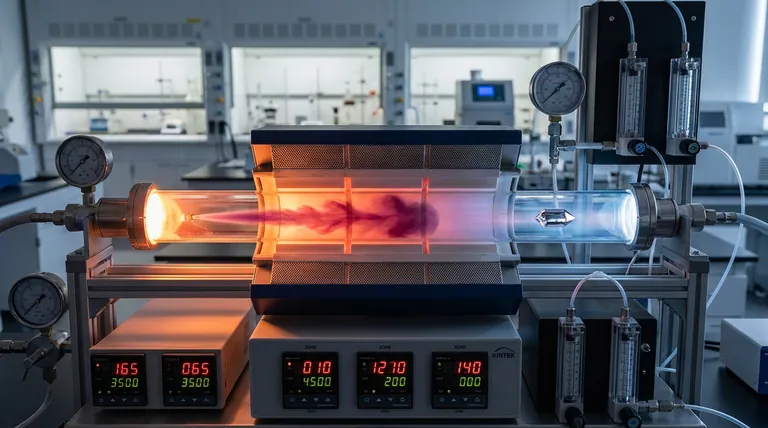
Overcoming Thermodynamic Barriers
The primary challenge in synthesizing RhSeCl is the fundamental mismatch in the thermal properties of its constituent elements.
The Melting Point Disparity
The synthesis requires combining metal Rhodium (Rh) and non-metal Selenium (Se). Rh has a very high melting point, while Se has a comparatively low sublimation point.
In a traditional solid-phase reaction, heating the mixture enough to react the Rh often causes the Se to volatilize uncontrollably. This results in an inability to maintain the correct stoichiometry.
Preventing Compositional Inhomogeneity
Because of these kinetic differences, solid-phase reactions frequently suffer from uneven mixing.
The reactants do not diffuse uniformly, leading to compositional inhomogeneities. This results in low-quality crystals that lack the precise structural integrity required for Janus materials.
The Mechanics of Gas-Phase Growth
CVT solves the issues inherent to solid-state reactions by shifting the growth medium from solid to gas.
Utilizing a Transport Agent
Instead of relying on direct contact between solids, CVT employs a gaseous transport agent (such as iodine) within a vacuum-sealed quartz tube.
This agent reacts with the solid precursors to convert them into a gaseous phase. This bypasses the need to melt the Rhodium directly in contact with the Selenium solid.
The Role of Temperature Gradients
The process is driven by a precise temperature gradient.
The gaseous material migrates from the hotter source zone to a cooler growth zone. This controlled migration ensures that the material is deposited gradually and consistently.
Achieving High-Quality Structure
This method enables the growth of large-scale single crystals.
By controlling the vapor transport, the method ensures the resulting crystals are homogeneous. This is essential for producing the specific Janus structure and ensuring high material quality.
Understanding the Trade-offs
While CVT is superior for quality, it introduces complexities that must be managed.
Operational Complexity
CVT is significantly more complex than solid-phase reactions.
It requires the preparation of vacuum-sealed quartz tubes and precise control over multi-zone furnaces to maintain the necessary temperature gradients.
Time Intensity
The process relies on the migration and recrystallization of vapor.
This growth mechanism is inherently slower than direct solid-state sintering. Producing millimeter-sized crystals suitable for anisotropic study requires time and patience.
Making the Right Choice for Your Goal
To determine if CVT is the correct approach for your specific application, consider the following:
- If your primary focus is crystal purity and size: You must use CVT to navigate the kinetic mismatch between Rh and Se, ensuring a homogeneous single crystal.
- If your primary focus is rapid synthesis of polycrystalline powder: You might attempt solid-phase reactions, but you must accept a high risk of impurities and stoichiometric imbalance.
For complex materials like Janus RhSeCl, the precision of gas-phase transport is the only reliable path to structural integrity.
Summary Table:
| Feature | Solid-Phase Reaction | Chemical Vapor Transport (CVT) |
|---|---|---|
| Phase State | Direct solid-to-solid contact | Gas-phase mediated transport |
| Thermal Management | Struggles with disparate melting points | Bypasses melting points via vapor |
| Purity & Quality | Risk of impurities and inhomogeneities | High purity, large-scale single crystals |
| Mechanism | Diffusion-limited | Controlled temperature gradient |
| Complexity | Relatively simple | High (vacuum seals & multi-zone furnace) |
Optimize Your Advanced Material Synthesis with KINTEK
Achieve unmatched precision in your single crystal growth today. Backed by expert R&D and manufacturing, KINTEK offers specialized Tube, Vacuum, and CVD systems, alongside other laboratory high-temp furnaces—all fully customizable to manage the complex temperature gradients required for Chemical Vapor Transport.
Whether you are synthesizing Janus RhSeCl or other advanced materials, our equipment ensures the thermal stability and vacuum integrity your research demands.
Ready to elevate your lab's performance? Contact us today to discuss your unique synthesis needs!
References
- Kefeng Liu, Huiyang Gou. Optimized Synthesis and Characterization of Janus RhSeCl with Uniform Anionic Valences, Nonlinear Optical and Optoelectronic Properties. DOI: 10.1002/advs.202505279
This article is also based on technical information from Kintek Furnace Knowledge Base .
Related Products
- Custom Made Versatile CVD Tube Furnace Chemical Vapor Deposition CVD Equipment Machine
- Multi Heating Zones CVD Tube Furnace Machine for Chemical Vapor Deposition Equipment
- Slide PECVD Tube Furnace with Liquid Gasifier PECVD Machine
- Split Chamber CVD Tube Furnace with Vacuum Station CVD Machine
- Vertical Laboratory Quartz Tube Furnace Tubular Furnace
People Also Ask
- What is a CVD tube furnace and what is its primary function? Discover Precision Thin-Film Deposition
- Why are CVD tube furnace sintering systems indispensable for 2D material research and production? Unlock Atomic-Scale Precision
- How does CVD tube furnace sintering enhance graphene growth? Achieve Superior Crystallinity and High Electron Mobility
- Which industries and research fields benefit from CVD tube furnace sintering systems for 2D materials? Unlock Next-Gen Tech Innovations
- How might AI and machine learning enhance CVD tube furnace processes? Boost Quality, Speed, and Safety



















