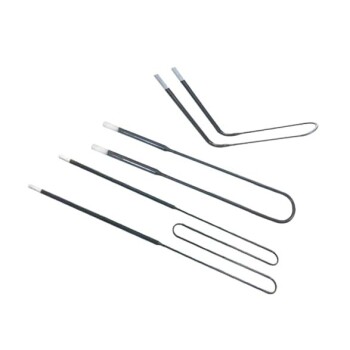
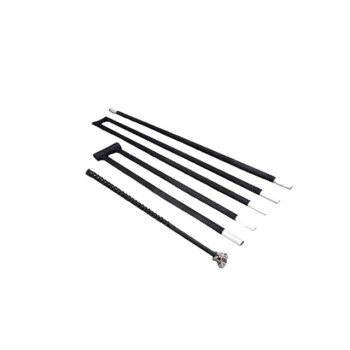
At its core, failing to accommodate thermal expansion and contraction is a direct path to mechanical failure. When a heating element is energized, it grows in size, and if this movement is restricted, the resulting internal stress will cause it to warp, buckle, or slowly deform, ultimately leading to a shortened operational life or immediate damage to the equipment.
The fundamental issue is one of physics, not just mechanics. All materials expand when heated and contract when cooled. Designing a durable heating system requires treating this movement as an inevitable operational characteristic, not an engineering problem to be eliminated.
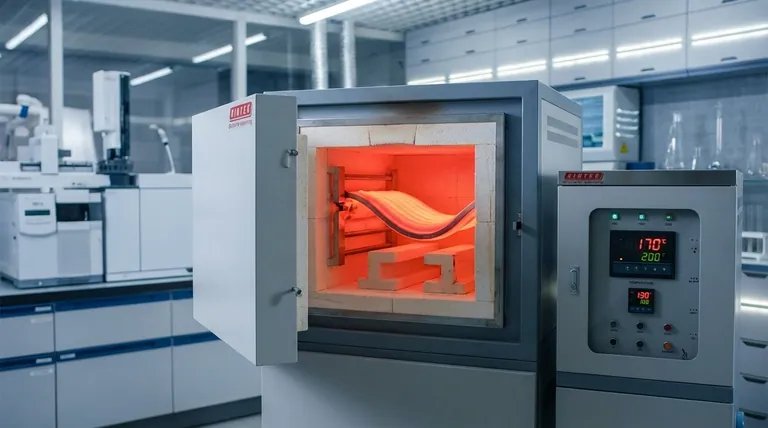
The Physics of Thermal Expansion
To understand why space is so critical, we must first look at what happens to the element at a molecular level. Heat is a form of energy that causes the atoms within the element's metal alloy to vibrate more vigorously.
From Atomic Vibration to Physical Growth
As these atoms vibrate, they push against their neighbors, increasing the average distance between them. While this change is microscopic on an individual atomic level, the cumulative effect across the entire length and diameter of the element results in a measurable, and often significant, change in its physical dimensions.
The Role of Material Properties
Different materials expand at different rates. This property is quantified by the Coefficient of Thermal Expansion (CTE). The alloys used in heating elements, such as Nichrome (nickel-chromium), are chosen for their high electrical resistivity and resistance to oxidation, but they also have a predictable CTE that must be factored into any design.
The Consequences of Ignoring Expansion
When an element is installed in a way that prevents it from expanding freely, the forces generated are immense. This stored energy must be released, and it does so by deforming the element itself.
Warping and Buckling
If the ends of a straight element are fixed, it will buckle or warp sideways as it heats up and tries to expand. This deformation can cause the element to make contact with a metal sheath, the furnace wall, or other components, creating a dangerous electrical short circuit.
Creep Deformation
Creep is a more insidious form of failure. It is the slow, permanent deformation of a material under persistent stress at high temperatures. Even if an element doesn't warp immediately, the combination of its own weight and internal thermal stress can cause it to sag or stretch over many heating cycles, a phenomenon known as thermal creep.
Premature Element Burnout
Both warping and creep can create localized problems that accelerate failure. A warped section may have poor airflow, causing a hot spot. A section that has been stretched thin by creep will have a higher electrical resistance, which in turn generates more heat at that point. These hot spots are the most common locations for an element to ultimately burn out.
Key Design Considerations
Properly managing thermal expansion is a balancing act. The element needs to be securely supported, but it must also be free to move.
Providing Support vs. Allowing Movement
Long, straight elements or large coils require intermediate supports to prevent sagging under their own weight, especially at high temperatures when the material's strength is reduced. However, these supports must be designed as guides, not rigid anchors. They should allow the element to slide freely along its axis.
The Impact of Mounting Hardware
Terminals and mounting brackets are the most common points of failure. Using fixed, bolted connections that don't account for linear growth is a critical design flaw. Effective designs often use floating or sliding terminals and ceramic insulators that can handle the high temperatures while allowing for movement.
Calculating the "Growth Gap"
Engineers must calculate the total expected expansion based on the element's length, material (CTE), and the change in temperature from its cold (ambient) state to its maximum operating temperature. This calculation dictates the minimum clearance, or "growth gap," required at the ends of the element or within its supports.
How to Apply This to Your Design
Your approach to managing thermal expansion will depend on your primary design objective.
- If your primary focus is maximum reliability and lifespan: Use robust, sliding supports and ensure all terminal connections are specifically designed to accommodate movement.
- If your primary focus is a compact footprint: Carefully calculate the absolute minimum clearances required and consider using coiled elements, which can absorb expansion and contraction within the coils themselves.
- If your primary focus is preventing electrical failure: Ensure that any potential warping or sagging will not allow the element to touch conductive surfaces, providing generous air gaps or robust insulation.
Accommodating thermal expansion is a foundational principle of reliable electric heater design.
Summary Table:
| Key Aspect | Description |
|---|---|
| Thermal Expansion | Heating elements expand when heated and contract when cooled due to atomic vibration, measured by Coefficient of Thermal Expansion (CTE). |
| Consequences of Restriction | Can lead to warping, buckling, creep deformation, hot spots, and premature burnout, causing equipment failure. |
| Design Solutions | Use sliding supports, floating terminals, and calculate growth gaps to allow free movement and ensure safety. |
Upgrade your lab's heating systems with KINTEK's advanced solutions! We specialize in high-temperature furnaces like Muffle, Tube, Rotary, Vacuum & Atmosphere Furnaces, and CVD/PECVD Systems. With our strong R&D and in-house manufacturing, we offer deep customization to precisely meet your unique experimental needs, ensuring reliable performance and extended lifespan by expertly managing thermal expansion. Contact us today to discuss how we can enhance your laboratory efficiency and safety!
Visual Guide

Related Products
- Molybdenum Disilicide MoSi2 Thermal Heating Elements for Electric Furnace
- Silicon Carbide SiC Thermal Heating Elements for Electric Furnace
- Molybdenum Vacuum Heat Treat Furnace
- 2200 ℃ Graphite Vacuum Heat Treat Furnace
- Multi Heating Zones CVD Tube Furnace Machine for Chemical Vapor Deposition Equipment
People Also Ask
- What are the typical application temperatures for molybdenum disilicide (MoSi2) heating elements? Master High-Temp Performance
- What is the primary use of molybdenum disilicide? Ideal for High-Temp Heating Elements
- What are the characteristics of molybdenum disilicide heating elements? Unlock High-Temp Performance
- What are the properties of molybdenum disilicide (MoSi2) that make it suitable for high-temperature applications? Discover Its High-Temp Resilience
- What are the applications of molybdenum disilicide heating elements? Achieve Extreme Heat Stability for Industrial Processes