
High-temperature preheating is critical for ensuring the successful processing of Fe-C-B-Cr-W alloys. An industrial muffle furnace is required to heat the alloy to a precise hot-working temperature of 1100 °C and maintain it, which lowers the deformation resistance of the matrix and significantly increases plasticity to facilitate smooth rotary swaging.
Core Takeaway The muffle furnace does not merely heat the material; it conditions the alloy’s microstructure by relieving internal casting stresses and promoting the homogenization of solute elements, preventing structural failure during mechanical deformation.
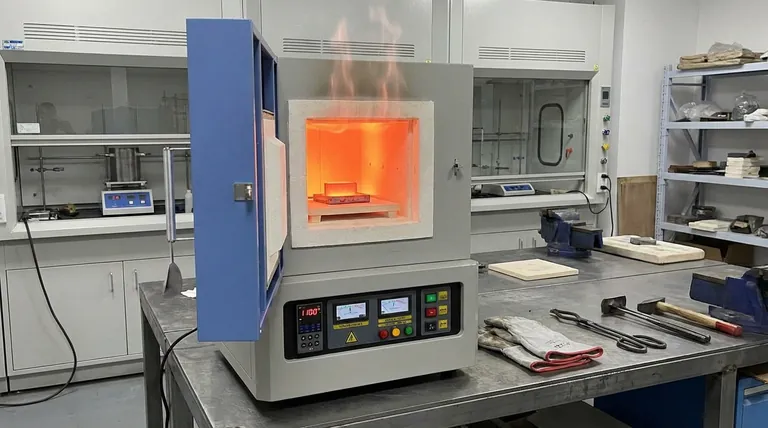
Optimizing Mechanical Properties for Deformation
To successfully work with complex alloys like Fe-C-B-Cr-W, the material must be physically prepared to withstand intense mechanical forces.
Reducing Deformation Resistance
At room temperature, the alloy matrix exhibits high resistance to shape change. Heating the material to 1100 °C in a muffle furnace drastically lowers this resistance.
This reduction is necessary to prevent excessive wear on tooling and to ensure the machinery can effectively shape the alloy without overcoming immense physical opposition.
Enhancing Plasticity
Plasticity refers to the material's ability to undergo permanent deformation without breaking.
By maintaining the high temperature within the furnace, the alloy becomes more pliable. This increased plasticity is the key factor that allows the rotary swaging process to proceed smoothly, permitting the metal to flow rather than fracture under pressure.
Microstructural Conditioning
Beyond the immediate mechanical benefits, the furnace environment addresses internal structural issues inherent in cast alloys.
Eliminating Casting Stresses
Castings often contain residual internal stresses resulting from the cooling process. If left unchecked, these stresses can lead to cracking during hot working.
High-temperature preheating effectively relieves these casting stresses, neutralizing internal tension before external mechanical forces are applied.
Homogenization of Solute Elements
In complex alloys containing Iron, Carbon, Boron, Chromium, and Tungsten, elements may be unevenly distributed after casting.
The sustained heat promotes the initial homogenization of these solute elements. This ensures a more uniform chemical composition throughout the matrix, which results in consistent material properties and behavior during the swaging process.
The Risks of Inadequate Thermal Preparation
While the benefits of preheating are clear, understanding the risks of bypassing or rushing this step is equally important.
The Consequences of Low Plasticity
If the alloy is not maintained at the target temperature of 1100 °C, the matrix retains too much rigidity.
Attempting rotary swaging on a material with insufficient plasticity typically results in brittle fracture or surface cracking, rendering the workpiece unusable.
Impact of Residual Stress
Ignoring the stress-relief aspect of preheating creates a compound loading scenario.
When the external force of swaging meets the internal force of residual casting stress, the material's failure threshold is exceeded much faster, leading to unpredictable structural failures.
Making the Right Choice for Your Goal
To achieve the best results with Fe-C-B-Cr-W alloys, apply the heating process with specific outcomes in mind.
- If your primary focus is Process Efficiency: Ensure the furnace stabilizes at 1100 °C to minimize deformation resistance, protecting your rotary swaging equipment from excessive strain.
- If your primary focus is Material Integrity: prioritize the duration of the heating phase to fully relieve casting stresses and promote element homogenization before deformation begins.
Proper thermal preparation is not just a preliminary step; it is the foundation of structural quality in hot-worked alloys.
Summary Table:
| Process Requirement | Benefit for Fe-C-B-Cr-W Alloy | Impact on Production |
|---|---|---|
| 1100°C Stabilization | Lowers deformation resistance of the matrix | Reduces equipment wear and tool strain |
| Extended Soaking | Promotes homogenization of solute elements | Ensures uniform chemical & mechanical properties |
| Thermal Conditioning | Relieves internal residual casting stresses | Prevents brittle fracture and surface cracking |
| Controlled Environment | Enhances material plasticity | Facilitates smooth and successful rotary swaging |
Optimize Your Alloy Processing with KINTEK Precision
Don't compromise the integrity of your Fe-C-B-Cr-W alloys with inconsistent thermal preparation. Backed by expert R&D and manufacturing, KINTEK offers high-performance Muffle, Tube, Rotary, Vacuum, and CVD systems designed to meet the rigorous demands of industrial metallurgy.
Our lab high-temp furnaces are fully customizable to ensure your materials reach the exact 1100°C threshold needed for maximum plasticity and stress relief. Contact us today to find your custom heating solution and see how our expertise can enhance your laboratory and production efficiency.
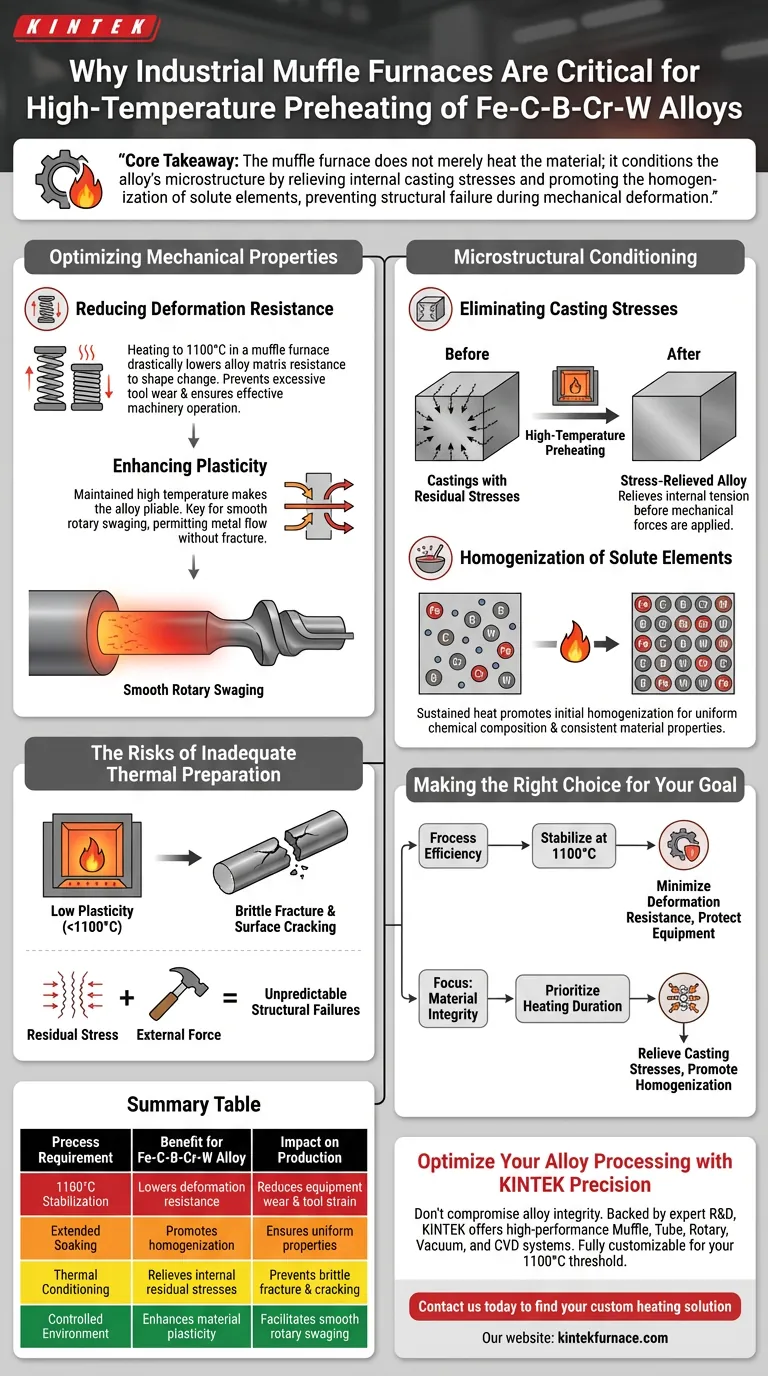
Visual Guide
References
- H. SCHAEFER, Sebastian Weber. Microstructure Formation in Hypoeutectic Alloys in the Fe–C–B–Cr–W System. DOI: 10.1007/s11661-024-07675-3
This article is also based on technical information from Kintek Furnace Knowledge Base .
Related Products
- 1400℃ Muffle Oven Furnace for Laboratory
- 1200℃ Muffle Oven Furnace for Laboratory
- 1700℃ High Temperature Muffle Oven Furnace for Laboratory
- 1800℃ High Temperature Muffle Oven Furnace for Laboratory
- High Temperature Muffle Oven Furnace for Laboratory Debinding and Pre Sintering
People Also Ask
- What is the primary function of a high-temperature laboratory muffle furnace in chemical synthesis? Achieve Precision.
- How does a high-temperature laboratory muffle furnace affect material properties? Transform Anodic Oxide Films Fast
- What is the purpose of using a laboratory high-temperature muffle furnace for drying Fe-Ni-Co catalysts? Boost Purity
- What role does a laboratory high-temperature muffle furnace play in the treatment of highly contaminated waste glass?
- What is the function of a muffle furnace in MOF-derived zirconia conversion? Optimize Phase & Pore Engineering



















