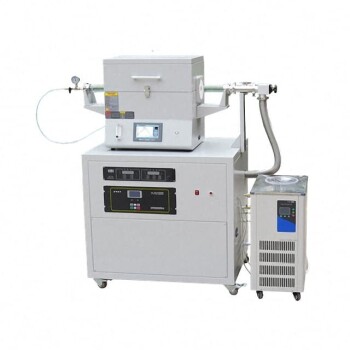
An atmosphere-controlled high-temperature tube furnace is the indispensable tool for transforming inactive nickel precursors into the active metallic state required for catalysis. This specialized equipment provides the precise thermal energy and reductive environment—typically a flowing hydrogen and nitrogen mixture—necessary to chemically reduce nickel oxide ($NiO$) to zero-valent metallic nickel ($Ni^0$). Without this controlled environment, the catalyst would remain in an oxidized, inactive state or become contaminated by atmospheric oxygen.
The primary purpose of using an atmosphere-controlled tube furnace is to facilitate the "activation" phase, where a specific chemical reduction occurs under high heat while strictly excluding oxygen to prevent the catalyst from re-oxidizing.
The Chemistry of Catalyst Activation
Transformation of Nickel Oxide to Metallic Nickel
The "activation" of a $Ni/SiO_2$ catalyst is essentially a chemical reduction process. In its initial state, nickel is often present as nickel oxide ($NiO$), which lacks the electronic structure necessary to facilitate catalytic reactions like methane reforming or hydrogenation.
The Role of Thermal Energy
High temperatures, often ranging from 500°C to 550°C, are required to break the chemical bonds within the nickel oxide lattice. The tube furnace provides a stable, uniform heat distribution that ensures every part of the catalyst bed reaches the specific temperature threshold required for this transformation.
Achieving High-Purity Active Sites
By providing a strictly controlled environment, the furnace ensures that the resulting metallic nickel ($Ni^0$) particles are of high purity. This purity is critical for the catalyst’s ability to efficiently crack molecules and perform long-term without premature failure.
The Necessity of Atmosphere Control
Maintaining a Reductive Environment
Atmosphere control allows for the continuous flow of reductive gases, such as a 10 vol% $H_2/N_2$ mixture. This flow carries away the water vapor produced during the reduction reaction, shifting the equilibrium toward the production of active metallic nickel.
Prevention of Re-oxidation During Cooling
Metallic nickel is highly reactive and will immediately revert to nickel oxide if exposed to oxygen while hot. The furnace allows the user to maintain an inert or reductive atmosphere during the cooling stage, "locking in" the active metallic state before the catalyst is handled.
Removal of Volatile Impurities
The flowing atmosphere within the tube helps to sweep away organic impurities and moisture trapped within the $SiO_2$ support pores. This process, often occurring during an initial calcination phase, ensures that the active nickel sites are accessible to the reactants.
Understanding the Trade-offs and Pitfalls
The Risk of Particle Sintering
While high temperatures are necessary for activation, excessive heat can lead to sintering, where small nickel nanoparticles merge into larger clusters. This reduces the total available surface area and significantly lowers the overall catalytic activity.
Atmospheric Contamination
Even minute leaks in the furnace seals can introduce oxygen into the system. This can result in incomplete reduction or the formation of a "shell" of oxide around the nickel particles, effectively insulating the active metal from the reaction.
Temperature Gradients
In lower-quality furnaces, temperature fluctuations across the tube can lead to an inconsistent catalyst batch. Some areas may remain under-reduced (inactive), while others may be over-heated (sintered), leading to unpredictable performance in the reactor.
Selecting the Right Parameters for Your Project
How to Apply This to Your Process
Successfully activating a $Ni/SiO_2$ catalyst requires balancing temperature, gas flow, and time to achieve the desired metal dispersion.
- If your primary focus is maximum catalytic activity: Prioritize precise temperature ramping and high hydrogen flow rates to ensure the complete reduction of $NiO$ into the smallest possible $Ni^0$ nanoparticles.
- If your primary focus is catalyst longevity: Use a strictly controlled inert atmosphere during the cooling phase to prevent surface oxidation, which can lead to "coking" or deactivation during the initial stages of a reaction.
- If your primary focus is structural integrity: Ensure the furnace provides a stable environment for the $SiO_2$ support to prevent the collapse of its microporous structure during high-temperature treatment.
Ultimately, the tube furnace acts as a chemical reactor that precisely dictates the final electronic and structural properties of the catalyst.
Summary Table:
| Requirement | Function in Activation | Impact on Catalyst |
|---|---|---|
| Reductive Atmosphere | Provides $H_2$ flow to reduce $NiO$ to $Ni^0$ | Creates active catalytic sites |
| Precise Temperature | Maintains 500°C - 550°C uniformly | Breaks oxide bonds without sintering |
| Atmospheric Isolation | Strictly excludes oxygen during cooling | Prevents immediate re-oxidation |
| Continuous Gas Flow | Sweeps away water vapor and impurities | Ensures high purity and accessibility |
Elevate Your Catalyst Research with KINTEK Precision
Don't let atmospheric contamination or temperature fluctuations compromise your catalyst's performance. KINTEK specializes in high-performance laboratory equipment, offering a comprehensive range of atmosphere-controlled tube furnaces, muffle furnaces, vacuum systems, and CVD solutions—all fully customizable to meet your specific research demands.
Whether you are activating Ni/SiO2 catalysts or developing next-generation materials, our furnaces provide the thermal stability and gas-tight integrity your work requires.
Ready to optimize your activation process? Contact our technical experts today for a tailored solution!
References
- Jie Fan, Meng Zhang. The Effects of Support Specific Surface Area and Active Metal on the Performance of Biphenyl Selective Hydrogenation to Cyclohexylbenzene. DOI: 10.3390/catal14100727
This article is also based on technical information from Kintek Furnace Knowledge Base .
Related Products
- 1700℃ Controlled Inert Nitrogen Atmosphere Furnace
- 1400℃ Controlled Inert Nitrogen Atmosphere Furnace
- 1200℃ Controlled Inert Nitrogen Atmosphere Furnace
- Mesh Belt Controlled Atmosphere Furnace Inert Nitrogen Atmosphere Furnace
- 1400℃ High Temperature Laboratory Tube Furnace with Alumina Tube
People Also Ask
- How do controlled-atmosphere furnaces support polymer pyrolysis? Master SiC & Si3N4 Ceramic Conversion
- How does oxygen partial pressure control affect ceramic sintering? Master Defect Chemistry
- How does real-time dilatometric analysis in a controlled-atmosphere furnace optimize PZT ceramic sintering?
- Why is thorough binder burnout necessary before sintering advanced ceramics? Ensure Peak Density & Zero Defects
- Why is controlled-atmosphere heating required for functional ceramics and sensors? Master Defect Engineering