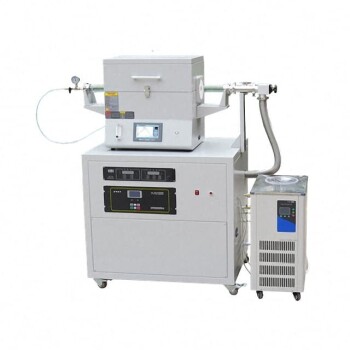
The atmosphere-controlled high-temperature tube furnace is the fundamental safeguard for carbon material integrity during synthesis. It provides a strictly inert environment, typically using high-purity nitrogen or argon, to prevent the oxidative combustion of precursors at extreme temperatures. By executing precise, programmed heating curves, the furnace facilitates the pyrolysis required to reorganize polymer chains into highly conductive carbon skeletons while preserving the intricate microscopic morphology of the nanofibers.
The tube furnace acts as both a protective shield and a molecular architect, ensuring that carbonization occurs in an oxygen-free zone while dictating the final porosity, conductivity, and structural purity of the nanofibers through exact thermal and atmospheric management.
Preventing Oxidative Ablation and Structural Loss
The Role of Inert Gas Isolation
At temperatures reaching up to 1000°C, carbon materials are highly susceptible to oxidative combustion if exposed to even trace amounts of oxygen. The tube furnace maintains a strictly controlled flow of high-purity nitrogen or argon, creating an oxygen-free environment that prevents the material from burning away. This isolation is the only way to ensure the precursor transforms into a solid carbon structure rather than ash.
Preserving Microscopic Morphology
The physical structure of a nanofiber is delicate and can easily collapse during the transition from polymer to carbon. An atmosphere-controlled furnace ensures that the chemical reactions occur under stable conditions, allowing the microscopic morphology to remain intact. This preservation is critical for applications that rely on the high surface-area-to-volume ratio characteristic of nanofibers.
Precise Control of Molecular Transformation
Pyrolysis and Chemical Reorganization
High-temperature carbonization involves complex pyrolytic reactions, including dehydrogenation and denitrogenation. The furnace provides the uniform thermal field necessary for these non-carbon elements to be stripped away, leaving behind a high-purity carbon skeleton. This process is what converts an insulating polymer into a highly conductive functional material.
The Importance of Programmed Heating Rates
The furnace allows for precise control over the heating rate, often measured in increments like 5°C per minute. Controlling the ramp speed prevents internal stresses and ensures uniform pyrolysis throughout the material. Gradual heating is essential for balancing conduction loss and dipole polarization, which directly affects the material's final electrochemical or electromagnetic performance.
Engineering Porosity and Surface Characteristics
Facilitating Pore Formation
The development of a rich network of micropores and mesopores depends on the thermal decomposition of pore-forming agents or the volatilization of salts like Zinc Chloride. A tube furnace provides the specific high-temperature environment needed to trigger these volatilization events at the exact moment the carbon matrix is hardening. This synchronization is what creates the "porous" nature of the nanofibers.
Tunable Molecular Sieving
By adjusting the carbonization temperature—typically between 600°C and 900°C—researchers can control the degree of micropore shrinkage. This precision enables the production of nanofibers with a tunable molecular sieving effect. Such control is vital for specialized applications like the size-exclusion separation of gases such as carbon dioxide and methane.
Understanding the Trade-offs and Limitations
Atmosphere Purity vs. Cost
Maintaining a "strictly controlled" atmosphere requires high-purity gases and a perfectly sealed system. Even minor leaks or low-grade nitrogen can introduce trace oxygen, leading to surface defects or structural weakened by partial oxidation. While high-purity argon offers superior protection, it significantly increases operational costs compared to nitrogen.
Thermal Gradients in Large Batches
While tube furnaces provide a highly uniform temperature field, the flow field distribution of the inert gas can vary depending on how the samples are placed. Inconsistent gas flow can lead to non-uniform carbonization or uneven pore distribution across a large batch of fibers. Achieving total consistency requires careful calibration of the gas flow rate and sample positioning within the tube.
Making the Right Choice for Your Goal
To achieve the best results with your high-temperature tube furnace, align your parameters with your specific material objectives:
- If your primary focus is Maximum Conductivity: Utilize higher temperatures (up to 1000°C) to promote a higher degree of graphitization and the removal of all non-carbon impurities.
- If your primary focus is High Surface Area: Focus on precise heating rates and the inclusion of pore-forming agents that degrade at specific temperature windows to maximize micropore volume.
- If your primary focus is Electromagnetic Shielding: Target a specific carbonization temperature (e.g., 800°C) to balance the ratio of structural defects and conductivity, optimizing reflection loss.
- If your primary focus is Structural Integrity: Ensure a stable flow of high-purity argon to prevent even minor surface etching caused by the trace impurities often found in industrial-grade nitrogen.
The precision of the tube furnace is the deciding factor in whether a precursor becomes a high-performance functional material or a failed chemical byproduct.
Summary Table:
| Key Requirement | Role of Tube Furnace | Material Outcome |
|---|---|---|
| Oxidation Prevention | Provides inert gas isolation (N₂, Ar) | Prevents combustion; maintains integrity |
| Structural Control | Precise programmed heating rates | Uniform pyrolysis & microscopic morphology |
| Porosity Engineering | Facilitates pore-forming volatilization | Tunable surface area & molecular sieving |
| Chemical Purity | Uniform high-temperature field | Efficient dehydrogenation & conductivity |
Achieve absolute precision in your carbon material synthesis with KINTEK. As experts in laboratory equipment, we offer a comprehensive range of high-temperature furnaces—including tube, atmosphere, vacuum, CVD, and rotary furnaces—specifically designed to meet the rigorous demands of nanofiber carbonization. Whether you are optimizing for conductivity, surface area, or structural purity, our customizable solutions ensure consistent, high-quality results for your research. Contact us today to discuss your unique laboratory requirements!
References
- Baolei Shen, Ting‐Ting Li. N‐Doped Porous Carbon Nanofiber Mats for High‐Performance Flexible Supercapacitor Electrodes. DOI: 10.1002/ente.202301138
This article is also based on technical information from Kintek Furnace Knowledge Base .
Related Products
- 1700℃ Controlled Inert Nitrogen Atmosphere Furnace
- 1400℃ Controlled Inert Nitrogen Atmosphere Furnace
- 1200℃ Controlled Inert Nitrogen Atmosphere Furnace
- 1400℃ High Temperature Laboratory Tube Furnace with Alumina Tube
- 1700℃ High Temperature Laboratory Tube Furnace with Alumina Tube
People Also Ask
- How does real-time dilatometric analysis in a controlled-atmosphere furnace optimize PZT ceramic sintering?
- How do controlled-atmosphere furnaces support polymer pyrolysis? Master SiC & Si3N4 Ceramic Conversion
- Why is thorough binder burnout necessary before sintering advanced ceramics? Ensure Peak Density & Zero Defects
- How does oxygen partial pressure control affect ceramic sintering? Master Defect Chemistry
- Why is controlled-atmosphere heating required for functional ceramics and sensors? Master Defect Engineering