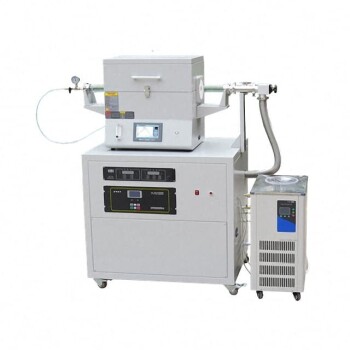
The atmosphere control tube furnace is the critical safeguard that prevents manganese-loaded biochar from incinerating during high-temperature activation. At the standard activation temperature of 800 °C, exposure to oxygen would cause the carbon matrix to undergo oxidative combustion, effectively turning the material into ash. By providing a sealed, inert environment—typically using nitrogen or argon—the furnace allows the biochar to undergo essential chemical transformations while maintaining its structural integrity.
Core Takeaway: An atmosphere control tube furnace is necessary to isolate the biochar from oxygen, preventing carbon loss while enabling the uniform conversion of manganese salts into stable, active metal oxide sites.
Preserving the Carbon Matrix and Pore Structure
Prevention of Oxidative Combustion
At temperatures reaching 800 °C, carbon reacts violently with oxygen. The atmosphere control furnace replaces ambient air with inert gases like nitrogen, which isolates the material and prevents it from burning. This preservation is vital for ensuring a high solid carbon yield and preventing the "ashing" of the biochar.
Maintenance of Microscopic Pore Integrity
The "activation" part of the process involves creating a high specific surface area. The furnace allows for controlled chemical etching or physical activation without "over-ablation," where the internal walls of the pores would otherwise be destroyed by uncontrolled oxidation. This results in a highly developed hierarchical pore structure.
Retention of Surface Functional Groups
Beyond just the physical holes, the surface chemistry of the biochar is sensitive to the heating environment. Atmosphere control ensures that the resulting biochar retains a high density of surface functional groups, which are essential for its performance in filtration or catalytic applications.
Facilitating Manganese Stabilization and Activation
Uniform Conversion of Manganese Salts
Manganese-loaded biochar relies on the transition of raw manganese salts into functional metal oxides. The tube furnace provides the precise, oxygen-free thermal environment required to decompose these salts and stabilize them uniformly across the carbon surface.
Creation of Stable Metal Oxide Active Sites
The controlled atmosphere ensures that manganese is converted into stable metal oxide active sites rather than reacting with atmospheric oxygen to form undesirable or unstable phases. These sites are the "engine" of the biochar, providing the catalytic or adsorptive power needed for environmental remediation.
Precision Temperature and Gas Flow Management
Tube furnaces allow for specific heating rates (e.g., 20 °C per minute) and constant gas flow (e.g., 170–330 mL/min). This level of precision ensures that the manganese is integrated deeply into the carbon skeleton, rather than just sitting loosely on the surface.
Understanding the Trade-offs and Limitations
Gas Purity and System Sealing
The effectiveness of the process is entirely dependent on the purity of the inert gas and the integrity of the furnace seals. Even a small leak can introduce enough oxygen to cause localized combustion, leading to inconsistent batches or "hot spots" that ruin the pore structure.
Operational Costs and Complexity
Using an atmosphere control furnace is significantly more expensive than standard muffle furnaces due to the cost of high-purity nitrogen or argon. Additionally, the precise control of gas flow rates requires sophisticated flow meters and a deeper level of technical expertise to operate safely and effectively.
Applying This to Your Activation Project
Choosing the Right Parameters for Your Goal
To achieve the best results with manganese-loaded biochar, your furnace settings must align with your specific performance targets.
- If your primary focus is Maximum Surface Area: Use a higher flow rate of activating gas (like CO2) within the tube furnace to promote deep chemical etching of the carbon skeleton.
- If your primary focus is Manganese Stability: Prioritize a strictly inert nitrogen atmosphere at 800 °C to ensure the metal salts are fully reduced and anchored to the carbon matrix without oxidation.
- If your primary focus is High Material Yield: Maintain a lower heating rate and ensure the furnace is perfectly sealed to prevent any carbon loss through trace oxygen exposure.
The atmosphere control tube furnace transforms a simple heating process into a precision engineering environment, ensuring your biochar remains intact while its catalytic potential is fully realized.
Summary Table:
| Key Feature | Benefit for Manganese Biochar | Technical Impact |
|---|---|---|
| Inert Environment | Prevents oxidative combustion/ashing | Isolates carbon at 800°C using N2/Ar |
| Pore Preservation | Maintains high specific surface area | Enables controlled chemical etching |
| Thermal Precision | Uniform manganese stabilization | Precise heating rates (e.g., 20°C/min) |
| Gas Flow Control | Consistent metal oxide active sites | Deep integration into carbon skeleton |
Elevate Your Material Synthesis with KINTEK
Achieving the perfect hierarchical pore structure and stable metal oxide sites requires absolute thermal and atmospheric control. KINTEK provides industry-leading high-temperature furnaces designed to prevent oxidative loss and ensure the performance of your manganese-loaded biochar.
Our specialized laboratory equipment includes:
- Atmosphere & Vacuum Tube Furnaces for precise inert gas management.
- Muffle, Rotary, and CVD Furnaces for diverse activation scales.
- Fully Customizable Solutions tailored to your specific heating rates and gas flow requirements.
Ensure high material yield and catalytic integrity with KINTEK’s reliable high-temp solutions. Contact our technical experts today to find the ideal furnace for your research!
References
- Carolina Quimbaya-Ñañez, Yenny Ávila-Torres. Improvement of the Carbocatalytic Degradation of Pharmaceuticals in Water by the Use of Ultrasound Waves. DOI: 10.3390/w15203679
This article is also based on technical information from Kintek Furnace Knowledge Base .
Related Products
- 1200℃ Controlled Inert Nitrogen Atmosphere Furnace
- Mesh Belt Controlled Atmosphere Furnace Inert Nitrogen Atmosphere Furnace
- Controlled Inert Nitrogen Hydrogen Atmosphere Furnace
- 1400℃ Controlled Inert Nitrogen Atmosphere Furnace
- 1700℃ Controlled Inert Nitrogen Atmosphere Furnace
People Also Ask
- What controlled-atmosphere furnace conditions are required for sintering powder metallurgy copper alloy compacts? Ideal Setup
- What Roles Do a Controlled Atmosphere Furnace and Oil Quenching Tank Play in AISI 5140 Steel Heat Treatment?
- What are the operational advantages of using a controlled atmosphere furnace? Boost Quality and Efficiency in Heat Treatment
- How does introducing reactive gases into a controlled atmosphere furnace affect ceramic densification and coarsening?
- Why is uniform atmosphere flow important in a controlled atmosphere furnace? Ensure Consistent Results and Avoid Costly Failures