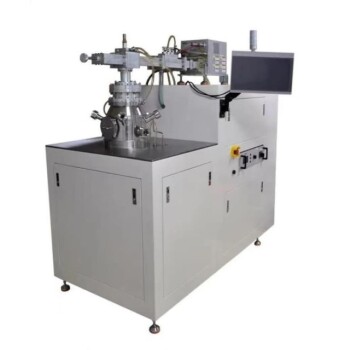
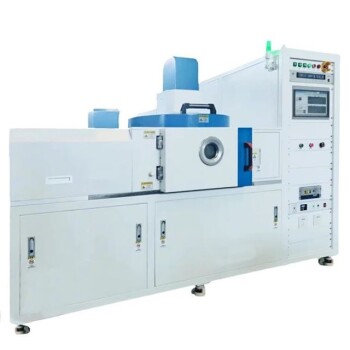
A vacuum deposition chamber is the critical foundation for high-performance industrial coatings. It functions by removing atmospheric gases to create a pristine environment, preventing oxidation and contamination during the coating process. This level of purity is essential for depositing complex multi-element alloys that protect thermal power equipment from the ravages of high-temperature corrosion.
The vacuum deposition chamber provides the necessary atmospheric isolation and environmental control to engineer specialized, high-durability coatings. By eliminating interference from air molecules, it enables the precise atomization and directional deposition required for thermal power applications.
Eliminating Atmospheric Interference
Removing Reactive Gases
In an open-air environment, oxygen and nitrogen react almost instantly with atomized coating materials. This creates brittle oxides or nitrides that significantly weaken the structural integrity of the protective layer.
Ensuring Material Purity
A high vacuum level ensures that the path between the coating source and the target component is clear. This allows the coating material to reach the substrate without losing energy or changing its chemical composition through unwanted molecular collisions.
Enabling Precision Control and Complex Chemistry
Managing Multi-Element Alloys
Thermal power equipment often requires sophisticated coatings composed of elements like Cr, Zn, Cu, Fe, Al, and Ti. The vacuum chamber allows these diverse elements to be combined in precise ratios that are impossible to achieve in a standard atmosphere.
Precise Energy Management
Within the chamber, parameters such as electric arcs and specific gas ratios can be finely tuned. This control allows technicians to trigger specific chemical reactions that enhance the functional properties of the coating, such as its ability to withstand extreme heat.
Facilitating Directional Deposition
The lack of air resistance in a vacuum allows for directional deposition, where particles move in a straight line to the substrate. This results in a more uniform and dense coating, which is vital for components that face high-stress thermal cycles.
Understanding the Trade-offs
Equipment Complexity and Cost
Vacuum deposition systems require a significant capital investment and specialized maintenance compared to atmospheric coating methods. The need for high-grade seals, powerful pumps, and specialized monitoring hardware increases the overall cost of production.
Throughput and Scale Limitations
Achieving the necessary vacuum level takes time, which can lead to longer cycle times for each batch of components. Additionally, the size of the power equipment that can be treated is strictly limited by the physical dimensions of the vacuum chamber.
Optimizing Coating Performance for Power Systems
To ensure your thermal power equipment achieves maximum service life, your coating strategy must match your specific operational environment.
- If your primary focus is high-temperature corrosion resistance: Use the vacuum chamber to deposit dense, multi-element alloy layers that act as an impermeable barrier against corrosive gases.
- If your primary focus is coating adhesion and structural integrity: Leverage the pure physical environment of the vacuum to ensure a contaminant-free bond between the substrate and the protective layer.
The vacuum deposition chamber is not merely a container; it is a precision instrument that transforms raw materials into advanced shields for critical energy infrastructure.
Summary Table:
| Feature | Benefit for Thermal Power Equipment | Impact on Coating Quality |
|---|---|---|
| Atmospheric Isolation | Eliminates oxygen and nitrogen interference | Prevents brittle oxides and nitrides |
| Purity Control | Ensures clean deposition path for materials | Enhances structural integrity and adhesion |
| Multi-Element Synthesis | Allows complex alloys (Cr, Al, Ti, etc.) | Optimized high-temperature protection |
| Directional Deposition | Precise energy and particle management | Creates uniform, high-density layers |
| Controlled Reactions | Fine-tuned gas ratios and electric arcs | Enhanced functional heat resistance |
Elevate Your Coating Precision with KINTEK
Don't let atmospheric contamination compromise the durability of your thermal power components. KINTEK provides industry-leading vacuum deposition environments designed to meet the rigorous demands of energy infrastructure.
Backed by expert R&D and world-class manufacturing, we offer a comprehensive range of Muffle, Tube, Rotary, Vacuum, and CVD systems, all fully customizable to your unique industrial requirements. Whether you are engineering complex multi-element alloys or seeking superior corrosion resistance, our team is ready to deliver the high-temperature hardware you need.
Ready to optimize your coating process? Contact KINTEK today for a customized solution!
References
- А.M. Yalova, Nazarii Bondar. The problem of increasing the working resource of energy equipment details. DOI: 10.31498/2225-6733.49.2.2024.321349
This article is also based on technical information from Kintek Furnace Knowledge Base .
Related Products
- Custom Made Versatile CVD Tube Furnace Chemical Vapor Deposition CVD Equipment Machine
- Split Chamber CVD Tube Furnace with Vacuum Station CVD Machine
- Slide PECVD Tube Furnace with Liquid Gasifier PECVD Machine
- Cylindrical Resonator MPCVD Machine System for Lab Diamond Growth
- MPCVD Machine System Reactor Bell-jar Resonator for Lab and Diamond Growth
People Also Ask
- Why are CVD tube furnace sintering systems indispensable for 2D material research and production? Unlock Atomic-Scale Precision
- What is a CVD tube furnace and what is its primary function? Discover Precision Thin-Film Deposition
- Which industries and research fields benefit from CVD tube furnace sintering systems for 2D materials? Unlock Next-Gen Tech Innovations
- How does CVD tube furnace sintering enhance graphene growth? Achieve Superior Crystallinity and High Electron Mobility
- What temperature range do standard CVD tube furnaces operate at? Unlock Precision for Your Material Deposition