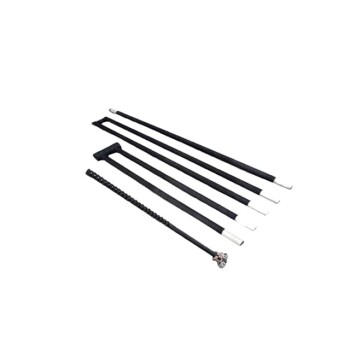
Silicon carbide (SiC) requires extreme temperatures because of its inherently stable chemical structure. Achieving full densification in SiC ceramics necessitates temperatures of approximately 2000°C to overcome the material's low diffusion coefficient and facilitate grain boundary diffusion. Without this extreme thermal energy, the atomic mass transfer required to transform loose particles into a high-strength, solid ceramic matrix simply cannot occur.
Fabricating high-performance silicon carbide requires a 2000°C furnace to overcome strong covalent bonds that resist traditional sintering. This temperature threshold is essential for triggering the recrystallization and grain boundary diffusion necessary for structural integrity and mechanical toughness.
Overcoming Covalent Bond Stability
The Challenge of Low Diffusion Coefficients
Silicon carbide is characterized by strong covalent bonding, which makes the material incredibly hard and chemically stable. However, these same bonds result in a very low diffusion coefficient, meaning atoms do not move easily through the crystal lattice at lower temperatures.
Driving Mass Transfer
A sintering furnace reaching 2000°C provides the intense thermal energy needed to initiate mass transfer between particles. At this temperature, atoms gain enough mobility for grain boundary diffusion, allowing the individual powder grains to merge into a continuous solid.
Structural Transformation and Reinforcement
Recrystallization and Particle Bonding
High-temperature environments (often exceeding 2000°C in graphite furnaces) facilitate the recrystallization of silicon carbide. This process allows particles to bond directly at their contact points, forming a robust, interconnected structure with high mechanical strength.
Activating Toughening Mechanisms
Extreme heat is required to integrate secondary phases, such as mullite whiskers, into the silicon carbide matrix. This bonding triggers vital reinforcement mechanisms like crack deflection and bridging, which significantly improve the fracture toughness of the final ceramic.
Controlling Porosity and Density
For specialized applications like ceramic membranes, 2000°C temperatures enable the formation of a controlled porous structure. Through precise temperature management, manufacturers can dictate the final microstructure and grain size distribution, ensuring the material meets specific performance metrics.
Critical Atmosphere Management
Preventing Oxidative Degradation
At high temperatures, silicon carbide reacts readily with oxygen to form silicon dioxide (SiO2), which can degrade the material’s properties. To prevent this, 2000°C furnaces must operate under a vacuum or an inert atmosphere (such as argon or nitrogen).
Ensuring Direct Grain Bonding
By isolating the material from oxygen and removing volatiles, the furnace ensures direct bonding between grains. This creates a high-performance non-oxide ceramic that maintains its integrity under extreme physical and chemical stress.
Understanding the Trade-offs
Equipment Wear and Operational Cost
Operating at 2000°C places immense stress on the furnace's heating elements and insulation, typically requiring high-grade graphite components. This leads to higher capital expenditures and more frequent maintenance cycles compared to lower-temperature sintering processes.
Risk of Excessive Grain Growth
While high temperatures are necessary for densification, prolonged exposure can lead to uncontrolled grain growth. If grains become too large, the mechanical strength of the ceramic may actually decrease, requiring precise temperature programming and timing to achieve the desired balance.
How to Apply This to Your Project
If your primary focus is maximizing mechanical strength: You must utilize a furnace capable of 2000°C with vacuum or inert gas capabilities to ensure full densification and direct grain bonding.
If your primary focus is fabricating porous SiC membranes: Focus on the recrystallization sintering phase at 2000°C, which builds structural strength while maintaining the necessary interconnected pore network.
If your primary focus is metal-matrix composites (Al-SiC): A 2000°C furnace is not required; instead, use a muffle furnace at 750°C to 1100°C to preheat particles and improve surface wettability.
The necessity of 2000°C sintering represents the technical price of entry for unlocking the superior hardness and thermal stability inherent in silicon carbide ceramics.
Summary Table:
| Requirement | Purpose in SiC Fabrication | Key Benefit |
|---|---|---|
| 2000°C Temperature | Overcomes covalent bonds & low diffusion | Full densification & structural integrity |
| Inert/Vacuum Atmosphere | Prevents SiO2 formation & oxidation | High-purity non-oxide ceramic bonding |
| Graphite Heating | Sustains extreme thermal energy levels | Reliable 2000°C+ operational stability |
| Recrystallization | Facilitates particle bonding & toughening | Enhanced mechanical strength & hardness |
Elevate Your Ceramic Engineering with KINTEK Precision
Achieving the perfect silicon carbide matrix requires more than just heat; it requires absolute thermal control and specialized environments. KINTEK specializes in high-performance laboratory equipment and consumables, offering a comprehensive range of high-temperature furnaces (vacuum, atmosphere, graphite, and tube) capable of reaching 2000°C and beyond.
Whether you are a researcher focused on material densification or a manufacturer scaling SiC production, our customizable solutions ensure uniform heating and reliable atmosphere management to prevent oxidation.
Ready to optimize your high-temperature sintering process? Contact KINTEK today to find the perfect furnace for your unique application!
References
- Shangwen Zhu, Yan Liu. Analysis of Factors Affecting the Preparation of Mullite Whiskers from Silica-Rich Slag and Application Studies. DOI: 10.3390/ma16247633
This article is also based on technical information from Kintek Furnace Knowledge Base .
Related Products
- Chairside Dental Porcelain Zirconia Sintering Furnace with Transformer for Ceramic Restorations
- Dental Porcelain Zirconia Sintering Ceramic Vacuum Press Furnace
- Spark Plasma Sintering SPS Furnace
- Vacuum Dental Porcelain Sintering Furnace for Dental Laboratories
- Silicon Carbide SiC Thermal Heating Elements for Electric Furnace
People Also Ask
- What factors determine the quality of sintered zirconia restorations? Master Material, Equipment, and Technique
- How do conventional vs rapid sintering in dental furnaces affect zirconia? Optimize Efficiency Without Sacrificing Strength
- What industries use zirconia sintering furnaces? Beyond Dental and Jewelry Applications
- Why is a zirconia sintering furnace considered essential for dental laboratories and clinics? Unlock Precision and Durability
- What are the key components of a zirconia sintering furnace? Unlock Precision for Superior Dental Restorations