
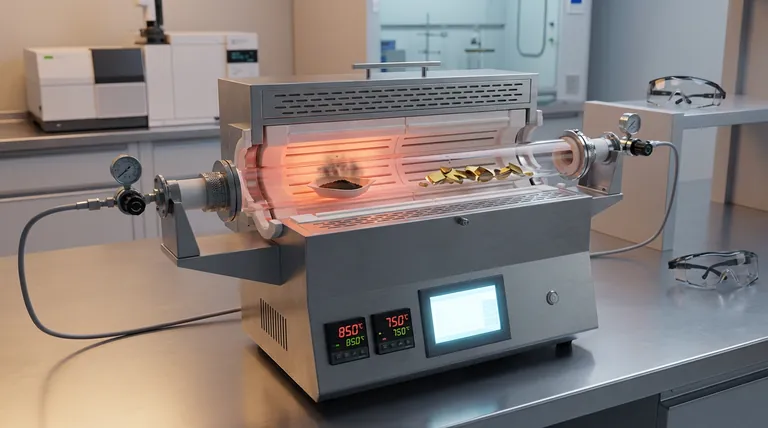
A high-precision dual-zone furnace is required to create a distinct, stable temperature gradient that drives the chemical vapor transport (CVT) process necessary for growing 1T-TaS2 crystals.
This equipment allows for the simultaneous maintenance of a high-temperature source zone (approximately 850 °C) for the volatilization of raw materials and a lower-temperature growth zone (approximately 750 °C) where the crystals actually nucleate and form.
The success of 1T-TaS2 synthesis relies not just on heat, but on the spatial distribution of that heat. The precise thermal gradient established by a dual-zone furnace is the governing factor that controls the reaction direction, the crystal growth rate, and the specific structural integrity of the 1T phase.
The Role of the Spatial Thermal Field
To understand why a standard single-zone furnace is insufficient, one must look at how the dual-zone configuration manipulates the physical movement of material inside the reaction tube.
Establishing Source and Sink Zones
The preparation of 1T-TaS2 is a transport process. The furnace must create two distinct environments within a single sealed system.
The "source" end must be maintained at approximately 850 °C. At this temperature, the raw materials react and volatilize, effectively turning into a vapor that can travel.
Driving the Transport Mechanism
The "sink" or growth end is maintained at a lower temperature, roughly 750 °C.
This temperature difference creates a thermodynamic drive. It forces the vaporized material to migrate from the hot end to the cooler end, where it becomes supersaturated and deposits as a crystal. Without this specific spatial separation, the material would simply sit in equilibrium and fail to grow into large crystals.
Impact on Crystal Quality and Phase
The "high-precision" aspect of the furnace is just as critical as the dual-zone capability. 1T-TaS2 is sensitive to thermal fluctuations.
Controlling Nucleation Rates
The precision of the temperature control directly dictates the nucleation rate.
If the temperature at the growth end fluctuates or is inaccurate, nucleation may occur too rapidly. This results in many microscopic crystals rather than a few large, high-quality single crystals.
Ensuring 1T Phase Integrity
Tantalum disulfide (TaS2) can exist in multiple structural phases (polymorphs).
The primary reference indicates that the specific thermal conditions provided by the furnace determine the "structural integrity of the 1T phase." Precise control ensures that the atoms arrange themselves into the desired 1T structure rather than slipping into a thermodynamically competing phase.
Understanding the Trade-offs
While a high-precision dual-zone furnace is the standard for quality, there are operational variables and risks to consider.
Growth Rate vs. Crystal Quality
A steeper temperature gradient (a larger difference between the two zones) can increase the transport rate, making the crystals grow faster.
However, pushing the speed often compromises quality. Faster growth can lead to structural defects or inclusions, whereas a more moderate, highly stable gradient yields better crystallinity.
Complexity of Calibration
Dual-zone furnaces require rigorous calibration to ensure the "flat zone" (the area of uniform temperature) in each zone is positioned correctly relative to the quartz tube.
Misalignment of the tube within these zones can skew the actual temperature experienced by the reactants, leading to failed transport or impurities despite the controller displaying the correct numbers.
Making the Right Choice for Your Goal
When configuring your thermal profile for 1T-TaS2, your specific scientific goals should dictate your furnace settings.
- If your primary focus is Crystal Size: Prioritize a highly stable, potentially shallower gradient to suppress spontaneous nucleation, forcing growth onto existing seeds.
- If your primary focus is Phase Purity: Ensure the growth zone temperature is calibrated strictly to the 750 °C range to prevent the formation of competing polymorphs.
Ultimately, the dual-zone furnace acts as the regulator of thermodynamic destiny, converting raw potential into structured order through precise thermal management.
Summary Table:
| Feature | Source Zone (Hot) | Growth Zone (Cool) | Purpose |
|---|---|---|---|
| Temperature | Approx. 850 °C | Approx. 750 °C | Creates thermodynamic drive for transport |
| Function | Material Volatilization | Nucleation & Deposition | Converts raw material to vapor then solid crystal |
| Precision Role | Constant Vapor Flow | Controlled Nucleation Rate | Ensures large single crystals vs. micro-crystals |
| Phase Control | Phase Stability | 1T Structural Integrity | Prevents formation of competing polymorphs |
Elevate Your Crystal Synthesis with KINTEK Precision
Successful 1T-TaS2 growth demands more than just heat; it requires a perfectly regulated spatial thermal field. KINTEK provides high-performance Tube, Vacuum, and CVD systems engineered to deliver the exacting dual-zone gradients your research depends on.
Backed by expert R&D and manufacturing, our lab high-temp furnaces are fully customizable to your unique thermal profile needs, ensuring superior crystal size and phase integrity every time.
Ready to optimize your CVT process? Contact our technical experts today to find your custom solution.
References
- Yihao Wang, Liang Cao. Dualistic insulator states in 1T-TaS2 crystals. DOI: 10.1038/s41467-024-47728-0
This article is also based on technical information from Kintek Furnace Knowledge Base .
Related Products
- Magnesium Extraction and Purification Condensing Tube Furnace
- Multi Heating Zones CVD Tube Furnace Machine for Chemical Vapor Deposition Equipment
- Multi Zone Laboratory Quartz Tube Furnace Tubular Furnace
- Split Multi Heating Zone Rotary Tube Furnace Rotating Tube Furnace
- Split Chamber CVD Tube Furnace with Vacuum Station CVD Machine
People Also Ask
- What are the advantages of using a condensing tube furnace for magnesium extraction? Achieve High Purity and Efficient Metal Recovery
- How do tube furnaces contribute to transport reactions and crystal production? Master High-Purity Synthesis with Precision Control
- What factors should be considered when choosing a tube furnace for a lab? Ensure Precision and Safety in Your Experiments
- What is the chemical vapor transport technique? A Guide to High-Purity Crystal Growth
- How does a tube furnace contribute to the accuracy of microplastic thermal decomposition? Ensure Pyrolysis Precision



















