
In short, compacting raw materials into briquettes is essential for two primary reasons in the vacuum carbothermal reduction of magnesium. It dramatically increases the effective contact area between the solid reactants for an efficient reaction, and it prevents the fine powder from being lost or blown around within the high-vacuum environment.
The core principle is transforming a loose, inefficient powder into a stable, engineered solid. This briquette form is purpose-built to maximize reaction efficiency and maintain process integrity under the extreme conditions of high temperature and high vacuum.
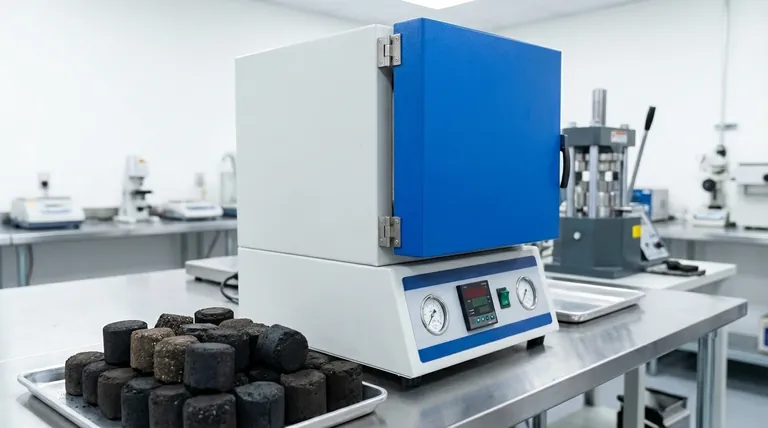
The Challenge of Solid-State Reactions
To understand the necessity of briquetting, we first need to appreciate the fundamental challenge of making two solids react with each other. Unlike liquids or gases that mix freely, solid particles only react where their surfaces touch.
Maximizing Reactant Contact
The reaction to produce magnesium is a solid-phase reaction between magnesium oxide (MgO) and carbon (C) powder. Compacting these powders into a briquette forces the individual particles into intimate, high-pressure contact.
This process vastly increases the total surface area where the two materials meet, which is an absolute prerequisite for the reaction to proceed at a viable rate. Without compaction, the contact would be minimal and random, leading to an extremely slow and inefficient process.
Ensuring Particle Proximity
At the atomic level, atoms from the magnesium oxide and carbon must be close enough to interact and form new chemical bonds. Briquetting mechanically ensures this proximity throughout the entire volume of the material, creating a consistent reaction environment.
Maintaining Stability Under Extreme Conditions
The process occurs under a high vacuum and at high temperatures, creating a harsh environment that loose powder cannot withstand. A properly compacted briquette provides the necessary mechanical stability.
Preventing Material Loss During Pumping
When a powerful vacuum is first applied to the reaction chamber, the rapid evacuation of air creates a significant gas flow. This flow would instantly sweep away fine, loose powders, carrying them into the vacuum system.
This not only results in a direct loss of valuable raw materials but can also contaminate and damage sensitive vacuum pumps, leading to costly downtime and repairs. A solid briquette holds its form, resisting this force.
Counteracting Gas Evolution
The carbothermal reduction process itself produces gases, specifically magnesium vapor (Mg) and carbon monoxide (CO). As these gases evolve and escape from the material, their flow can disturb and carry away loose powder.
A briquette with sufficient strength, often cited around 10 MPa, ensures the solid reactants remain in place. This stability guarantees that the reaction proceeds as intended and maximizes the final yield of magnesium.
Understanding the Compaction Trade-offs
While briquetting is essential, the process itself requires careful control. The goal is not simply to create the densest briquette possible.
Density vs. Porosity
A briquette must be dense enough to ensure good particle contact and mechanical strength. However, it must also retain enough porosity to allow the gaseous products—magnesium vapor and carbon monoxide—to escape.
If the briquette is too dense, these gases can become trapped, increasing internal pressure and potentially slowing or even stopping the reaction. The optimal compaction pressure finds the balance between contact efficiency and gas permeability.
Briquette Strength and Handling
The briquette must be robust enough to be handled and loaded into the furnace without crumbling. If it breaks apart before or during the process, all the benefits of compaction are lost. This is why a target mechanical strength is often specified for the process.
Making the Right Choice for Your Process
Optimizing the briquetting step is critical for a successful outcome. Your specific focus will determine your primary target for optimization.
- If your primary focus is reaction efficiency: Your goal is to maximize the intimate contact between MgO and carbon particles by optimizing the particle size distribution and compaction pressure.
- If your primary focus is process yield and stability: You must ensure the briquettes have sufficient mechanical strength to prevent any material loss during vacuum pumping and gas evolution.
- If your primary focus is maximizing reaction rate: You need to strike a precise balance between briquette density for reactant contact and sufficient porosity for product gases to escape freely.
Ultimately, briquetting is the critical preparatory step that transforms a simple mixture of powders into an engineered reactant, purpose-built for the demands of vacuum carbothermal reduction.
Summary Table:
| Key Reason | Impact on Process |
|---|---|
| Maximizes Reactant Contact | Forces MgO and C particles into intimate contact, dramatically increasing the reaction surface area for efficient reduction. |
| Prevents Material Loss | Provides mechanical strength (target ~10 MPa) to resist being swept away during high-vacuum pumping and gas evolution. |
| Ensures Process Stability | Creates a stable, engineered solid that maintains integrity under high temperature and vacuum, protecting equipment and maximizing yield. |
| Balances Density & Porosity | Optimized compaction allows gaseous products (Mg vapor, CO) to escape while maintaining sufficient contact for the reaction to proceed. |
Ready to Optimize Your High-Temperature Processes?
Briquetting is a critical step for efficient solid-state reactions like magnesium production. The right equipment is key to achieving the perfect balance of density, strength, and porosity in your materials.
KINTEK's expertise can help you succeed. Backed by expert R&D and manufacturing, we offer Muffle, Tube, Rotary, Vacuum, and CVD furnace systems, all customizable for your unique high-temperature process needs. Whether you are developing a new metallurgical process or scaling up production, our lab furnaces provide the precise control and reliability required.
Let's discuss how our solutions can enhance your yield and process stability.
Contact our experts today to find the perfect furnace system for your application!
Visual Guide

Related Products
- Vacuum Hot Press Furnace Machine for Lamination and Heating
- Vacuum Hot Press Furnace Machine Heated Vacuum Press
- Vacuum Hot Press Furnace Machine Heated Vacuum Press Tube Furnace
- 600T Vacuum Induction Hot Press Vacuum Heat Treat and Sintering Furnace
- Dental Porcelain Zirconia Sintering Ceramic Vacuum Press Furnace
People Also Ask
- What are the primary components of a vacuum hot press furnace? Master the Core Systems for Precise Material Processing
- What safety features are incorporated in vacuum hot press furnaces? Ensure Operator and Equipment Protection
- What are the benefits of the vacuum environment system in a vacuum hot press furnace? Unlock High-Density Sintering
- What industries benefit from the use of vacuum hot press furnaces? Unlock High-Performance Materials for Your Industry
- Why is a high vacuum environment crucial when preparing copper-carbon nanotube composites in a vacuum hot press furnace? Achieve Superior Composite Integrity




